111Obmen is a small instant-exchange brand aimed at users who want to swap crypto or electronic payment balances without opening an account on a major trading platform. It occupies the same crowded territory as BestChange-listed exchangers and no-KYC swap sites, where convenience matters more than sophisticated trading tools. That can be useful, but it also means a buyer has to do more homework than they would with Kraken, Coinbase, or a long-established regional exchange.
The service appears designed around a straightforward order form rather than an order book. You choose what you send, choose what you receive, provide the destination details, and wait for the operator or automated system to complete the exchange. For someone moving a modest amount from one asset to another, that is simpler than placing market orders and arranging a withdrawal separately.
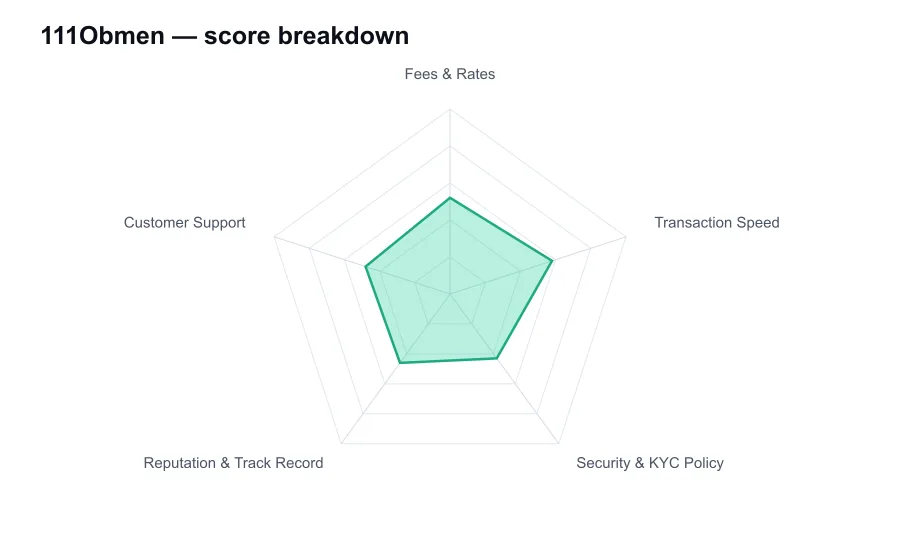
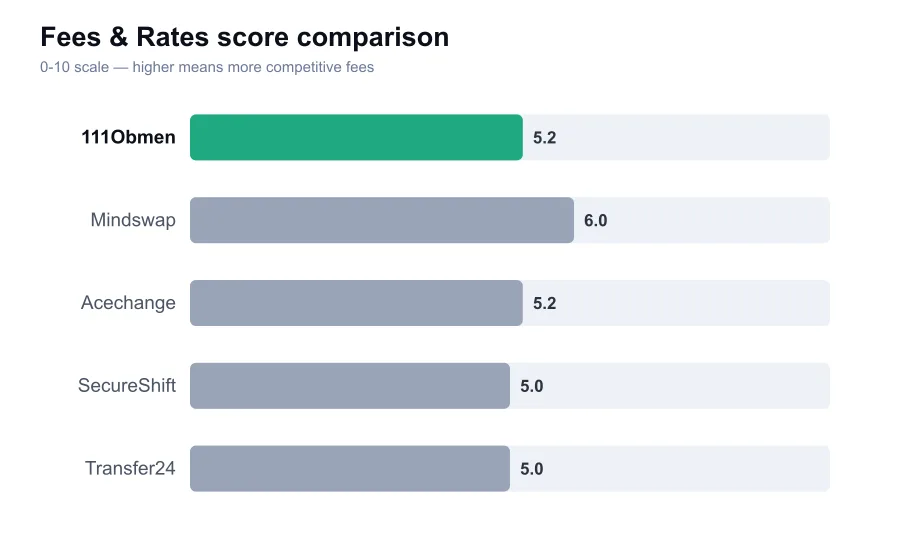
The problem is that simplicity can disguise the actual cost. Small exchangers rarely present fees in the clean maker and taker format used by large exchanges. The charge is generally embedded in the quoted conversion rate. That is normal for this segment, but it makes comparison harder because a seemingly fee-free swap may carry a substantial spread against the market rate.
My view is that 111Obmen should be treated as a quote-shopping service, not a default venue. Check its displayed payout against at least two alternatives, then include network fees and any payment-system charges. If the difference is only a few dollars, the more established provider is usually the safer choice. If 111Obmen's quote is clearly better, start with a small test transaction rather than trusting a large first order.
Speed depends heavily on the payment rail and the reserve on hand. A crypto-to-crypto order can be relatively quick once the incoming transaction has enough confirmations. Bitcoin, bank transfers, cash-like electronic currencies, and transactions that need manual review are another matter. The advertised instant-exchange model should never be read as a guarantee that funds arrive in minutes.
The most frustrating failures in this category are not always technical. An order can sit waiting because the incoming amount differs by a few decimals, a memo is missing, a wallet has not been credited, or a reserve needs replenishing. That is why users should save the order page, transaction ID, sending address, and screenshots of the quoted rate. Those details are what support will need if something goes wrong.
111Obmen does not have the broad public footprint, institutional disclosure, or independently audited infrastructure that would justify blind trust. A smaller exchanger can operate honestly for years, but a thin public record leaves fewer external signals for judging how it handles disputes, liquidity stress, or operational mistakes. That uncertainty deserves a meaningful discount in any safety assessment.
The KYC picture also needs a realistic reading. Services marketed as no-registration or low-friction exchanges may still request identification when a transaction triggers anti-fraud or anti-money-laundering checks. That is common across the sector. Anyone who absolutely cannot tolerate a delayed exchange or an identity request should not send funds first and hope the policy will bend later.
There is no good reason to keep money sitting with an exchange operator after an order is complete. Use a self-custody wallet you control, verify the receiving address carefully, and avoid routing a large payment through an unfamiliar service. Those rules apply to every exchanger, but they matter more where public corporate information and mature security reporting are limited.
Reputation is where 111Obmen has the steepest hill to climb. It may have user feedback on monitoring sites and forums, but those listings are not equivalent to a regulated exchange's transparent operating history. Reviews can be helpful for spotting recurring delays or payout complaints, yet they are not a substitute for audited reserves, named leadership, or a long record of handling major market volatility.
I would pay close attention to patterns rather than isolated praise. A handful of complaints about delayed AML checks is not automatically damning. Repeated reports of changed rates, unresponsive communication, unexplained extra payments, or requests to send funds to a new address are serious warning signs. Do not continue an order if a representative asks for an additional transfer to unlock a previous one.
Support appears to be a practical necessity rather than a premium feature here. Smaller exchangers often rely on chat, ticket forms, or messaging channels, and the quality of response can vary with operating hours and order volume. Before placing a meaningful exchange, test the published contact channel with a simple question. A provider that cannot answer a basic pre-sale query clearly is not where I would risk a four-figure transfer.
The best use case for 111Obmen is a small, price-sensitive conversion where you have independently checked the rate, understand the settlement route, and are comfortable with the counterparty risk. It is not a sensible place for recurring business treasury flows, large Bitcoin sales, or first-time crypto users who need dependable human help. The service may be functional, but the evidence available to a cautious reviewer does not support a stronger endorsement.
There are better-known choices for people who value a documented security program, predictable compliance handling, and clear costs. A centralized exchange such as Kraken is more cumbersome but materially easier to assess. For onchain users, a reputable decentralized aggregator can reduce custody risk, though it introduces smart-contract and gas-cost considerations of its own.
My final take is restrained. 111Obmen may suit a careful user making a modest one-off swap, especially if its live quote beats competitors after all costs. The lack of a strong public track record and transparent fee structure means it should remain a secondary option. Keep the amount low, document every step, and move the received assets immediately into your own wallet.