Spark is a difficult provider to assess because the name has been used by more than one crypto product, and that ambiguity is part of the problem. The exchange service most users mean by Spark is a small, swap-focused platform rather than a full trading venue with an order book, regulated fiat rails, or a long public operating history. It aims at the simple end of the market: choose two assets, supply a destination wallet, and receive the converted coins. That can be appealing, but it puts Spark in a very different class from Coinbase, Kraken, or even established instant-swap names such as ChangeNOW and StealthEX.
The first thing I would ask before sending anything is whether the exact Spark site you are using is active, legitimate, and independently verifiable. The brand's weak discoverability creates a phishing risk that better-known providers simply do not have to the same degree. A search for Spark produces results for Lightning products, NFT projects, wallet features, and unrelated companies. A service handling irreversible crypto transfers needs a clearer public identity than that. Confusion is not a minor branding issue here, it is a practical safety problem.
Spark's advertised experience is usually built around non-custodial swapping. In theory, that means it should not hold an account balance for users or require deposits into a traditional exchange wallet. You send the source asset to a quoted address, a liquidity partner executes the conversion, and the output is delivered to the wallet address you supplied. That arrangement reduces the damage from an exchange-account breach, but it does not make the service trustless. Users still depend on Spark, its quote engine, and its liquidity counterparties to route the funds correctly.
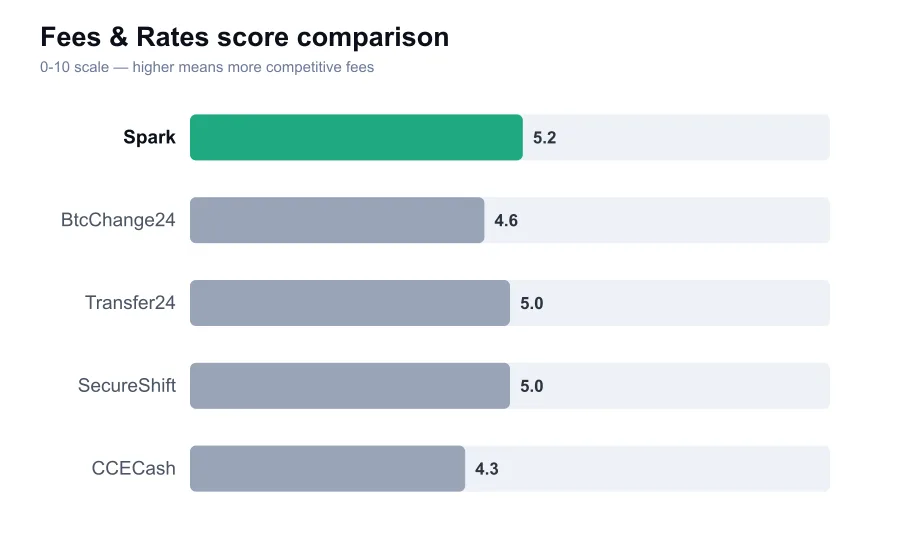
Fees are also harder to judge than they should be. Spark-style instant exchanges often promote a zero-fee or low-fee message, while making their margin through the exchange rate. There is nothing inherently improper about a spread, but a clean quote must show the expected output, the network fee, and whether the rate can move before settlement. If a platform cannot explain those pieces in plain language, the user has no sensible way to compare it with a competitor. A supposedly free swap that returns materially less USDT, BTC, or ETH is not cheap.
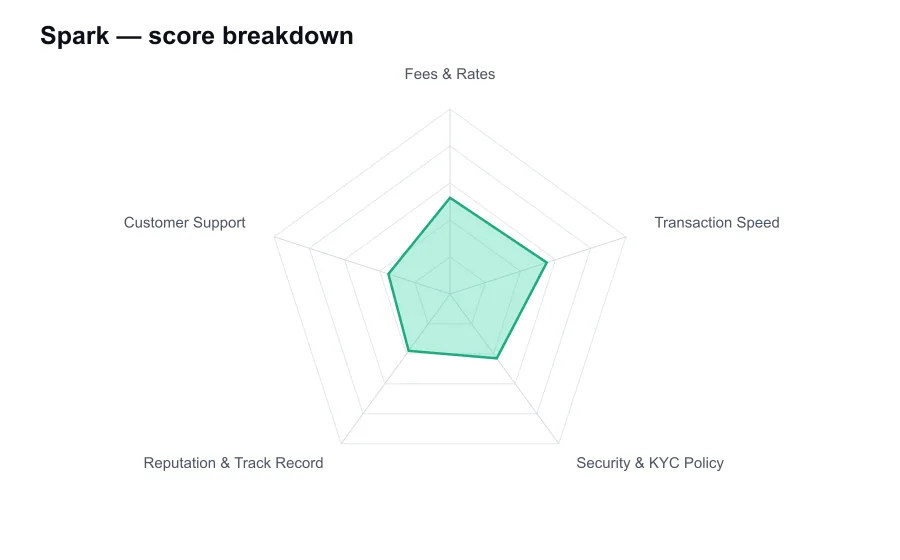
For small conversions, the difference between a stated service fee and the final received amount matters more than marketing language. I would quote the same trade on Spark, StealthEX, ChangeNOW, and an exchange with a transparent spot market before proceeding. On liquid pairs, a competitive instant-swap service should not be far outside the cost of a visible trading fee plus a withdrawal charge. Spark has not earned enough public scrutiny to let its pricing be taken on faith. That places its fee value below services that publish more explicit rate mechanics and have years of users comparing results.
Speed depends mostly on block confirmations and the provider's routing partner. A straightforward swap on a fast chain can complete in several minutes, while Bitcoin input transactions commonly take much longer because confirmation requirements and network congestion cannot be wished away. The worrying cases are not normal blockchain delays. They are swaps marked pending for hours with no detailed transaction explanation, a changed quote after funds arrive, or a manual review with no firm timeline. Smaller operators need exceptionally good status information to offset that concern, and Spark has not built a widely trusted reputation for it.
The lack of a conventional account can be good for privacy. A user generally should not have to submit a passport for a routine wallet-to-wallet conversion, and that is one reason people seek out this category. Still, no-KYC should never be read as no-compliance. Crypto services can flag transactions for sanctions exposure, fraud indicators, source-of-funds checks, or unusual patterns. Spark's public policy material and escalation process are not as easy to evaluate as those of mature competitors, so a user cannot confidently predict what happens if a transfer is paused.
That gap affects security more than the absence of a login page does. A reputable swap provider explains its minimum and maximum limits, blocked jurisdictions, refund route, address requirements, and the conditions that can trigger a review. It should also publish a real legal entity, support contacts, and enough documentation to tell customers who is responsible when something breaks. With Spark, the available public footprint has been too thin and too inconsistent to inspire that level of confidence. I would not use it for a first large conversion or for money needed on a deadline.
There is also little evidence of the kind of long, independently documented track record that separates a durable exchange service from a polished frontend. A few positive mentions, affiliate pages, or anonymous review snippets do not prove much. The useful signals are sustained user discussion, a recognisable company presence, transparent incident handling, and support cases that can be checked over time. Spark does not compare well against established brands on those measures. That does not prove bad intent, but it does mean the burden of caution stays with the customer.
Customer support is where this sort of service is most likely to disappoint. A simple swap needs almost no assistance until it goes wrong, then the customer needs a human who can locate a transaction by hash, explain the delay, and authorise a refund if execution fails. A generic contact form or chat widget is not enough if there is no visible service standard, ticket record, or escalation channel. Spark's support presence is not sufficiently documented for me to treat it as dependable during a difficult case.
A careful user can reduce some of that risk. Start with a small amount, save the quote and every transaction hash, double-check the destination chain, and do not send funds from an exchange account that might reject an unusual return transaction. Never use a new swap provider to move an entire wallet. It is also wise to avoid cross-chain transactions when the destination address format or token contract has not been independently checked. A wrong-chain transfer is not a customer-service test anyone wants to run.
Spark may suit an experienced user who has independently verified the exact site, needs a small one-off swap, and understands that convenience does not equal institutional reliability. Even then, I would use it only after comparing the final output against known alternatives. The service has none of the public depth needed to justify paying a premium spread simply for its name. If the quote is not clearly better, there is little reason to choose the less proven route.
For larger amounts, recurring conversions, fiat purchases, or any transfer tied to a time-sensitive payment, Spark is the wrong level of risk. Kraken and Coinbase are better for transparent market execution and accountability, while a better-established instant exchanger is more sensible for a wallet-to-wallet conversion. Users who value privacy can still find providers that disclose their process more clearly. Privacy and opacity are not the same thing.
My view is blunt: Spark has to earn trust before it deserves meaningful volume. The basic non-custodial swap model is familiar and can work perfectly well, but the brand ambiguity, shallow track record, and limited support visibility are serious weaknesses. A low advertised fee cannot compensate for uncertainty about who is operating the service and how a dispute is handled. Treat it as an experimental option for a test transaction, not a dependable exchange relationship.