CCECash operates in the instant exchange category, offering crypto conversions through a simple order form rather than a full service exchange account. It is aimed at users who want to exchange assets directly from one wallet to another. That is a reasonable product niche, but CCECash is a comparatively obscure name in a market where obscurity should never be treated as a neutral fact.
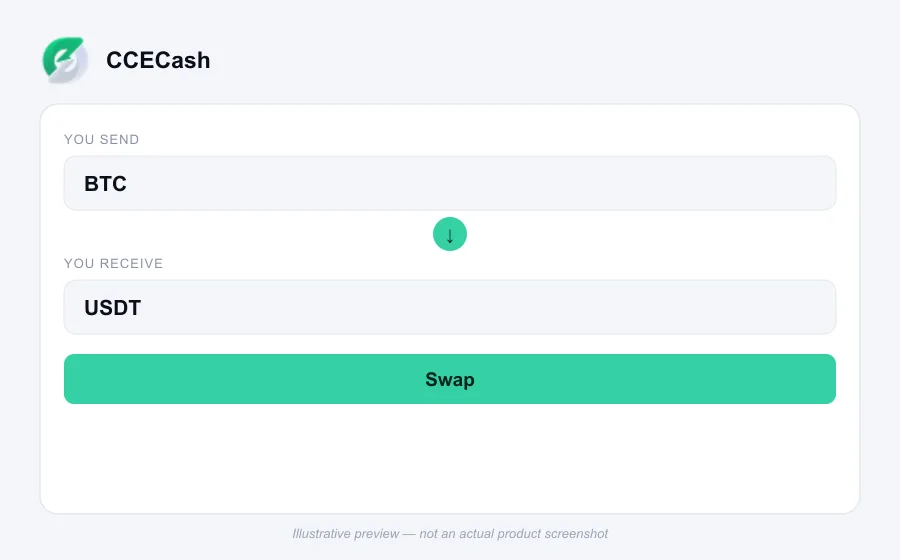
The first impression is familiar to anyone who has used an instant swap service. Pick a send coin, choose a receive coin, enter the destination address, and fund the order. This keeps the workflow short, especially for users who do not want another custodial account. It also means the customer has to make several irreversible decisions correctly. There is no bank style chargeback if the wrong network or destination is used.
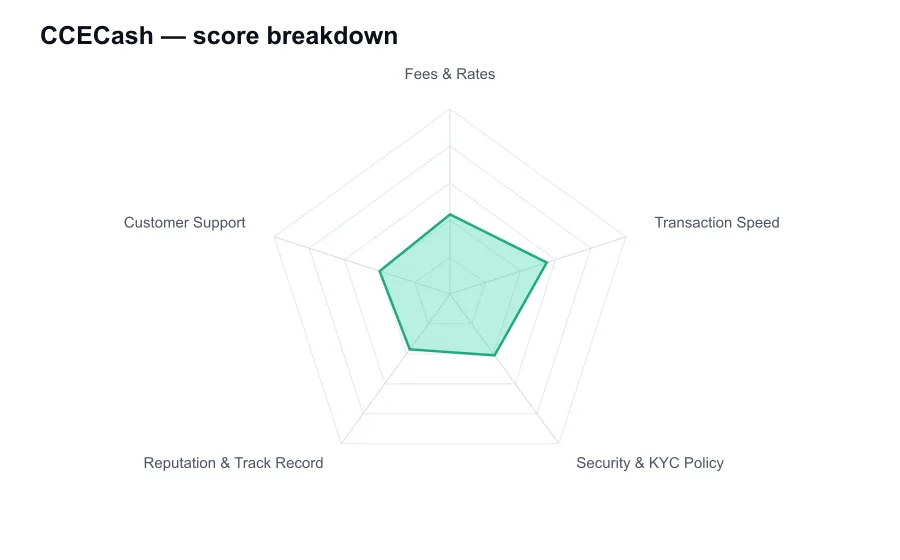
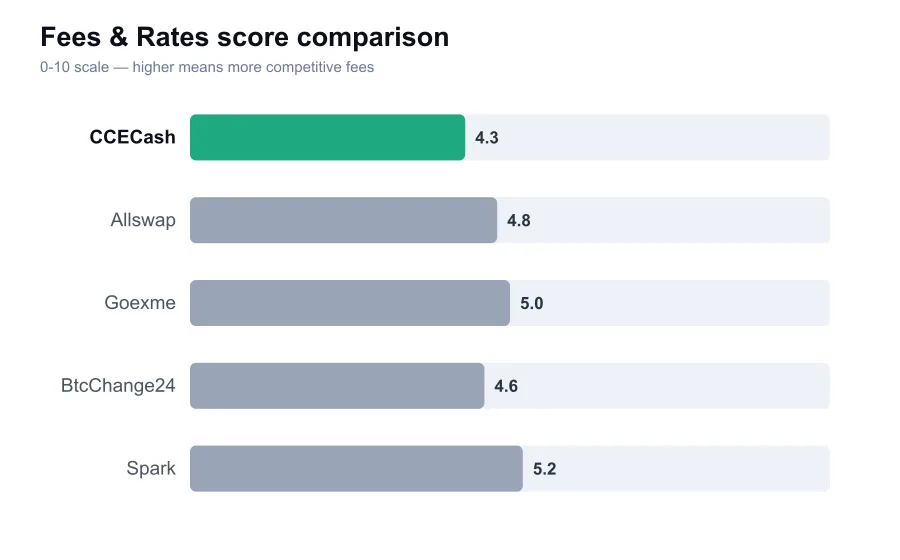
CCECash does not stand out as a fee leader because it does not offer the kind of public, standardised pricing disclosure that serious comparison shoppers expect. The service can show a quote, but a quote is not a complete explanation of pricing. The customer needs to account for exchange spread, miner fees, and whether the rate is floating or fixed. Without that context, it is difficult to know how much of the conversion value the provider retains.
That does not mean every CCECash quote is poor. It means users must do the work. Open a comparison tab and check the final payout at two or three alternatives, including ChangeNOW, SimpleSwap, and a major exchange's spot price after withdrawal fees. A small difference on a modest swap may be acceptable for convenience. A large gap is a clear reason to walk away, especially since a lesser known intermediary offers fewer assurances if something goes wrong.
Speed is similarly dependent on conditions outside CCECash's own interface. Blockchain confirmations are the first gate, and outbound processing is the second. Faster chains and liquid assets generally make for a smoother experience. Bitcoin deposits can take longer, Ethereum fees can make small transfers uneconomic, and niche token routes may require more complicated liquidity handling. A user who needs an exact arrival time should not rely on any instant exchange.
The service is more suitable for a clean wallet to wallet transaction than for a chain of trades. Every extra conversion creates another spread, another confirmation period, and another point at which an order can be delayed. If you are rebalancing a portfolio regularly, a transparent exchange account is almost certainly cheaper. CCECash is at its most defensible when it solves one specific conversion without asking the user to park funds on a platform.
The low account friction is attractive, but the KYC issue needs plain language. A no registration style flow does not mean all transactions are permanently anonymous or immune from review. Providers in this category may use third party liquidity and transaction screening. If a deposit is flagged, a request for identity or source of funds information can happen after the money has already been sent. That operational reality is a major drawback for users who require certainty.
CCECash does not provide the level of public security reporting that would justify a high score. I did not see the sort of detailed custody architecture, external audit history, insurance explanation, or incident disclosure expected from a major custodial exchange. For an instant service, the narrowest possible exposure is the best defence. Send only what is needed for the order, receive to a wallet you control, and do not leave coins sitting with the provider.
The reputation question is more serious than the interface question. A smaller exchange can operate correctly for thousands of routine transactions while still being difficult to evaluate in a rare dispute. Public reviews can be useful as leads, but they are not conclusive evidence because crypto review ecosystems are easily manipulated and unhappy customers often post without full context. What matters is whether an operator has a long, verifiable history of transparent handling under pressure. CCECash has limited visible proof on that front.
Support looks like a practical, online only operation rather than a high touch service. That may be enough if an order completes normally. It is much less comforting if the user sends to a wrong chain, forgets a memo, or faces a compliance request. Before using CCECash, check how to contact support and save the order number immediately. Do not wait until a problem appears, because recovery requests often need precise transaction data.
There is a particular risk with assets carrying tags and memos, including some XRP, XLM, and exchange deposit routes. Users often assume an instant exchange can manually fix anything. Sometimes it can, sometimes it cannot, and manual recovery may take time or involve extra network costs. CCECash should not be used by someone who is unsure what a memo is or why token networks are not interchangeable. The apparent simplicity hides technical consequences.
For experienced users, CCECash can still be useful as a rate source. Check its quote, inspect the expected payout, and use it only if the numbers are genuinely favourable. That is a much more rational approach than choosing it because it appears at the top of a search result. Search visibility is marketing, not a security credential. In crypto, the boring providers with extensive documentation often deserve more trust.
I would also avoid using CCECash for any payment where the recipient is waiting on the other end. The sender has too little control over confirmation time, exchange processing, and support escalation. Send the destination coin from a liquid exchange or from an asset you already hold if timing really matters. CCECash may work quickly, but dependable timing is not its strongest selling point.
CCECash is not necessarily a service to avoid outright. It is a service to use with a narrow mandate and sensible limits. It can handle a small conversion for an experienced user who checks rates and understands self custody. It does not offer enough pricing transparency or reputation depth to deserve blind trust. The sensible customer is cautious before sending, not angry afterward.