Goexme presents itself as a lightweight crypto exchange service aimed at users who want to swap assets without opening an account on a large centralised venue. That places it in a crowded and difficult corner of the market. The appeal is obvious: select a pair, send coins, receive the output asset. The problem is that convenience alone is not a substitute for a visible operating history, transparent ownership, or independently verifiable liquidity.
The site experience is geared toward a simple conversion flow rather than active trading. There is no obvious order-book environment, advanced charting suite, derivatives market, or locally regulated fiat brokerage layer comparable with Kraken, Coinbase, or Independent Reserve. For someone holding crypto already and looking for a one-off conversion, that can feel refreshingly direct. For anyone planning to trade regularly, it is a very limited proposition.
My central concern with Goexme is not that a small exchange is automatically unsafe. Plenty of specialist services start small. It is that the public information available around the business is thin relative to the level of trust users are asked to place in it. Crypto users send funds first in these flows. Once a deposit has been broadcast, the practical question is not how clean the widget looked, but who is accountable if the trade stalls.
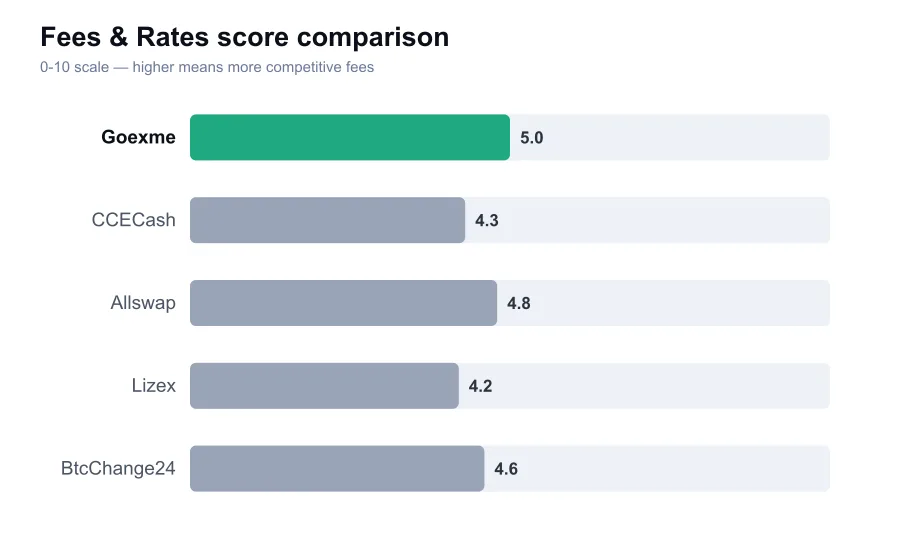
Pricing needs particular caution. Services in this category frequently promote a floating exchange rate or a fixed-rate option, but the effective cost is rarely just a neat headline percentage. The quote can include a spread between the underlying market price and the price shown to the customer, plus network fees and any change in rate while a transaction is waiting for confirmations. If Goexme gives a quote, users should compare it against at least two alternatives at the same moment, such as ChangeNOW, FixedFloat where available, or a liquid spot exchange.
That comparison matters more than people think. A service can say it charges no fee and still earn a meaningful margin through the rate. That does not make the model dishonest, but it does mean the customer needs to judge the final amount received, not a marketing claim. Small swaps may have an acceptable premium for speed and simplicity. On a larger conversion, even a modest spread can cost more than the network fee several times over.
The best way to use a service like Goexme, if using it at all, is to start with a small transaction and record the quoted output before sending funds. Check whether the quote is fixed or floating, how long it is held, and whether a minimum or maximum amount applies. Do not send an unusually large amount because a rate happens to look attractive. There is no deep public record here that justifies treating it like an established custodian.
Transaction speed is also conditional rather than guaranteed. A swap can be completed quickly if the deposit network is uncongested, the receiving asset is liquid, and the exchange's liquidity provider is functioning normally. Bitcoin deposits need confirmations, Ethereum transactions depend on gas conditions, and token swaps can be delayed by wallet maintenance or compliance checks. A claimed average processing time is not the same thing as a service-level commitment.
For mainstream assets, a completed conversion may reasonably take minutes to an hour after the incoming transaction is confirmed. Anything beyond that should prompt a careful look at the transaction ID, the status page, and support correspondence. The real risk is the edge case: a rate change, an address issue, a large transfer, or an automated risk flag. Those are precisely the moments where small, lightly documented services can become frustrating.
Goexme's apparent no-account approach may appeal to privacy-minded users, but no-account does not necessarily mean no compliance review. Many instant exchange providers reserve the right to request identification or source-of-funds information after receiving a transaction. That can leave funds in limbo if a user expected an entirely permissionless experience. Anyone unwilling or unable to complete a potential verification request should not use a custodial conversion intermediary at all.
Security transparency is another weak point. I would want to see clear company information, a meaningful explanation of how customer funds are handled, explicit security controls, incident disclosures, and published support escalation channels. I have not seen enough public material to put Goexme in the same confidence bracket as regulated exchanges or prominent noncustodial protocols. A polished interface and HTTPS connection are basic requirements, not proof of operational maturity.
The distinction between custody and counterparty risk is important here. Goexme may not hold a long-term user balance in the way a conventional exchange does, which reduces one kind of exposure. But it still becomes the counterparty after you send coins into its process. The user has to trust that the route, price calculation, wallet operations, and payout system work as represented. That is a short-duration risk, but it is real.
Reputation is where the service struggles most. A platform does not need to be famous to be legitimate, yet long-standing reviews, accountable leadership, clear jurisdiction, technical documentation, and a history of resolving public complaints all matter. Goexme does not have the visible institutional track record of Bitstamp, Kraken, or Independent Reserve. It should therefore be treated as an experimental convenience tool, not a primary venue.
Support can make or break an instant swap. A responsive chat or ticket channel is useful, but users should test how clearly the service explains delays, transaction hashes, failed payouts, and refund procedures. Vague replies such as "processing" are not enough when a transfer has been pending for hours. Before funding a larger swap, check that there is a documented contact route and retain screenshots of the quote, address, and transaction status.
I would not describe Goexme as a provider for newcomers depositing their savings, traders moving meaningful size, or anyone who needs regulated consumer protections. Its possible use case is narrow: an experienced crypto holder making a small, low-stakes conversion and willing to accept the trade-off between account-free simplicity and limited transparency. That is not an endorsement to trust blindly. It is a reason to keep the amount small.
There are better choices for different priorities. A regulated local exchange is better for bank transfers and repeat trading. A large global venue is better for depth and price discovery. A self-custodial decentralised exchange is often better for users who understand wallet security and want to avoid handing assets to an intermediary. Goexme only makes sense if its live quote beats those alternatives enough to compensate for the weaker public record.
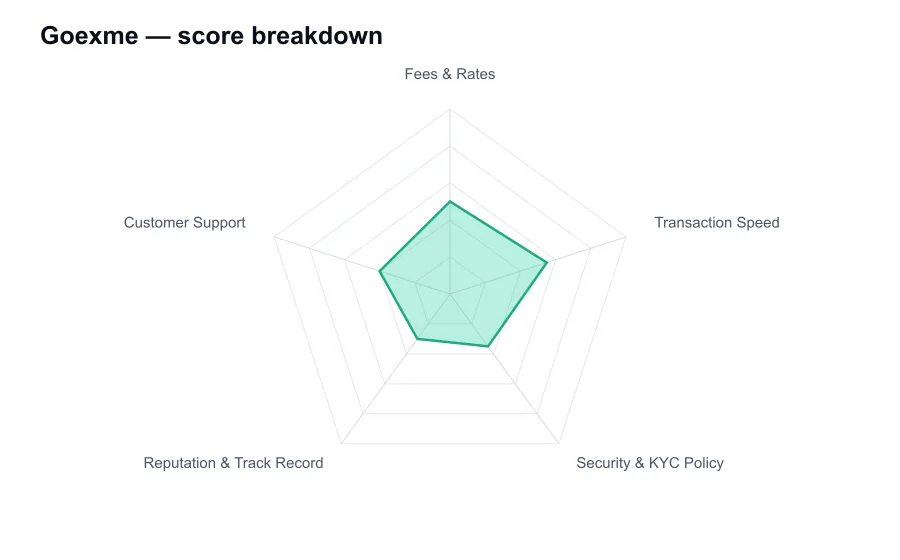
My take is blunt. Goexme may complete ordinary swaps without incident, but the available public footprint does not earn a high confidence score. Fees are hard to assess until the final quote is compared, speed is dependent on external networks, and the security picture is too opaque for sizeable funds. Treat it as a small-transaction tool, document every step, and do not confuse a streamlined conversion page with the safeguards of an established exchange.