Allswap is a comparatively obscure crypto swap provider, and that fact shapes the review more than any attractive quote widget can. The service appears to target the familiar instant-exchange customer, someone who wants to send one cryptocurrency and receive another without managing a custodial exchange account. That is a legitimate need. The problem is that Allswap does not carry the public recognition or independently documented operating history that helps a customer judge whether the convenience is worth the counterparty risk.
A swap service lives or dies on a simple promise: deposit one asset, receive another asset at a quoted rate, and get help if something goes wrong. The happy path is easy. A website can make the process look effortless with a few dropdown menus and a generated deposit address. The difficult path is more revealing, involving delayed deposits, liquidity shortfalls, wrong-network transfers, sanctions screening, or a disputed rate. That is where an unknown provider has the most to prove.
Allswap's apparent model is closer to an exchange aggregator or instant broker than a conventional trading venue. Customers do not bring their own order to a public order book. They accept a quoted conversion and trust the service and its partners to source the outgoing asset. This can be convenient, especially for altcoin pairs unavailable at a user's usual exchange, but it introduces spread and execution risks that are not always visible before the deposit is made.
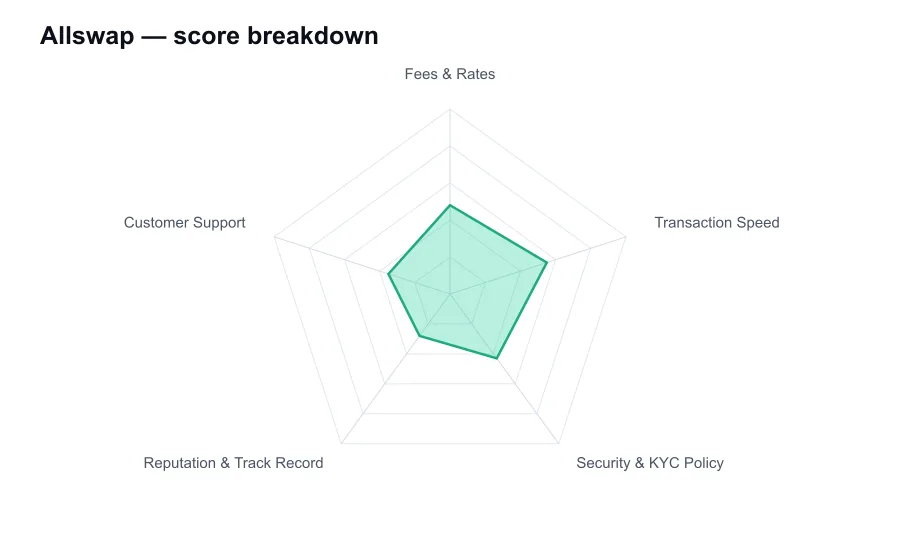
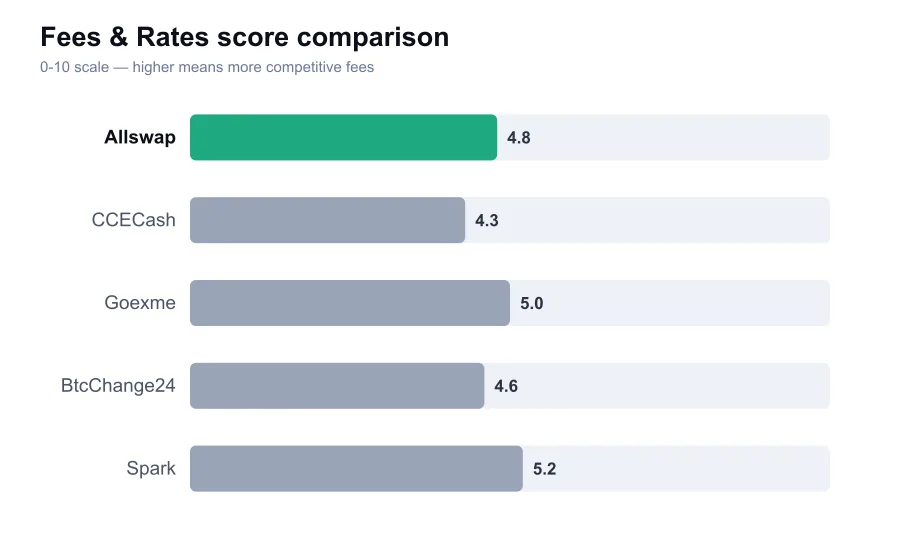
Fees deserve skepticism rather than guesswork. If Allswap does not show a clear fixed percentage plus an itemised network fee, the customer should assume that some of the cost is embedded in the offered rate. That is standard industry practice, but standard does not mean customer-friendly. A quote can look reasonable until compared with three alternatives at the same time. The final receive amount is the number that matters.
For a small conversion, the cost difference may not justify opening another account elsewhere. For any significant amount, it absolutely does. Check the quote against ChangeNOW, SimpleSwap, StealthEX, and a liquid spot market if you already have access to one. Include withdrawal fees and the time needed to move funds. If Allswap cannot match the better known services closely, there is little reason to take additional reputational risk for the privilege of using it.
Transaction speed is similarly conditional. The platform may create an order instantly, but no swap is faster than the incoming network confirmation and the outgoing chain. Bitcoin can wait through multiple confirmations. Ethereum and stablecoin networks can become congested or costly. A token swap with a thin liquidity route may need longer than an advertised average. Customers should view estimated times as ordinary-case guidance, not a contractual settlement guarantee.
I am especially wary of generic claims such as instant, best rate, or no registration when they are not supported by detailed public operating information. Instant can mean the order is accepted instantly. Best rate can mean the best route available to that provider rather than the market's best executable price. No registration can mean no account at the start, while a compliance team retains the right to request documents later. The language has to be read precisely.
KYC and AML risk is not optional simply because a service presents itself as a lightweight swap tool. Blockchain analytics, payment partners, and liquidity providers can all cause an order to be flagged. In a legitimate compliance event, funds may be held while the customer is asked to provide ID or source-of-funds evidence. That creates a serious practical concern at a low-profile operator, because a user has less public evidence about turnaround times, escalation standards, or dispute practices.
The safest way to use a service like Allswap is to avoid treating it as storage. Send only the exact source amount for a single conversion, and move the received coins to a wallet you control. Do not leave balances sitting anywhere. Confirm the chain on both sides, especially for USDT and USDC, where similarly named assets exist on several networks. A correct address on the wrong network can be as destructive as a typo.
Reputation is Allswap's weakest category because there is not enough broad, durable, independent material to award confidence. A handful of positive comments or an active social account would not change that. A strong reputation is built over time through identifiable operators, consistent service, transparent policies, and a visible record of resolving difficult orders. Allswap has not established that kind of public assurance in the way leading exchanges have.
That does not automatically make it fraudulent. It does mean a rational customer should price uncertainty into the decision. The responsible approach is a small test order, not a large first transaction prompted by a rate that is a fraction better than competitors. Keep screenshots of the quote and order page. Record the deposit transaction hash. If the order is delayed, those details are essential to any support request or later complaint.
Customer support is hard to score generously without a deep, independently visible service record. A contact form or chat icon is not the same as demonstrated resolution quality. Customers need timely, specific answers when money is already in transit. Until a provider has shown that it can handle edge cases consistently, I would assume support is a risk factor, not a reason to choose the service.
Allswap could be useful for a technically capable user seeking a niche pair and willing to test the route with an amount they can tolerate having delayed. That is a narrow recommendation. It is not the platform I would give to a newcomer who needs instructions, a buyer using fiat, or someone swapping a meaningful share of their portfolio. Established alternatives offer a much clearer baseline of accountability.
My final take is blunt: Allswap may offer a functioning swap mechanism, but the public trust case is underdeveloped. The potential upside is convenience, perhaps an available pair or acceptable quote. The downside is that a problem order leaves the customer depending on an operator with limited proven reputation. Use it only after comparing rates and only with conservative transaction sizing.