BtcChange24 is the sort of small instant exchange that attracts users with a direct promise: convert crypto without the overhead of a conventional account. It occupies a less visible part of the market than the household names, and that matters. A clean landing page and a large token list are easy to build. Trust, responsive operations, and a documented history of resolving difficult cases take years to build.
The service is best understood as a swap intermediary. You select the asset being sent, select the asset being received, accept the quoted amount, then deposit to the address supplied for that order. There is no evidence that it should be treated like a deep liquidity venue or a trading platform. Customers looking for limit orders, transparent books, margin, recurring purchases, or audited reserve reporting are simply shopping in the wrong category.
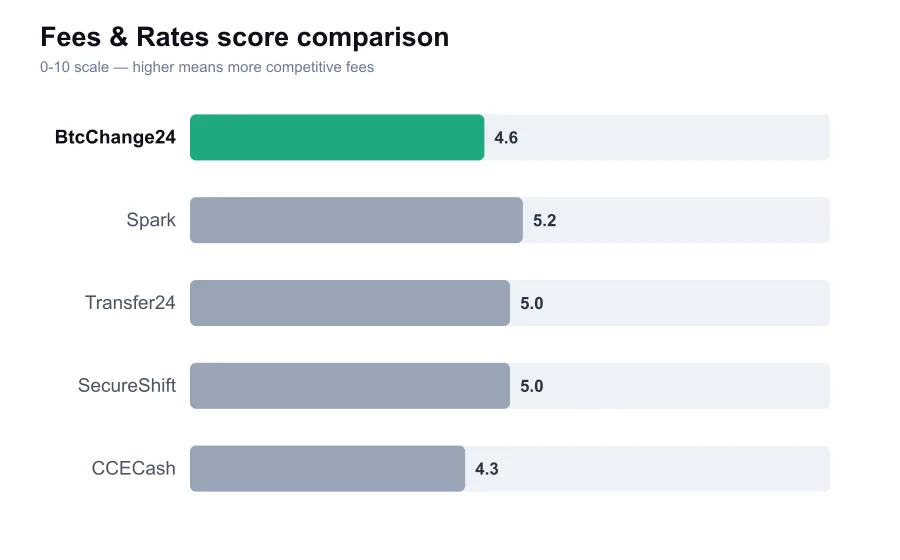
Price is BtcChange24's biggest question mark. The site experience may present an attractive conversion estimate, but the meaningful figure is always the amount actually received after the service's exchange margin and blockchain costs. Small providers rarely have the purchasing power or direct liquidity relationships of the largest brokers. That can show up as a weaker rate, particularly on obscure assets, cross chain routes, or pairs with low trading volume.
I would not call a quoted rate competitive merely because the site does not separately display a commission line. A spread is still a cost. Compare the exact payout with ChangeNOW, SimpleSwap, StealthEX, and a liquid spot market before committing. If BtcChange24 wins on the final number, convenience becomes a genuine advantage. If it loses by a meaningful amount, there is little reason to accept additional counterparty risk for the same basic service.
The practical speed of a BtcChange24 transaction is variable. Incoming deposits must receive the required blockchain confirmations, the provider needs to source or route the destination asset, and the outbound transfer then needs to propagate. For common assets on efficient networks, this can feel almost immediate after confirmation. For Bitcoin, Ethereum at busy times, or unusual tokens, patience is required. Any claim that every swap is instant should be read as marketing shorthand.
The interface is appropriate for users who already understand addresses and network selection. It does not protect a sender from choosing the wrong chain, missing a destination tag, or sending less than a network's practical minimum. Those errors are not always recoverable, and recovery can require manual work. Before pressing send, check the network label character by character. This is especially important for USDT, which exists across several incompatible networks.
BtcChange24's low barrier to entry may be attractive to people who dislike handing over identity documents for ordinary crypto swaps. That convenience has limits. Compliance checks can still occur if the transaction is connected to a flagged address, unusual value, sanctioned jurisdiction, or third party screening alert. The absence of an account creation wall is not the same as a contractual guarantee of no KYC under every circumstance.
Security information is not as deep or independently verifiable as it is at a large regulated exchange. That is not unusual in this segment, but it should influence behaviour. Do not use BtcChange24 as a wallet. Do not send assets you cannot afford to have delayed. Keep your own transaction record and make sure the receiving wallet is controlled by you. A one time swap has limited custody exposure, which is the sensible way to use a service like this.
The company has a comparatively thin public reputation record. It lacks the years of broad user discussion, regulatory filings, product documentation, and public incident analysis available for mature exchanges. Smaller operators can perform well, and some do. But reputation is a risk control in crypto, not a popularity contest. If a payment is held or routed incorrectly, a provider with a small support operation and limited public accountability gives customers fewer levers.
Customer support is likely to be most effective on normal cases, such as a pending deposit confirmation or a question about a quote. It is less clear how well the business handles difficult recovery cases. The quality of support only becomes visible after a mistake, a compliance hold, or an external wallet problem. That uncertainty is why I would avoid BtcChange24 for transactions involving a deadline, a business payment, or a large percentage of anyone's crypto holdings.
There is also little reason to confuse availability with reliability. A service can operate every day and still struggle during volatile periods, when liquidity spreads widen and support queues increase. BtcChange24 may be perfectly usable during quiet market conditions, but that is not the same standard as proving resilience through major market stress. Experienced crypto users know that a smooth small swap tells you little about the worst day.
One advantage of this kind of service is that it can be less cumbersome than registering with a centralised exchange for a single conversion. That benefit is real for a user moving from one self custody asset to another. It disappears if you make repeated swaps, pay a poor embedded rate, or later need a detailed account history for tax reporting. For regular activity, transparent exchange fills and downloadable records are more practical.
BtcChange24 therefore makes sense only under narrow conditions: a small amount, a mainstream pair, a verified receiving address, and a rate that beats alternatives at that moment. It is a tool for someone who knows exactly what they are doing, not a confidence building starting point for a newcomer. New users are better served by a more established provider with comprehensive help material and stronger public accountability.
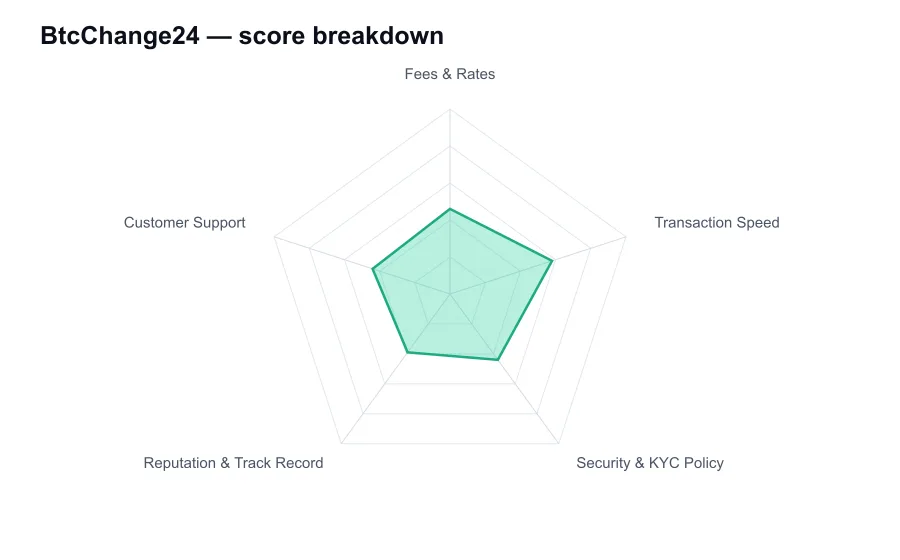
My assessment is restrained. BtcChange24 may complete a simple swap without fuss, but it offers too little independently visible depth to justify a high trust score. Its main value is friction reduction, not superior pricing, security disclosure, or support infrastructure. Keep transactions small, compare the payout closely, and retain custody before and after the exchange. That is the right relationship to have with it.