SecureShift presents itself as an instant crypto exchange service, part of the crowded market of platforms that let users swap one digital asset for another without opening a full trading account. That category can be useful. It removes order books, account dashboards, and sometimes identity checks from a simple conversion. It is also a category where marketing claims are easy to make and independent evidence is often thin. SecureShift needs to be assessed with more caution than an established household-name exchange.
The basic workflow is familiar. A user selects the asset being sent, chooses the asset to receive, enters a destination wallet address, and transfers funds to an address generated for the exchange. The provider then sources liquidity, processes the swap, and sends the output to the user's wallet. This is convenient for a one-off exchange, but it is not the same as a non-custodial atomic swap. For a period of time, the provider controls the transaction flow and the user's funds are exposed to execution and counterparty risk.
SecureShift's strongest apparent attraction is simplicity. A person who already has crypto in a wallet may be able to exchange it without depositing into a conventional centralized exchange, placing a market order, and later withdrawing. That can save time and reduce the number of accounts involved. It does not remove the need for care. Users must select the correct network, confirm the destination address, and understand whether they are receiving a fixed or floating rate.
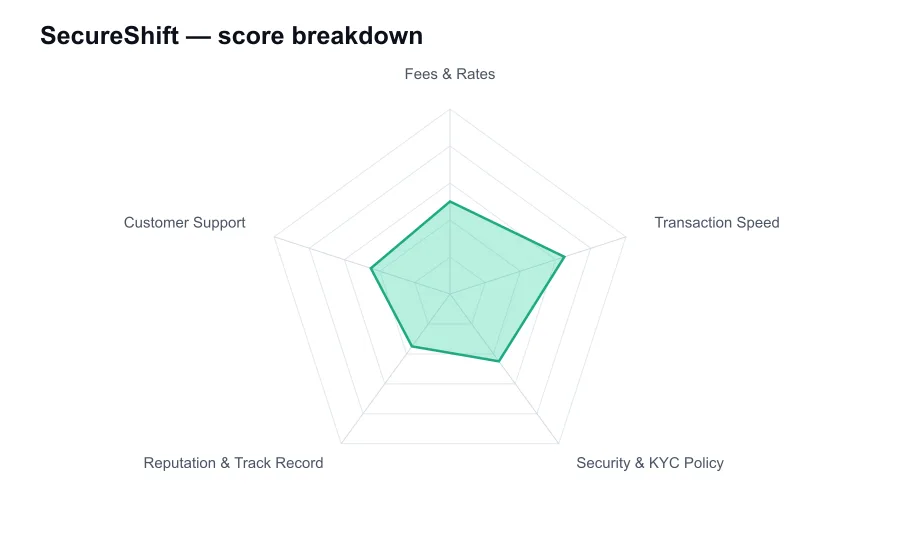
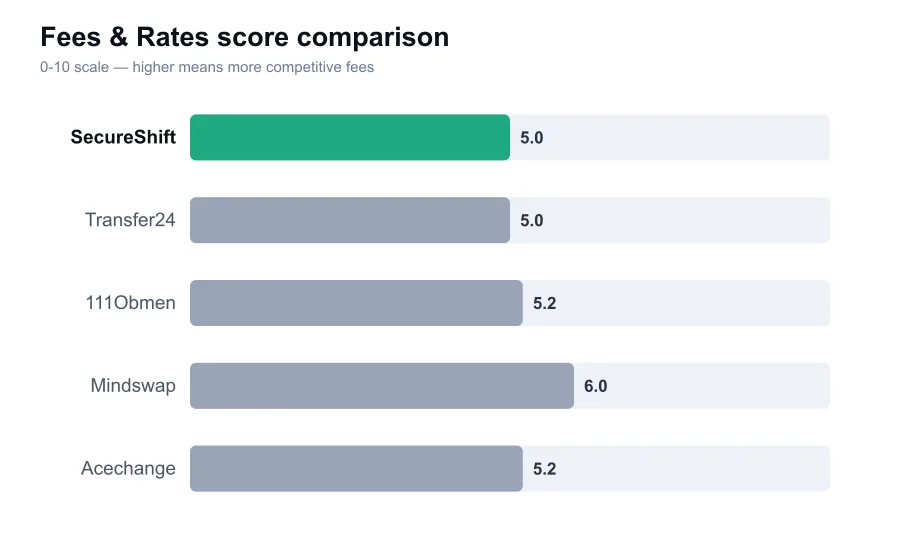
Pricing is where instant exchangers often disappoint. SecureShift may advertise competitive rates, but the practical fee is usually embedded in the quoted conversion amount rather than displayed as a straightforward maker or taker percentage. Liquidity-provider costs, spread, network fees, and the service's own margin can all be reflected in the final output. Comparing only the headline exchange rate is not enough. Compare the amount you will actually receive with at least one established alternative.
A fixed-rate quote can be useful during volatile markets because it gives the user more certainty, assuming the deposit reaches the service within the stated time and tolerance. Floating-rate exchanges can sometimes produce a better result in stable conditions, but users bear more market movement risk between initiating the order and final settlement. SecureShift users should read the quote terms closely. A rate label is not protection if the platform's policy allows a material repricing after the deposit arrives.
Speed depends on more than the platform's processing claim. Bitcoin deposits can take from minutes to much longer depending on fee conditions and required confirmations. Ethereum and token transfers can be faster, while low-cost networks may settle quickly but create a greater risk of selecting an unsupported chain. After the incoming transaction is confirmed, instant exchange services often complete ordinary swaps in minutes. A large order, an illiquid asset, or a compliance review can make that estimate irrelevant.
This is the point where SecureShift's limited public track record matters. A new or lightly documented service may work perfectly for routine small swaps, but users have less evidence about how it handles disputes, delayed orders, large transactions, and locked funds. Reputation is not merely a collection of positive review widgets. It is years of visible operations, documented incident handling, clear leadership, and a history of honoring customers during difficult market conditions.
I would not treat SecureShift as a place to park funds. Send the amount needed for a specific exchange, then receive the output into a wallet you control. That approach is prudent with any instant exchanger, but especially with one that lacks the public scrutiny and institutional footprint of platforms such as Kraken, Coinbase, or even better-known swap services like ChangeNOW and SimpleSwap.
The service's KYC position should be understood as conditional, not absolute. Many instant exchange platforms allow ordinary transactions without creating an account, yet reserve the right to request identity documents or source-of-funds information under anti-money-laundering rules. A user should never assume that no account registration means no compliance review. If a transaction is flagged, access to the exchanged funds can be delayed while the provider asks questions.
Security starts with the website itself. Phishing clones are common in the instant-swap sector, and a typo in a URL can send assets to a criminal rather than a service provider. Users should verify the domain through trusted sources, avoid sponsored search results where possible, bookmark the legitimate page, and never share a seed phrase. No legitimate exchange needs a wallet recovery phrase to process a swap.
The lack of a mature, independently verifiable corporate profile is SecureShift's main weakness. I have not seen enough public evidence to place it in the same trust category as older providers with extensive operating histories. That does not prove misconduct. It does mean the burden of proof remains with the platform, and cautious users should limit exposure until its transparency and record are clearer.
Support is another unknown. Instant exchangers frequently advertise around-the-clock assistance, but the meaningful test is whether an agent can locate a transaction, explain a delay, and resolve a genuine issue promptly. Before sending a substantial amount, I would test SecureShift with a small transaction and save the order ID, transaction hash, quote details, and screenshots. That is not paranoia. It is basic operational hygiene.
The platform may fit users who value no-account convenience for small, ordinary swaps and who understand that they are using a higher-risk part of the crypto market. It does not fit beginners sending their entire portfolio, businesses needing formal compliance documentation, or traders requiring guaranteed deep liquidity. In those cases, the small extra effort of using a larger venue is usually worth it.
SecureShift has a plausible use case, but it has not earned automatic trust. The instant exchange format is convenient, and a clean user flow can be genuinely helpful. Yet opaque all-in pricing, conditional compliance checks, and a limited visible record leave too many unanswered questions for a high score. Use it only with funds you can afford to have delayed, and test it before relying on it.
My final view is blunt: SecureShift may be serviceable for a low-value swap, but it is not a provider I would make central to my crypto routine. Until it demonstrates deeper transparency, stronger independent reputation, and consistently visible support performance, more established competitors are the safer default. Convenience is valuable. In crypto, proven reliability is more valuable.