1WM is another crypto-service name with a much smaller public footprint than the major exchanges and established decentralized protocols. It appears to sit in the exchange or wallet-adjacent end of the market, where users may be offered a fast conversion route without the account structure of a large trading venue. That proposition can sound appealing, particularly to people who dislike lengthy onboarding, but it should be approached with a high level of skepticism.
The central issue is verification. A trustworthy financial provider should make it easy to establish its legal entity, operating jurisdiction, terms of service, privacy policy, compliance process, support channels, and security practices. With 1WM, there is not enough broadly verifiable public material for me to confidently assess those fundamentals at the standard I would apply to a provider handling customer crypto.
That makes the name itself a risk factor. Short exchange names are easy to imitate in search results, social profiles, messaging apps, and phishing domains. Before sending any assets, users should independently verify the precise official web address from a reliable source, check certificate details, and avoid links supplied through unsolicited messages. A convincing imitation can be nearly indistinguishable from a genuine small operator.
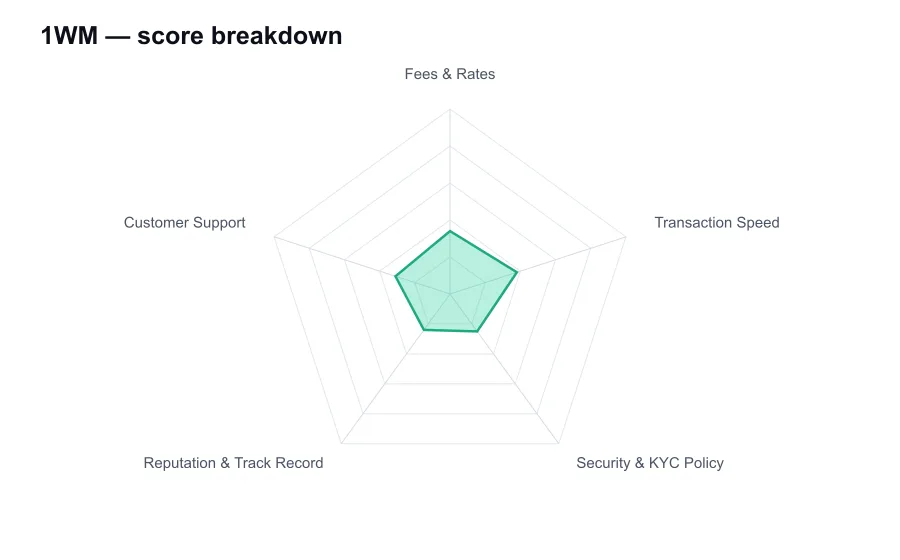
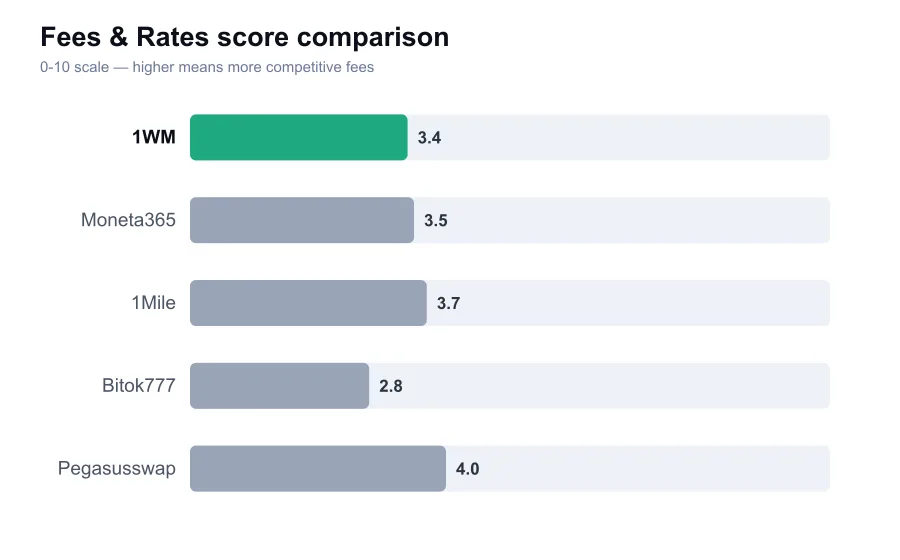
Fee transparency is not strong enough to earn a favorable score. In the instant-exchange market, the displayed rate often contains the operator's margin, liquidity cost, and risk premium. There is nothing inherently wrong with that arrangement, but the customer needs a firm answer to a simple question, how much will reach my destination address after every charge? If the answer can change without a clearly disclosed floating-rate policy, the service is not competitively transparent.
Compare a quote with the current mid-market price only as a starting point. The more useful comparison is the actual number of coins delivered after network costs. A centralized exchange can sometimes look expensive because it has a trading fee plus a withdrawal fee, yet still beat a swap provider's all-in rate. For any meaningful transaction, calculate both routes instead of relying on a percentage claim.
Speed is another category where promotional language should be discounted. Blockchain settlement depends on the chain, required confirmations, wallet availability, and the recipient asset. A provider can process an order promptly and still be unable to make Bitcoin move faster than its confirmation model allows. Conversely, an operator may hold a completed deposit while it checks the source, replenishes reserves, or waits for staff intervention.
There is no independently established evidence that would let me rate 1WM's operational speed alongside high-volume platforms. The safe assumption is that a straightforward small crypto order may complete normally, but any exception could take longer and be harder to resolve. Do not use a lightly documented service for a deadline-sensitive payment, liquidation, or transfer connected to a property purchase, tax payment, or business settlement.
Security demands the same restraint. I could not verify public proof of reserves, third-party audits, detailed custody controls, bug-bounty activity, or a mature incident-disclosure record for 1WM. Those items do not guarantee safety, but their absence makes it impossible to distinguish strong controls from good marketing. The rational response is to limit exposure, not to fill the gaps with optimism.
If 1WM uses a no-registration or no-KYC message, read it narrowly. An exchange may allow an initial order without an account and still stop a transaction for sanctions screening, fraud review, or source-of-funds checks. This can become especially painful after you have already sent the asset. Users should know whether a refund is possible, which currency it will be returned in, and who bears blockchain fees if verification cannot be completed.
Never respond to a request for a seed phrase, private key, screen-sharing session, or an extra payment to release funds. Those are classic fraud markers. Real support may need an order ID, wallet address, and transaction hash. It does not need the credentials that control your wallet. This is basic advice, but small and obscure brands are precisely where social-engineering attempts flourish.
Reputation is currently the decisive negative. A provider earns a durable reputation by surviving volatile markets, public complaints, withdrawal surges, and technical failures while communicating clearly. 1WM has not accumulated a sufficiently visible independent record for a reviewer to make that case. A handful of positive ratings, especially where reviewer identity and transaction details cannot be assessed, should not carry much weight.
Support may exist through a contact form, chat, or messaging channel, but responsiveness is unproven. Before depositing, send a low-stakes question that requires a specific answer, such as the confirmation threshold for a particular asset or the refund process for an underpaid order. Generic replies, pressure to move to private messaging, or refusal to identify the applicable terms should end the experiment.
There are narrow cases where someone might try 1WM. An experienced crypto user could make a very small test exchange after verifying the domain and finding a meaningfully better all-in quote than credible alternatives. Even then, use a fresh receiving address, retain evidence of every screen, and do not repeat the transaction with a larger amount simply because the first one worked.
For nearly everybody else, the better choice is obvious. Use a recognized centralized exchange for fiat conversion and account support, or use a well-known noncustodial protocol if you understand smart-contract risk and do not need fiat rails. Those providers have their own shortcomings, but they offer a far more assessable combination of liquidity, documentation, and public scrutiny.
1WM does not receive a failing score because a limited public record is not proof of misconduct. It receives a low score because trust in financial services should be earned with evidence. The lack of transparent security information, clear reputation signals, and verifiable service performance outweighs any possible convenience. I would not recommend it for meaningful funds.