1Mile is a lightly documented crypto-exchange name rather than a provider with the obvious market presence of Binance, Kraken, Bitstamp, or 1inch. That matters from the first click. In crypto, a polished exchange form can be built quickly, while the hard part is proving that the operator has reliable liquidity, secure controls, accountable management, and a record of honoring withdrawals through difficult markets.
The available public identity signals around the 1Mile name are too limited for me to treat it as a fully established exchange brand. I would not infer licensing, regulation, insured custody, audited reserves, or a particular corporate structure without direct and independently verifiable evidence. A logo, a social account, and a few promotional reviews do not meet that standard.
That does not automatically mean the service is fraudulent. It does mean the burden of proof sits with the operator, not with the customer. A provider asking people to send irreversible assets should clearly explain who runs it, where it is incorporated, what terms govern a disputed transaction, how reserves are managed, and how users can reach a real support team. If those answers are hard to find, the risk is not theoretical.
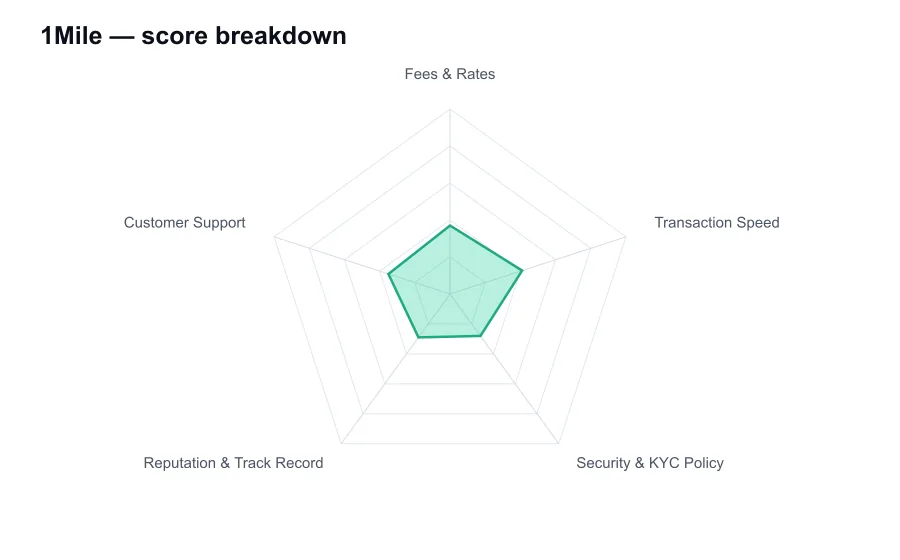
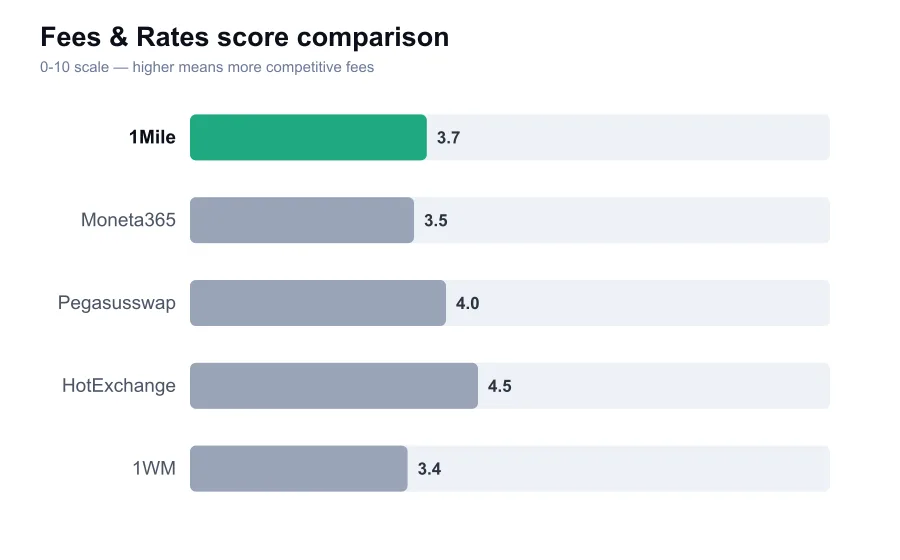
Pricing is impossible to score generously without a transparent schedule and consistently observable execution. Many small swap services advertise attractive rates while earning through the spread between the reference market price and the amount actually paid out. That model can be legitimate. The issue is whether the user can calculate the final cost before committing, rather than discovering a changed payout after blockchain confirmations arrive.
Anyone considering 1Mile should record the quoted rate, expected payout, network fee, minimum amount, maximum amount, and stated timing before sending. Then compare that final payout with a liquid exchange and at least one established instant-swap competitor. If the price advantage is tiny, it does not compensate for higher counterparty uncertainty. Cheap is only cheap if the coins actually arrive.
Speed claims are similarly hard to accept at face value. A small crypto-to-crypto exchange can be quick if it has adequate hot-wallet inventory and automated monitoring. Yet delays arise from blockchain confirmation policies, wallet maintenance, reserve shortages, operator intervention, and compliance screening. Without a large, independently observable record of completed orders, there is no sound basis for assuming reliable near-instant settlement.
A good test is a low-value transaction in each direction you expect to use. Pay attention to whether the order status updates clearly, whether the quoted rate is honored, whether the payout transaction is visible onchain, and how long it takes after your deposit confirms. Never test an unfamiliar provider with the amount you actually cannot afford to have delayed.
Security disclosure is the weakest part of the 1Mile proposition from a reviewer's perspective. I could not verify the sort of public detail that would justify confidence in wallet segregation, multi-signature controls, penetration testing, incident-response procedures, proof of reserves, or independent security audits. Absence of public detail does not prove weak security, but it prevents a serious reviewer from awarding a strong score.
KYC deserves special caution. Some small providers describe themselves as no-KYC because they do not ask every customer to create an account before a basic swap. That does not prevent them from requesting documents or source-of-funds information after receiving a transfer. Read the terms for transaction holds, refund procedures, blocked jurisdictions, and the exact conditions that trigger verification. Vague language is a warning, not a convenience.
There is also a practical privacy point. Sending funds through any centralized exchange or operator creates a transaction trail and potentially exposes your email, IP address, wallet addresses, and payment information. No-KYC is not the same as private by design. Users seeking robust privacy should understand the legal and technical implications of their choices rather than relying on a promotional label.
Reputation cannot be manufactured by a few favorable comments. I would look for a durable history across independent review platforms, long-running forum discussions, clear responses to complaints, domain history, and evidence that users have completed withdrawals during volatile periods. A provider with little independent discussion has not earned the same trust as one that has operated visibly through years of market stress.
Customer support becomes decisive when the product itself is not widely documented. A capable operator should provide an official support route, explain response hours, and ask for an order ID rather than conducting sensitive account matters through random direct messages. Never send a seed phrase, private key, or additional “verification deposit” to support. No legitimate exchange needs your seed phrase.
1Mile could be usable for a small, disposable test order if a prospective customer independently validates the exact domain, terms, and quote. That is the most positive case I can make from the limited verifiable public record. It is not appropriate for storing assets, using leverage, conducting repeated business payments, or converting a large balance under time pressure.
People who need straightforward crypto buying and selling should choose a recognized regulated exchange available in their jurisdiction. Traders who want self-custody swaps should compare established decentralized tools, while accepting the different smart-contract risks involved. Neither path is perfect, but both provide more information than an opaque operator does.
My judgment is blunt because it has to be. 1Mile has not presented enough verifiable public evidence to earn confidence on fees, security, reputation, or support. It may deliver a routine small exchange, but routine delivery is not the same as demonstrated reliability. Until disclosure and independent track record improve, I would keep it off the list of providers entrusted with meaningful funds.