HotExchange is one of the many small crypto exchange brands competing for users who want a quick trade without the bureaucracy of a major platform. That market has no shortage of attractive websites and ambitious promises. What separates a serious provider from a risky one is not the colour scheme or the number of coins listed. It is whether the operator can be identified, the pricing can be tested, and a customer has somewhere credible to turn when a transaction goes wrong.
The publicly visible profile around HotExchange is not strong enough for me to treat it as a peer of established exchanges. That does not prove wrongdoing, and careful reviewers should not make that leap. It does mean the burden of caution moves to the customer. Crypto transfers are final by design, so the lack of easily verifiable operational detail is a material downside rather than a cosmetic issue.
The platform appears geared to exchange functionality rather than full-service investing. Users seeking recurring purchases, bank rails, audited reserves, sophisticated order types, tax reporting, or institutional custody should not expect the same depth they would find at Coinbase, Kraken, Bitstamp, or Independent Reserve. A simple exchange interface can be useful, but its limitations become apparent fast when a user needs anything beyond a straightforward conversion.
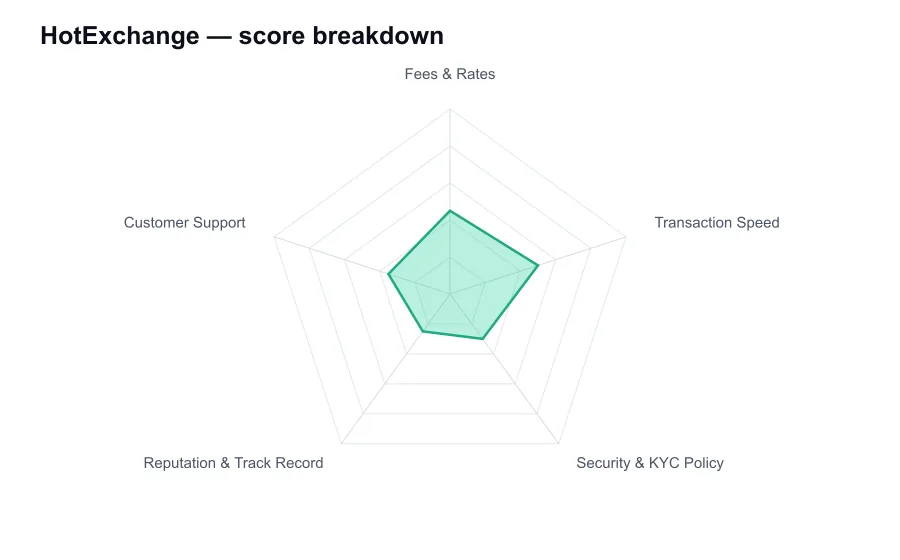
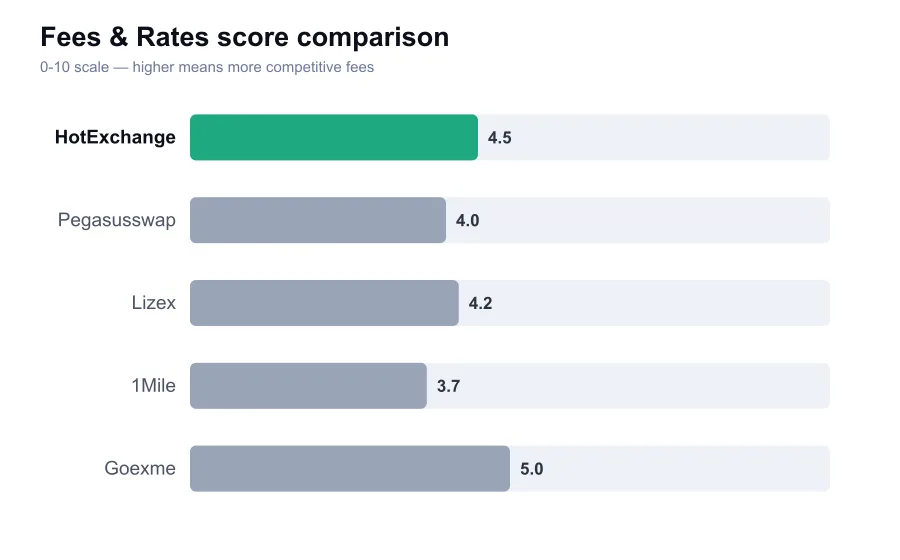
Fees deserve scepticism before praise. Smaller exchange services often frame costs as low or zero, while taking their revenue through the quoted conversion price. That is a normal commercial model, but it is not free trading. The only number that matters is the amount of destination asset that arrives in your wallet after all costs, including the provider's spread and blockchain fee.
A quick manual comparison is easy and should be mandatory. Price the same pair and amount at HotExchange, then check a large spot exchange and another instant-swap provider. Do it within a few minutes, because crypto markets move quickly. If HotExchange gives noticeably less output, the convenience premium may be too high. If it provides a competitive rate, that still does not remove the counterparty-risk question.
Floating-rate quotes require extra attention. If the asset being sent drops or rises during confirmation, the final result can depart from what was shown initially. Some services offer fixed rates for a premium, while others simply calculate the execution after the deposit clears. Before sending funds, users should know which model applies, how long a quote lasts, whether a minimum deposit is enforced, and what happens if the received amount is short.
Speed is a similar story. A swap can look instant at the front end while depending on Bitcoin confirmations, Ethereum gas, wallet maintenance, liquidity partners, and manual review at the back end. For a small transfer of a liquid asset, it may complete in a reasonable time. But there is no reason to assume a small provider has the redundancy, internal treasury depth, or engineering coverage of a major exchange.
The practical danger is not a ten-minute wait. It is an exception that is hard to resolve. An incorrect memo, an unsupported token contract, a deposit below the minimum, or a compliance flag can turn a quick exchange into a lengthy support case. The more obscure the asset or network, the more I would avoid using a lightly documented service. Use established chains, verify the address character by character, and never use money needed urgently.
HotExchange's KYC position should also be read carefully. Crypto users often equate a low-friction sign-up process with guaranteed anonymity. That is a mistake. A provider can accept an initial transfer with minimal registration and later request identity documents before releasing the proceeds. In a legitimate compliance framework that may be necessary, but users need the policy stated clearly in advance, including timelines and refund arrangements.
I have not found enough strong, independent public evidence to score HotExchange well on security. A trustworthy exchange normally provides meaningful information about legal entity details, custody controls, account protections, incident response, and official support routes. Two-factor authentication and encryption are useful technical basics, but they do not answer the larger question of who controls the wallets and how a customer is protected if the business fails.
Reputation in crypto is built over years, usually through boring things: continued withdrawals during volatile markets, clear communication during outages, credible leadership, and a record that can be checked beyond affiliate review pages. HotExchange does not have that kind of widely visible record. It should not be placed in the same trust category as a long-running, licensed exchange merely because it offers similar trading pairs.
Support is especially hard to judge with lesser-known providers. A chat bubble proves there is a chat bubble. It does not prove that complex cases are handled promptly or that refunds are authorised fairly. Before using HotExchange, I would look for a current support email, terms that explain dispute handling, and a real response to a basic pre-sale question. A platform that cannot answer a simple policy question before receiving funds is not a platform I would fund.
For some experienced users, the service might be an acceptable option for a tiny test swap if its price is unusually good and they understand the exposure. That is the most generous case I can make. It is not appropriate for a first crypto purchase, a retirement-sized holding, or a transfer where timing matters. There is simply too little visible reassurance to justify taking those risks.
HotExchange also lacks the broader safeguards many people now expect. It is not a substitute for a regulated on-ramp, and it should not be treated as a wallet. Keep assets under your own control before and after a trade. If you need to hold funds on an exchange, choose one with published legal information, stronger market recognition, and a demonstrated history of serving customers through difficult market conditions.
The right comparison is not between HotExchange and doing nothing. It is between HotExchange and the many alternatives that may offer similar convenience with better disclosure. Decentralised exchanges can remove intermediary custody for users who understand slippage and wallet safety. Major centralised exchanges can offer tighter spreads and stronger customer processes. A smaller swap service needs to offer a clear advantage to overcome its reputation discount.
My verdict is reserved rather than enthusiastic. HotExchange may function for routine small transactions, but there is not enough independently verifiable information to recommend it confidently. Its likely benefits are simplicity and potentially quick execution, while the drawbacks are unclear effective pricing, limited transparency, and a shallow public track record. If you decide to try it, test it with an amount you can afford to lose and keep better-established alternatives at the front of your shortlist.