Pegasusswap presents itself as a crypto swap service for users who want to convert one asset into another without learning a professional exchange interface. That proposition is familiar. The market is crowded with instant exchangers, and the better known names, such as ChangeNOW, SimpleSwap and FixedFloat, have years of user reports, public documentation and recognizable operating histories behind them. Pegasusswap does not carry that same level of established market visibility.
That distinction shapes this review more than any attractive rate on a landing page. A small exchange service can be perfectly functional, but the burden of proof is higher when it asks customers to send irreversible crypto to an address controlled by an operator they have not encountered before. With a decentralized exchange, funds remain in a wallet until a smart contract transaction is signed. With an instant swap provider, the user is trusting a business to receive, exchange and forward funds correctly.
The basic process is simple: choose a pair, provide a destination address, send the source asset and wait for delivery. Services built on this model can be useful because they remove account funding, order books and custody dashboards from the experience. The trade-off is that the customer often gets less information about the liquidity source, execution method and exact margin embedded in the rate. Pegasusswap's public footprint does not make those details especially easy to independently verify.
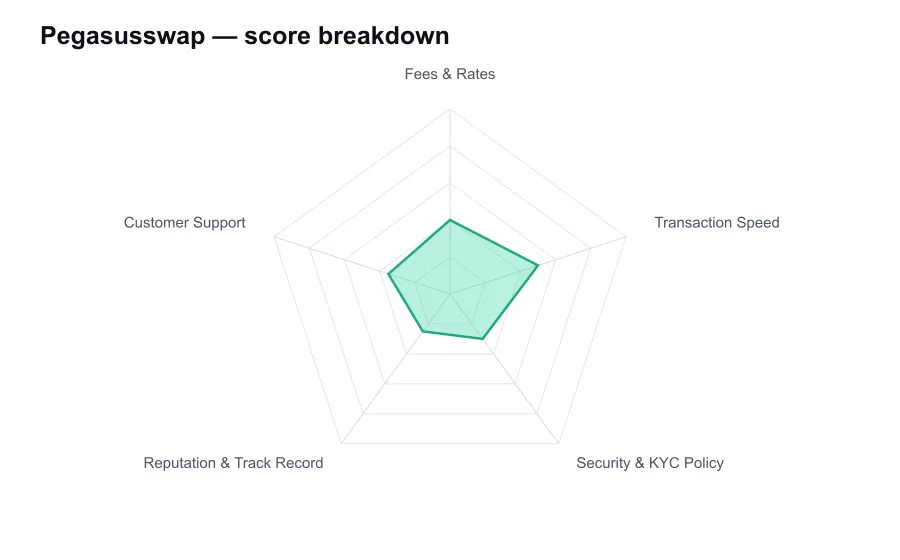
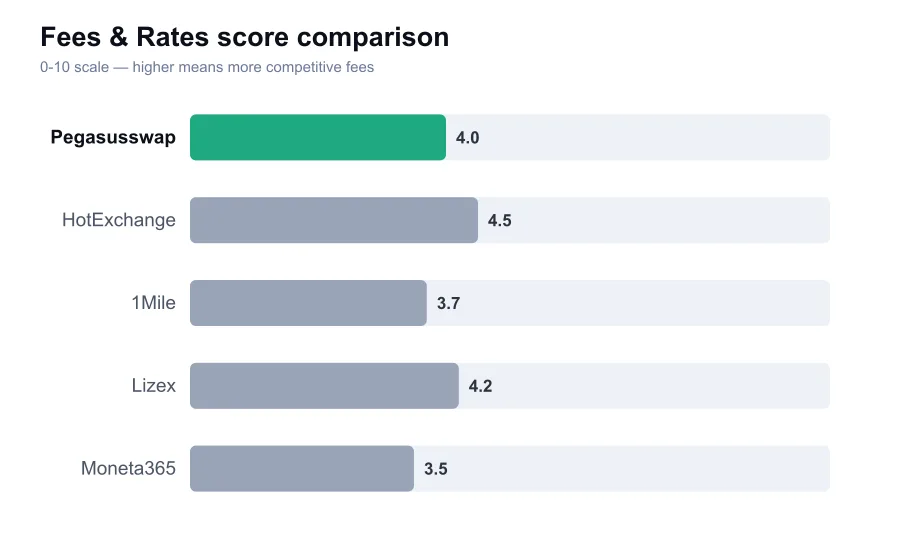
Fee transparency is the chief weakness. A quoted exchange rate may include a provider fee, a liquidity-provider spread and estimated network costs, but a user needs a clear final quote to understand the actual price. If a service says it has low fees without showing whether it uses fixed or floating rates, that is not enough for a serious transaction. I would treat every Pegasusswap quote as an all-in offer and compare it immediately with at least two alternatives before sending funds.
A small percentage difference can become expensive quickly. On a $100 conversion, an extra two or three percent might feel tolerable if speed matters. On a $5,000 or $20,000 swap, it is material. Large providers can sometimes be more competitive because they aggregate more liquidity, and decentralized routes through 1inch or a major DEX can be cheaper for assets on the same chain. That does not mean they are always simpler, but it does mean Pegasusswap needs to win on a visible quote, not vague claims.
Transaction speed is similarly conditional. The provider can process an order quickly, but it cannot override Bitcoin confirmation times, Ethereum congestion, destination-chain delays or risk checks imposed by its liquidity partners. A routine swap between liquid assets might settle after a handful of blockchain confirmations. Cross-chain conversions or assets on congested networks can take much longer. A service should clearly show status updates and transaction identifiers. Without that visibility, users have little way to distinguish a normal delay from an operational problem.
I would not use Pegasusswap for a time-sensitive liquidation or a transfer connected to a major market move. The instant-exchange model is not truly instant in the way its branding suggests, and less established operators have less room for error. Use a small test order first. Confirm that the asset, memo, tag and network match exactly. Sending USDT on the wrong network, or omitting an XRP destination tag, creates the kind of support case that can turn a quick swap into days of uncertainty.
Security assessment is where caution becomes essential. A customer should look for a named legal entity, reachable support channels, a clear terms page, an intelligible privacy policy and evidence of how the service handles compliance reviews. Publicly available information around Pegasusswap does not provide the same depth of independent reassurance offered by larger regulated exchanges or longstanding noncustodial swap brands. That does not prove misconduct. It does mean there is less evidence on which to base confidence.
No-KYC marketing, if offered for routine swaps, should not be confused with a guarantee that identification will never be requested. Many instant exchangers reserve the right to pause a transfer and request verification if automated monitoring flags an address, size or transaction pattern. That is a painful reality of this category. Before using any such service, read the AML wording carefully. The key question is whether a held transaction has a clear escalation path and a defined process for return of funds if verification is declined.
Reputation is not built by a website alone. It is built over time through independently traceable customer reports, resolved complaints, transparent incident handling and a visible operating team or company. Pegasusswap has a limited public track record compared with household exchange names. The lack of a long record is not a minor drawback for an irreversible crypto service. It means a prospective customer should avoid treating it as a place to park funds or route a large one-off transaction without testing it.
There is also a difference between a real review and promotional referral content. Smaller crypto swap brands can accumulate glowing short reviews that say little about delayed orders, KYC holds or recovery problems. Search for detailed reports that include dates, transaction types and outcomes. Look at criticism as closely as praise. If the only feedback is generic, recent or affiliate-driven, that is not useful reputation evidence. A trustworthy operator should not need customers to rely solely on its own testimonials.
Customer support is the last line of defense in this model, and it should be judged harshly. A contact form or chat widget is not adequate proof of effective support. For a failed swap, users need a ticket number, human response, transaction-level investigation and clear communication about what is happening. I would only send a meaningful amount after confirming that Pegasusswap support can answer a basic pre-sale question coherently and identify its expected process for delayed or compliance-flagged transfers.
The sensible way to use a service like this is with a deliberately limited risk budget. Make a small conversion, save screenshots of the quote and destination address, and wait until the funds arrive. Do not make it the sole bridge between an exchange withdrawal and a deadline. Do not send your entire wallet because a rate looks attractive. Crypto transactions are irreversible, and a new or thinly documented intermediary magnifies operational risk even if its software works exactly as advertised.
Pegasusswap may suit a technically confident user making a small, non-urgent conversion after independently validating the quote and support responsiveness. It has not earned the trust level I would require for large transfers, recurring use or funds that cannot be delayed. The category itself can be useful, but trust is the product, and Pegasusswap's limited verifiable public history leaves too much unanswered. Better-established alternatives are the responsible choice until that record becomes much deeper.