ChangeNOW is one of the stronger independent players in the instant-exchange category. Founded in 2017, it offers crypto swaps without requiring users to operate a conventional exchange account, while also selling a wider ecosystem that includes wallet tools, APIs and business products. Its core service is familiar: choose a pair, send crypto, and receive the output in a destination wallet. The company has built a larger profile than many competitors, and that visibility helps, though it does not remove the standard risks of aggregator-based swaps.
The appeal is immediate for self-custody users. ChangeNOW supports a very wide selection of coins and networks, including many assets that are awkward to access on a single regulated exchange. It is particularly useful for moving between ecosystems, such as a stablecoin on one network and an asset on another. The website and wallet integrations reduce friction well. A newcomer can make a basic exchange without studying candles, order books or trading pairs, while a power user can get in and out quickly.
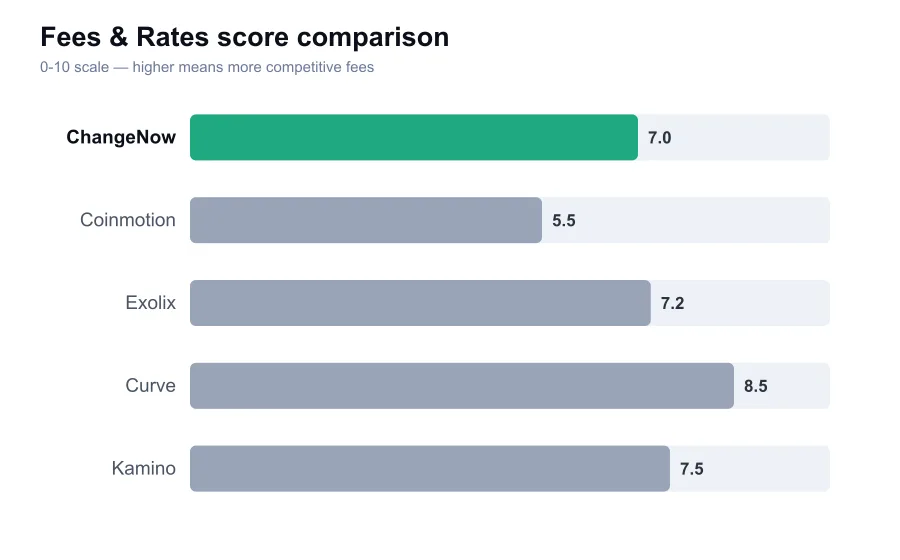
Its pricing is not built around a simple public trading commission. ChangeNOW says its quotes include applicable fees and that there are no hidden charges, but the effective cost is embedded in the offered conversion rate. That can include liquidity-provider spreads, its own margin and network costs. This is normal for instant exchanges, but it makes direct fee comparisons difficult. The advertised payout is the only number worth judging, and it should be checked against at least two rival services before a meaningful transfer.
On liquid pairs, ChangeNOW often produces competitive quotes. It has substantial routing coverage and can be a good alternative to Changelly or ChangeHero, particularly where one provider has poor liquidity or temporary wallet maintenance. Still, it is not consistently the cheapest. If you are converting a large amount of BTC, ETH or stablecoins, a low-fee spot exchange can often beat it after withdrawal costs are considered. ChangeNOW is paying for simplicity and speed, not promising best-in-class price discovery.
The platform offers both floating and fixed-rate exchanges. Floating rate is appropriate if you prioritize the best current estimate and can tolerate market movement while the transaction is being processed. Fixed rate is better if you care about receiving a defined minimum amount. As with other providers, the fixed route normally reflects the cost of absorbing volatility. It is not a free upgrade. For a small casual swap, floating is often fine. For a larger conversion in a fast market, fixed rate is the more disciplined choice.
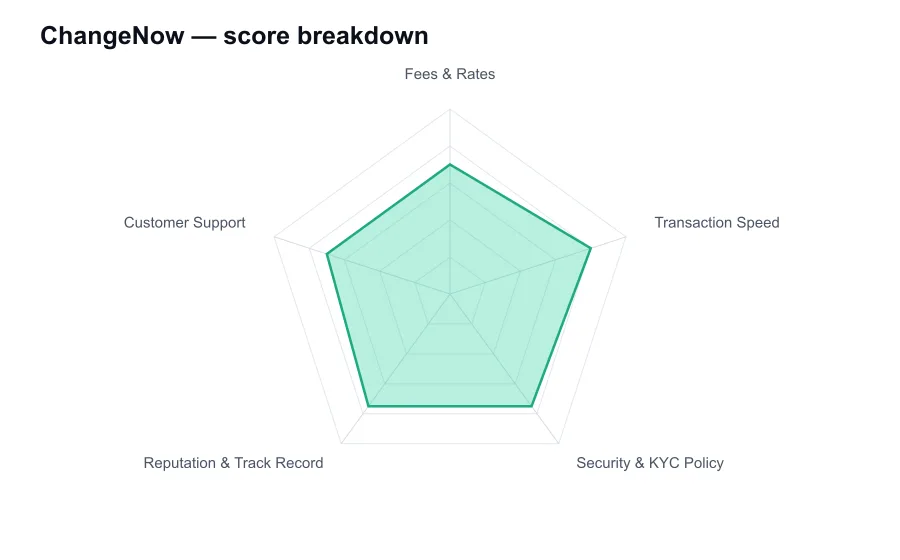
Transaction speed is one of ChangeNOW's better attributes. On a straightforward route using fast networks, exchanges can complete in a few minutes. Ten to twenty minutes is common for ordinary swaps, while Bitcoin or congested Ethereum routes can take longer. The service has a good reputation for processing routine transactions promptly, and its status pages are useful. Yet a user should never interpret instant as guaranteed. Confirmations, blockchain fees, partner availability and wallet maintenance are outside the control of a polished front end.
The most frustrating cases tend to arise from network mismatches. Crypto has grown complicated enough that USDT is not one asset operationally. It may be sent on Ethereum, Tron, Solana, BNB Chain or another network, and the destination route must match. ChangeNOW presents network choices clearly enough, but the user still bears responsibility. Verify the chain twice, especially where the token ticker is identical. A wrong-network deposit can be recoverable in some situations, but it can also be expensive or impossible to recover.
ChangeNOW is designed as a non-custodial service, so it does not ask users to maintain a long-term exchange balance. That is an advantage over smaller centralised exchanges where users may leave funds exposed. It also offers tools such as NOW Wallet that are intended to support self-custody use. But the swap itself is not trustless. The company handles execution and relies on outside liquidity and infrastructure. A self-custody destination protects your coins after receipt, not necessarily during an interrupted conversion.
The KYC policy is more nuanced than the marketing phrase no registration suggests. Standard transactions can generally be made without creating an account or submitting identity documents. ChangeNOW has AML procedures, however, and it can place a transaction under review if screening identifies risk. It may request KYC and source-of-funds evidence. That is a sensible compliance control in principle, but users should regard it as a genuine operational possibility rather than fine print that never affects ordinary people.
This is where ChangeNOW is somewhat better positioned than less established anonymous swap sites, but it still faces the same customer trust problem. A user with a halted transfer wants a clear explanation, a timeline and a route to resolution. Automated risk scores are not always transparent, and support cannot always share every detail. If your funds have connections to a flagged address, a mixer, a disputed service or a suspicious counterparty, do not send them through an instant exchanger and expect a seamless result.
ChangeNOW's reputation is stronger than many peers because it has operated through multiple cycles, expanded its products and remained visible rather than disappearing after a hype period. It has also attracted criticism, including reports of delayed transactions and verification issues. That mixture is unsurprising for a high-volume instant exchange. I would place its reputation above the average new swap site, but below the confidence level of a large, heavily supervised exchange with clear legal jurisdiction and formal customer protections.
Support is available around the clock through live chat and email, and ChangeNOW has invested more in public-facing assistance and knowledge resources than many tiny competitors. For ordinary tracking questions, it tends to be responsive. Complex cases are another matter. Network recovery, a stuck liquidity route or a compliance investigation may take far longer than the customer wants. The best users can do is provide the exchange ID, deposit hash, screenshots and accurate details from the start, then avoid creating contradictory duplicate tickets.
For casual use, I like ChangeNOW more than many instant-exchange alternatives because of its broad coverage, decent speed and mature product experience. It is particularly handy for someone consolidating assets from multiple chains into a self-custody wallet. I would still compare it with Changelly and ChangeHero for every meaningful transaction, because pricing changes route by route. And I would not send a life-changing sum just because the site looks smooth. A clean interface is not a guarantee against operational complexity.
ChangeNOW is one of the better convenience services in its class, but it should be evaluated as a convenience service. Its strongest qualities are breadth, ease of use and quick routine settlement. Its limitations are opaque effective spreads, dependence on third-party liquidity and the possibility of AML interruption without the predictability of a fully onboarded regulated exchange. For modest self-custody swaps, it is a good option. For large trades, active trading or guaranteed timing, a proper exchange remains the better tool.