Curve is one of DeFi's foundational exchanges, built for traders who want to swap assets that should trade close to the same price. Its original specialty was stablecoins, so a USDC to USDT trade or a stETH to ETH trade could be far cheaper and less slippy than on a conventional automated market maker. It is not a beginner's exchange in the Coinbase sense. Curve is a collection of smart contracts, liquidity pools, gauges and voting incentives spread across several chains.
That design still matters. A standard constant product pool is excellent for unrelated assets, but it gets inefficient when two tokens are meant to hold roughly equal value. Curve's stableswap formula concentrates liquidity around parity, which is why it became a major venue for stablecoin routing. For the right pair, the price impact can be remarkably low, even on fairly large trades. For the wrong pair, Curve may simply not be the best place to trade.
The interface has improved from its notoriously dense early days, though it remains unapologetically technical. You connect a self-custody wallet, choose a network and approve token spending before swapping. There is no account recovery, no bank transfer and no friendly safety net if you send assets to the wrong address. That is normal in DeFi, but readers should treat Curve as infrastructure, not as a retail brokerage.
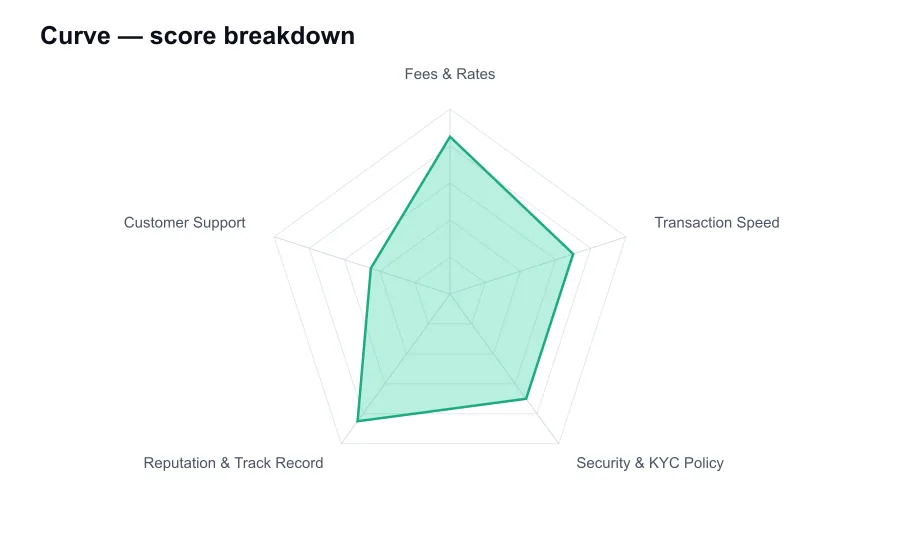
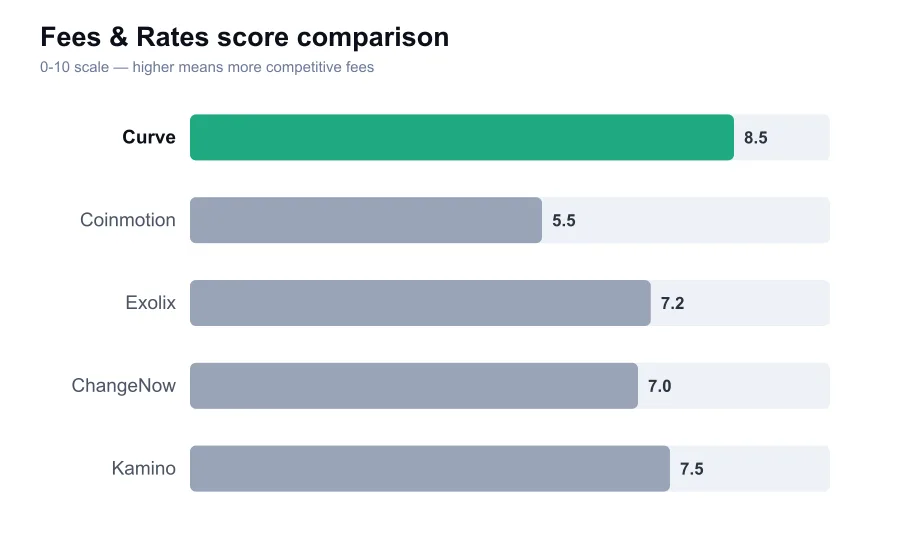
Fees are one of Curve's strongest points, particularly in mature pools. Many traditional pools used a 0.04% swap fee, although pool parameters and newer pool designs can vary. In practice, the displayed quote matters more than any headline percentage because Curve uses dynamic mechanisms in some pools and because gas can dominate a small Ethereum transaction. On Arbitrum, Optimism, Base or Polygon, the total cost can be very attractive. On Ethereum mainnet, a modest stablecoin swap can become silly during congestion.
Liquidity providers receive much of the economic benefit from those fees, and the CRV incentive system adds another layer. Users who lock CRV as veCRV can vote on gauge emissions and may boost rewards in certain circumstances. That created Curve's famous vote market economy, with Convex and other protocols competing for influence. It is fascinating finance, but it also means the attractive yields shown around Curve are never simple savings-account returns. They depend on token incentives, pool composition, emissions and governance politics.
A trader should also distinguish low fee from low execution cost. Curve can beat a centralized exchange or Uniswap for an on-chain stablecoin conversion, but not always. A shallow, obscure pool can quote poorly. A bridge-wrapped asset might depeg. An aggregator can occasionally find a better route by splitting an order among Curve, Uniswap and other venues. I would check Curve directly for major stablecoin and liquid staking pairs, then compare the final amount against a reputable aggregator before confirming a large trade.
Speed is determined mostly by the chain beneath it. A swap on Base or Arbitrum often settles in seconds once included, while Ethereum mainnet may take minutes if a wallet uses a conservative gas setting. Curve itself does not hold an order book or manually process requests. Once the transaction is broadcast, it is governed by normal blockchain confirmation rules. That is fast enough for ordinary conversions, but it is not suitable for anyone expecting a centralized exchange's instant internal fills.
Security is the central tradeoff. Curve does not require routine KYC and users retain their private keys, which reduces the risk of a platform freezing a personal account. Yet self-custody transfers responsibility to the user, and smart contract exposure is real. Curve has been audited many times and has survived years of intense use, but its history includes the 2023 Vyper compiler vulnerability that affected several pools and led to major losses. A protocol can be battle-tested and still be vulnerable through an unexpected technical dependency.
That incident deserves more weight than polished marketing usually gives it. Curve's core pools and contracts were not all equally affected, and the community coordinated recovery efforts, but the event showed why liquidity providers should not think of stablecoin pools as cash. Pool tokens can carry smart contract risk, depeg risk, oracle risk and concentrated exposure to one asset. The CRV token's own price volatility has also periodically magnified pressure on the ecosystem.
Curve's reputation is substantial because it has been operating since 2020, has handled enormous historical volume and remains deeply integrated into DeFi. It is a respected protocol among experienced users, not an anonymous swap site with a newly created domain. The less flattering side is that governance and incentives are complicated enough that ordinary users can feel like spectators in a system shaped by large CRV holders, protocols and professional yield strategists.
Support is where Curve feels most like a protocol rather than a service business. Documentation, governance forums, Discord and community channels can help, but there is no conventional help desk that can reverse an approved transaction. Impostor support accounts are a persistent risk. Nobody legitimate needs a seed phrase, private key or remote access to solve a Curve issue. Users who need a phone number and a named case manager should use a regulated exchange instead.
Liquidity provision requires more care than swapping. Before depositing, inspect the pool's assets, historical volume, current APY composition and whether the return is mostly fees or CRV emissions. A pool with an eye-catching percentage may be compensating depositors for real depeg risk. The 3pool model was once a simple reference point for stablecoin liquidity, but the wider stablecoin market is now more fragmented and every pool needs its own scrutiny.
Curve also operates across multiple networks, which is useful but can confuse newcomers. A token named USDC on one chain is not automatically interchangeable with its counterpart elsewhere. Bridging adds another protocol, another fee and another source of failure. I prefer using Curve after assets are already on the desired network, rather than treating it as a complete cross-chain solution.
For advanced DeFi users, Curve remains essential plumbing. It is especially good at what it was built for, efficient swaps among tightly correlated assets and deep liquidity for certain liquid staking tokens. It is less convincing as a one-stop trading app, a beginner education platform or a place to chase the highest advertised yield without research. Its best feature is precision, and its biggest weakness is that precision demands an informed user.
My view is that Curve deserves respect rather than blind trust. The fee structure and execution for core pools can be excellent, and its longevity sets it apart from the usual DeFi clone. Still, no-KYC self-custody does not mean no risk, and the history of exploits means deposits should be sized with discipline. Use it for deliberate, well-understood on-chain trades. Don't mistake a sophisticated liquidity machine for a simple savings product.