Exolix is a non-custodial instant exchange service aimed at people who want to swap one crypto asset for another without opening a trading account. It occupies the same broad territory as ChangeNOW, SimpleSwap, LetsExchange and Godex, but has built its identity around a relatively clean interface, a large coin list and a choice between floating and fixed-rate orders. It is not a spot exchange with an order book, advanced charts or fiat deposits. You send coins in, Exolix finds liquidity through its partners, then it sends the output asset to your wallet.
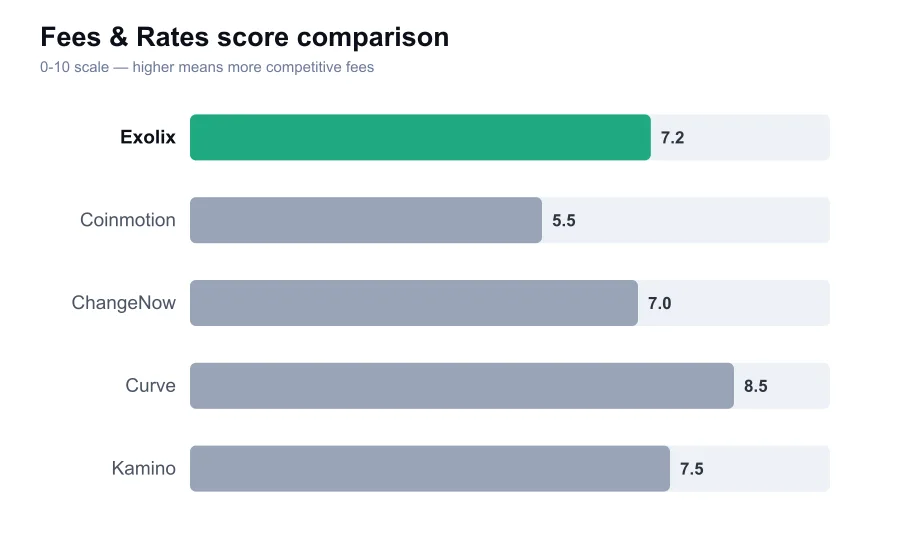
That distinction matters. Exolix can be convenient, especially for a one-off wallet-to-wallet conversion, but it is not usually the place to hunt for the absolute best execution. Its quote is the product. The company aggregates liquidity and presents a final rate that includes its compensation and any provider spread. There is no simple public maker and taker schedule, so comparing it with a centralized exchange charging 0.1 percent is misleading. Compare the final amount you receive against alternatives instead.
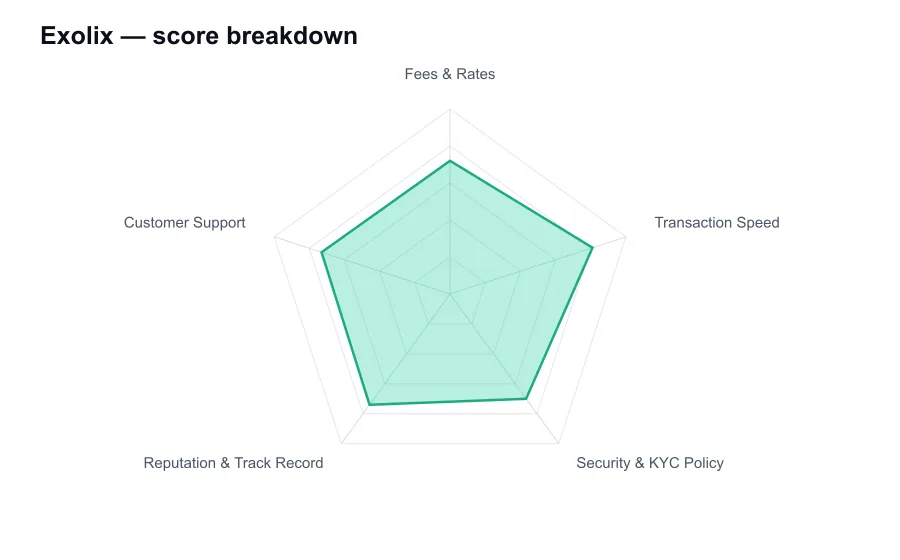
The fee presentation is reasonably understandable during the swap flow, though not as transparent as a flat-fee service. Exolix displays the estimated output before you deposit and identifies network fees, but the exchange margin is embedded in the quoted rate. That is standard for this category, not a special failing, yet users should recognize it for what it is. A low network fee does not mean the swap itself is cheap. On liquid pairs such as BTC to USDT or ETH to USDC, quotes are often competitive. On thin tokens, the spread can widen sharply.
The fixed-rate option is the main reason to consider Exolix over a bare-bones aggregator. A fixed order gives the customer a quoted amount within a specified deposit window, subject to the service's stated tolerance and network conditions. That can be valuable in a volatile market, particularly for someone paying an invoice or moving between assets during a fast selloff. Floating-rate swaps may produce a better result if the market moves in your favor, but they also leave the final amount exposed to price changes between deposit and execution.
The catch is that fixed-rate language is never a substitute for reading the order conditions. Crypto transactions can arrive late, arrive short because the sender set too low a fee, or be affected by an asset's confirmation rules. If the received amount differs materially from the expected deposit, the service may need to recalculate the transaction. That is not unique to Exolix, but a newcomer expecting the simplicity of a card purchase can be surprised by it. Send the exact amount, use a sensible network fee and do a small test first.
Speed is good on normal, liquid routes. A swap involving fast chains can complete within minutes after the incoming transaction is confirmed. Bitcoin and Ethereum swaps often take longer simply because Exolix cannot responsibly forward assets before it has enough confirmation confidence. The company advertises rapid processing, and that is broadly fair for ordinary orders, but no instant exchanger controls a congested blockchain or a liquidity partner's wallet maintenance. A twenty-minute exchange is not alarming. A transaction stalled for several hours deserves a support ticket.
Exolix supports a wide collection of major coins, stablecoins and smaller assets, which is useful but creates operational risk. The more networks a service offers, the more chances there are for a wallet to be temporarily unavailable or for a user to select the wrong chain. USDT is the familiar trap. Sending TRC20 USDT to an ERC20 address, or selecting the wrong destination network at checkout, can create an expensive recovery problem. Exolix shows network choices, but it cannot protect users who rush through the final address check.
The service markets itself as registration-free, and most standard swaps do not require creating an account or submitting identity documents. That is a genuine convenience for privacy-minded users. It should not be confused with a promise of unconditional anonymity. Exolix has an AML policy and can request KYC material when a transaction triggers risk controls, is linked to sanctions exposure, or is otherwise flagged by its compliance systems. Funds can be held while that review is underway. Anyone who cannot tolerate that possibility should not use any compliance-aware instant exchanger.
Non-custodial is also a narrower claim than some users assume. Exolix does not hold a standing customer balance like a conventional exchange, and you retain control until you send the deposit. Once coins are sent to the order address, though, the service and its liquidity infrastructure control the processing path. This is still counterparty risk. You are trusting its hot-wallet operations, pricing sources, compliance decisions and ability to return funds if something goes wrong. Keep large treasury conversions on venues with institutional controls rather than treating an instant swap as a vault.
On security disclosure, Exolix gives users the basics, HTTPS access, transaction IDs, order tracking and an AML framework, but it does not publish the kind of deep custody, reserve or audit reporting that a serious regulated exchange might offer. That is common in the instant-exchange sector. It doesn't make the service inherently unsafe, but it limits how much an outside reviewer can verify. The sensible approach is practical rather than romantic. Use a self-custody destination, secure your own wallet, bookmark the real domain and never rely on a search-advertisement link.
Exolix has operated since 2018, which gives it a longer record than many small swap sites that appear for a year and vanish. Its public footprint includes partner integrations, wallet listings and a substantial volume of routine user feedback. It has not attained the institutional stature of Kraken or Coinbase, and it has the expected share of complaints about AML holds, changed rates and delayed transactions. Those complaints are not proof of misconduct, but they are exactly why the service should be used for transactions you can monitor rather than an urgent, life-critical payment.
Support is available around the clock through the website's live chat and email channels, with social channels also used for contact. In ordinary cases, a visible order ID makes support more useful than it is at services that provide no transaction tracking at all. Response quality appears strongest on straightforward technical matters, such as a missing memo or an unconfirmed deposit. The difficult cases are compliance reviews. Frontline support cannot simply override AML procedures, and users caught in those queues can find the experience opaque and frustrating.
I like Exolix most for a user who already understands wallets and wants a reasonably polished route between established assets. Its interface is less intimidating than an exchange terminal, fixed-rate orders offer a useful form of certainty, and the asset selection is broad enough for many practical portfolio moves. I like it less for people who need a fully disclosed fee model, formal regulation, a fiat ramp, or a trading venue where they can control limit prices. Those are different jobs.
My view is that Exolix is a credible mid-tier instant exchanger, not a magical shortcut around crypto's usual risks. Check two or three quotes before confirming, especially for a large swap, and treat the fixed-rate option as insurance rather than a bargain. For modest, time-sensitive conversions it can be a strong choice. For six-figure transfers, obscure tokens, or any situation where a compliance delay would cause real damage, choose a venue with more transparent execution and a stronger institutional support structure.