Kamino is not a conventional crypto exchange, and judging it as one would miss the point. It is a decentralised finance protocol on Solana focused on lending, borrowing, liquidity provision, and automated liquidity vaults. Users connect a self-custody wallet rather than opening a standard brokerage account. The protocol is built for people who already understand on-chain transactions, collateral risk, and the occasionally brutal mechanics of leveraged DeFi.
That positioning matters immediately. Kamino does not operate like Independent Reserve, Coinbase, or Kraken. It does not take an Australian bank transfer, verify your passport, hold your cash balance, or run a centralised customer-support desk capable of reversing a mistaken transaction. Its strengths are composability, wallet control, and access to Solana-native markets. Its weakness is that the user bears much more responsibility.
Kamino's lending market lets users supply supported assets to earn variable yield or borrow against collateral. The protocol also offers Multiply, a tool designed to create leveraged exposure through repeated supply-and-borrow loops without requiring users to manually execute every loop. That is clever infrastructure, and it can be efficient for sophisticated users. It is also an extremely easy way for inexperienced users to take more risk than they realise.
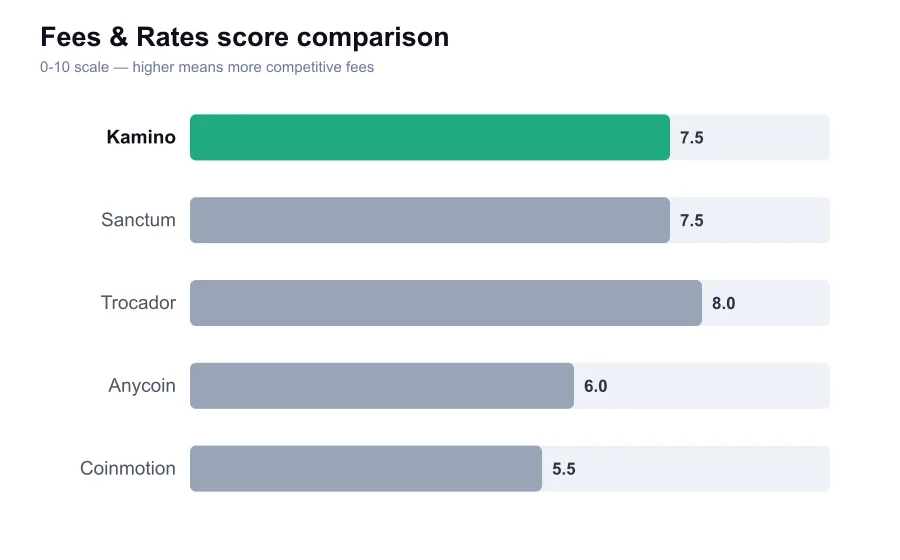
Fees are not a single simple percentage. A Kamino user faces the interest rate on borrowed assets, reserve-level fees, swap and liquidity costs where relevant, Solana transaction fees, and the economic impact of price impact or slippage in connected markets. Supply APYs and borrowing APRs move constantly with utilisation. Anyone who looks only at the large yield figure and ignores borrowing cost, token emissions, and liquidation risk is not analysing the position properly.
Solana's low transaction costs are a genuine advantage. A routine interaction often costs a tiny fraction of what the equivalent activity on Ethereum mainnet might cost during congestion. That makes it practical to rebalance, repay, or adjust collateral without spending tens of dollars in gas. Cheap transactions do not make a strategy cheap, though. A bad leveraged position can lose far more to market movement and liquidation than it ever saves on network fees.
The protocol's automated liquidity products are another major draw. Kamino Liquidity can package concentrated liquidity management into vaults that automatically manage positions according to a defined strategy. This reduces the work of manually maintaining a range on Solana decentralised exchanges. It does not eliminate impermanent loss, smart-contract risk, or the possibility that a strategy performs badly in a sharp one-way market.
Speed is excellent in the narrow sense that Solana transactions typically settle quickly, often within seconds under normal network conditions. Opening or adjusting a position can feel dramatically faster than using a centralised exchange's deposit and withdrawal rails. The relevant caveat is that speed at the chain level is not the only issue. Oracle updates, liquidity availability, congestion, RPC reliability, and wallet signing all affect the actual experience.
Solana has had historical periods of network instability and performance disruption. The network has matured substantially, but users should not build a leveraged strategy on the assumption that every transaction will always land immediately during violent volatility. That is exactly when liquidations matter most. A protocol can work perfectly according to its rules while the user still has a terrible outcome because they could not adjust collateral quickly enough.
Kamino is noncustodial in the usual DeFi sense. You interact from a wallet such as Phantom or another compatible Solana wallet, and you authorise transactions yourself. There is no routine KYC gate at the protocol interface. That is attractive for users who value permissionless access, but it also means there is no account recovery department if you lose a seed phrase, approve a malicious transaction, or send an asset to the wrong address.
The absence of KYC should not be marketed as an absence of legal or practical risk. Users remain responsible for obeying laws in their jurisdiction, reporting taxable activity, and understanding that front ends can impose restrictions or change access policies. More importantly, DeFi positions are public on-chain and can be analysed by anyone. Privacy from an exchange onboarding process is not the same as complete financial privacy.
Security is Kamino's most complicated category. The protocol has undergone security reviews and has developed into one of Solana DeFi's prominent lending venues, which is materially better than deploying funds into an anonymous, unaudited contract. Yet audits are snapshots, not guarantees. Smart contracts, price oracles, integrations, governance decisions, and Solana infrastructure all create attack surfaces. Every extra strategy layer adds another way for assumptions to fail.
The best risk management is boring. Use a hardware wallet where possible, verify the official domain, revoke unnecessary permissions, avoid copying links from social media, and do not leverage a position to its liquidation threshold. Keep collateral buffers wide enough to survive a sudden market move. Stablecoins also have issuer and depeg risk, so lending USDC or borrowing against it is not equivalent to holding cash in a bank account.
Kamino has a credible reputation within the Solana ecosystem, particularly among users interested in borrowing, looping positions, and managed liquidity. Its reputation is far stronger than an unknown DeFi fork, but it remains a protocol in a young sector rather than a regulated bank. The relevant track record is on-chain usage, transparent contracts, integrations, and how the team responds to risk events. Those are useful signals, not guarantees.
Customer support is necessarily different from support at a centralised exchange. Kamino provides documentation and community-led help channels, but support staff cannot undo a signed blockchain transaction or restore a compromised wallet. That frustrates newcomers, although it is inherent to self-custody. Users should be suspicious of anyone claiming to be support through an unsolicited direct message, because impersonation scams are relentless in DeFi communities.
The protocol is best for an experienced Solana user who can explain liquidation price, loan-to-value ratio, variable interest rates, and impermanent loss without reaching for a search engine. It can also suit a sophisticated investor seeking capital efficiency rather than simple buy-and-hold exposure. It is not a sensible first stop for someone whose main goal is to buy Bitcoin with a debit card or earn a supposedly safe yield on their savings.
I like Kamino as infrastructure more than I like it as a casual investment product. The interface and Solana economics make advanced DeFi operations more accessible, which is useful. But accessibility can conceal complexity. Multiply positions and automated liquidity vaults should be approached as active risk products, not as a savings account with a nicer APY.
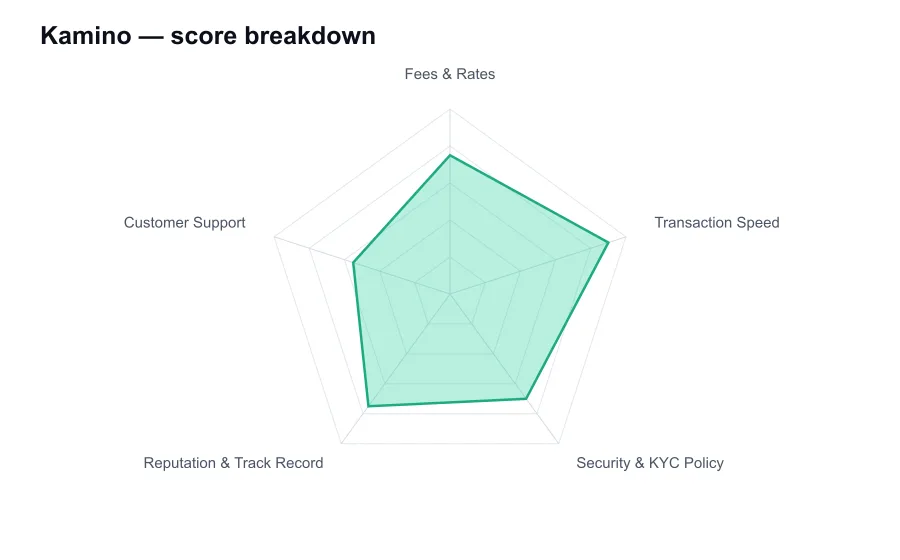
My final view is positive but strict. Kamino is one of the more substantial DeFi applications in the Solana ecosystem, with fast execution, self-custody, and genuinely useful lending and liquidity tools. It earns a respectable reputation score for that, while security cannot score like a regulated custodian because smart-contract and liquidation risk remain fundamental. Skilled users may find it excellent. Everyone else should learn with a wallet containing small amounts, or choose a simpler regulated platform.