Trocador is a crypto exchange aggregator with a clear identity: it is built for users who want to compare instant swap providers, preserve as much privacy as possible, and avoid creating an account at a large centralized exchange. Rather than operating like a conventional order-book exchange, Trocador presents offers from third-party exchangers and routes the user to the selected service. Its positioning is especially popular with Bitcoin and Monero users who care about self-custody and minimal data collection.
That model is important because Trocador is not the same thing as the underlying swap provider. It can improve discovery, compare rates, and offer tools such as its refund feature, but the actual conversion is generally performed by a partner service. If a user selects an offer from ChangeNOW, Exolix, FixedFloat, or another listed provider, that provider's liquidity, AML rules, wallet availability, and processing speed still matter. Trocador reduces search friction. It does not eliminate third-party risk.
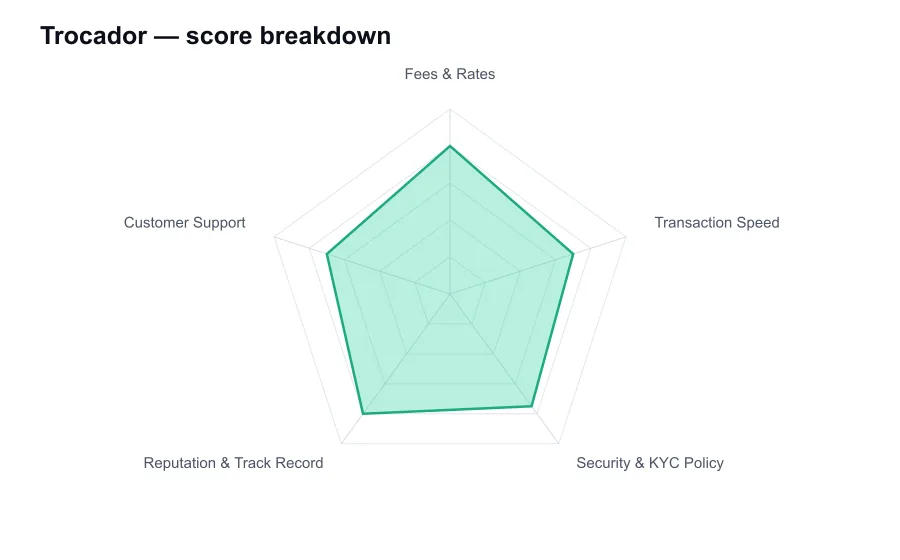
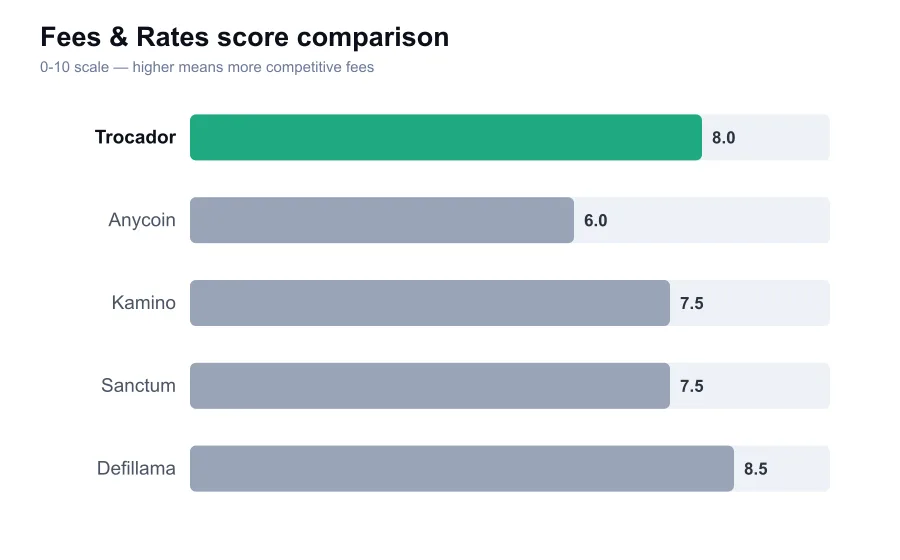
Its fee approach is more transparent than many instant swap sites. Trocador has historically stated that it takes a 0.5% fee from the exchange partner rather than adding a separate fee on top of the user's displayed rate. The practical result is that the quoted amount should already reflect the economics of the selected offer. That is a decent model, but users should still compare output amounts because each partner uses different spreads, liquidity sources, and network-fee assumptions.
The best use of Trocador is not blindly choosing the first offer. Look at the rate type, minimum and maximum order amount, estimated time, provider name, and payout details. A fixed-rate offer can be preferable if market movement worries you, while a floating rate can offer a better initial quote but change during confirmation. The aggregator makes this comparison easier than opening several websites, and that alone is a meaningful advantage.
For liquid pairs, Trocador can be competitive. It often gives users access to several exchange quotes without requiring them to surrender custody to a centralized account for days or weeks. The economics are usually better understood as a final-output comparison than as a flat-fee comparison. If one provider delivers 0.024 BTC and another delivers 0.0236 BTC for the same deposit, the first is cheaper for that transaction, regardless of whichever provider advertises the lowest percentage.
The platform's speed is usually good for ordinary exchanges, but the word instant needs restraint. A Litecoin, Bitcoin, or Monero swap has to wait for deposit confirmations, the partner has to process the order, and the outbound network has to confirm. A quick route may complete in ten to thirty minutes. Bitcoin and busy-network transactions can take longer. If the chosen provider flags the trade for review, the delay may become far more significant.
Trocador's privacy-first stance is a genuine differentiator. It does not require an account for normal use, and it has openly appealed to users who dislike the pervasive surveillance model of large centralized exchanges. That is appealing, particularly to people who use self-custody and do not want to build a permanent trading profile. But it must not be marketed as a guarantee that every transaction will remain verification-free.
The underlying providers can have their own AML systems and may request KYC in exceptional cases. Trocador has also had to navigate the difficult relationship between privacy coins and regulated liquidity providers. A user exchanging Monero should be especially careful to check the exact partner and terms. The sensible interpretation is no routine account KYC at the aggregator level, not immunity from compliance controls further down the route.
Security is strong in one important respect: Trocador does not ask users to deposit funds into a standing custodial account. You control the sending wallet until you initiate the swap, and you can receive the output directly to your own wallet. That sharply reduces the risk of leaving a long-term balance on an exchange. It does not remove the temporary counterparty exposure that exists after you send coins to a partner deposit address.
The platform's optional Protect feature is among its most interesting additions. It is designed to help users obtain a refund if a partner fails to complete a transaction, subject to its terms and the circumstances of the order. This is better than an aggregator simply pointing at a third party and washing its hands of any dispute. Still, users should read the current conditions before treating it as insurance. A refund process can take time, and a wrong address or a prohibited transaction type may not be covered.
Trocador has earned a comparatively solid reputation in the privacy-oriented crypto community. It has been operating for years, is frequently discussed alongside other non-custodial swap tools, and has developed a recognizable brand beyond a single promotional campaign. Its public reputation is not identical to regulatory assurance. It is not a publicly audited bank, and it should not be confused with a licensed custodial exchange. Yet it has considerably more community recognition than an anonymous one-page exchanger.
The Monero-friendly identity is both a strength and a source of controversy. For privacy advocates, supporting XMR and helping users find exchange routes is a practical service. For users who prioritize regulated access, institutional reporting, and guaranteed fiat rails, it signals that Trocador is not aimed at them. The company knows its audience, and that focus makes the product better for that audience than a generic exchange trying to please everyone.
Support is better than the bare-minimum standard common among aggregators. Trocador provides support channels and has a visible interest in helping users navigate partner problems, particularly where Protect applies. Still, a complex dispute may involve the selected exchanger, blockchain confirmation evidence, and compliance questions. That is inherently slower than a simple password reset at a centralized exchange. Keep your order ID, deposit transaction hash, payout address, and screenshots until the exchange is complete.
The interface is functional rather than flashy, which suits the product. It makes it easy to select assets, compare providers, and review the offer. The main danger is user impatience. Do not close the order page without recording details, do not send a different asset than the order requests, and do not use a network the provider does not support. Most crypto swap disasters are operational mistakes, not sophisticated hacks.
Trocador is one of the better options for a self-custody user who wants to compare swap quotes while minimizing routine data collection. Its partner model means every trade still requires judgment, and its strongest privacy appeal should not encourage reckless assumptions about KYC or compliance delays. I would happily use it as a quote-discovery and routing tool for ordinary amounts, particularly for common crypto-to-crypto swaps. For fiat purchases, institutional use, or a transaction that cannot tolerate any delay, a regulated exchange is the more appropriate choice.