DefiLlama is best known as the crypto market's independent dashboard for total value locked, chains, bridges, yields, stablecoins and protocol revenue. It is not a conventional exchange that takes custody of customer balances. Its Swap function is better understood as an interface and route finder for on-chain trading. That distinction matters because a user judging DefiLlama by the standards of Binance or Kraken will miss both its strengths and its limits.
The main site earned its audience by making DeFi data easier to inspect without charging visitors for basic access. You can compare protocol TVL, identify where a token is deployed, look at chain activity and inspect yield opportunities. Its willingness to surface data rather than push a house token gives it a credibility that many competing dashboards lack. The product is utilitarian, sometimes almost austere, but that is part of the appeal.
DefiLlama Swap plugs into decentralized liquidity instead of maintaining a proprietary order book. It sources routes from aggregators and decentralized exchanges, with available routes changing by network and token. You connect a wallet, request a quote and sign the transaction yourself. DefiLlama generally does not become the long-term custodian of the funds. That setup is a meaningful advantage for users who want transparency and control.
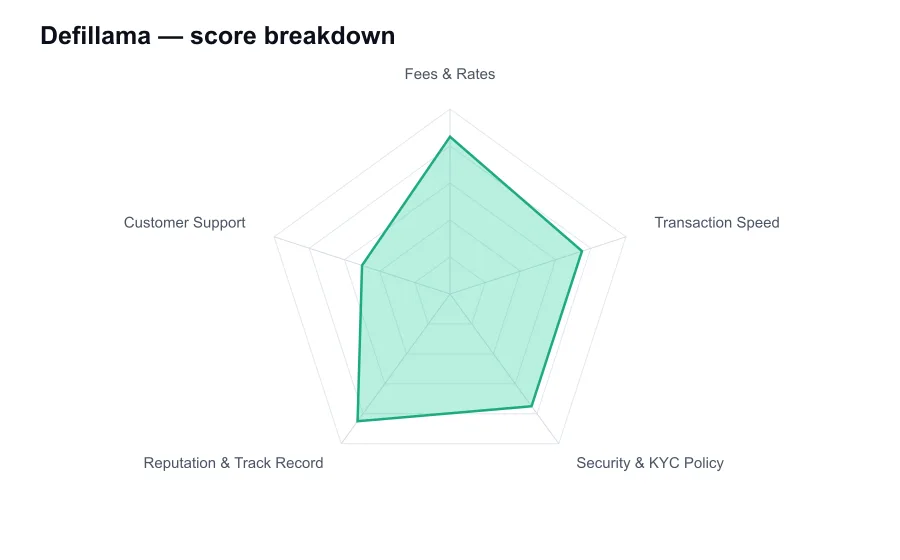
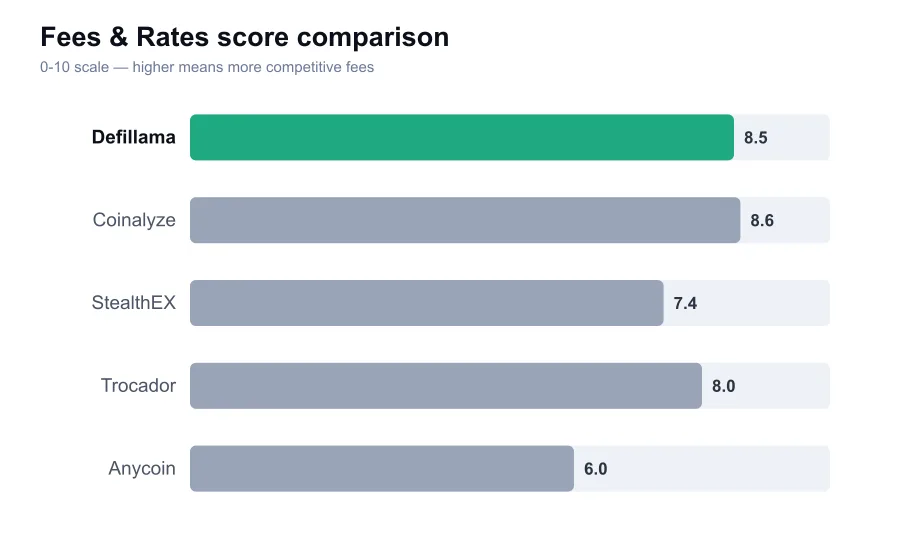
The cost story is good, though it needs to be described carefully. DefiLlama Swap has promoted a no-interface-fee approach, meaning it does not ordinarily add a visible platform toll to the quote. That does not make trades free. Users still pay blockchain gas, liquidity provider fees, possible aggregator fees embedded in a route and the price impact caused by the market. A zero platform fee is valuable, but only the final received amount tells the truth.
For a common token pair on a low-cost network, the resulting quote can be excellent because the tool is built to compare routing sources instead of forcing a user into one venue. It can save time versus opening several DEX tabs. But sophisticated traders should not assume that one quote engine always wins. 1inch, Matcha, Odos, Cow Swap and direct DEX routes can each outperform in particular conditions, especially for large orders or unusual assets.
Speed is similarly not really a DefiLlama-controlled measure. The interface can produce a quote quickly, then the transaction lands according to the network's block times, gas conditions and the route's contract calls. A simple Base or Arbitrum swap may confirm quickly. An Ethereum mainnet transaction at a low gas setting can sit for a while, and a multi-step route may require more gas than a direct pool trade. There is no internal balance system that gives instant off-chain settlement.
The strongest security feature is its non-custodial model. DefiLlama does not ask users to deposit coins into a centralized hot wallet or hand over a private key. There is usually no account creation or KYC for simply using its public data tools and connecting a wallet to swap. That privacy is useful, but users should not confuse no-KYC with risk-free trading. Wallet approvals, malicious token contracts, fake domains and weak routes are all part of the DeFi threat model.
A careful user should inspect the transaction in the wallet, verify the domain, and be especially wary of obscure tokens whose names mimic established assets. Token approvals should be limited where the wallet allows it, then revoked when no longer needed. DefiLlama can provide intelligent routing, but it cannot determine whether a token you chose is a scam, whether a stablecoin will hold its peg or whether a newly deployed pool is safe. Those decisions remain yours.
Its reputation is unusually strong for a data-focused DeFi brand. DefiLlama has become a default reference source for researchers, protocol teams and crypto journalists since launching in 2020. The team has also emphasized open-source development and a no-token stance, which has helped it avoid some of the conflicts that damage analytics platforms. There was a public governance dispute in 2023 involving an attempted token launch, but the core team and site continued operating and the episode reinforced why independence matters to its audience.
The data itself should still be treated as a research starting point, not scripture. TVL can be inflated by recursive collateral, incentives or token price movements. Yield figures can change faster than a dashboard refresh cycle. Protocol labels and chain data require judgment. DefiLlama is better than blindly trusting promotional material, but intelligent use means opening the underlying protocol documentation and contracts before committing capital.
Support is modest. The project has documentation, social channels and community contact points, but it does not resemble a regulated broker with telephone support and a formal complaints process. If a connected wallet transaction fails or gets sandwiched, there may be no person who can intervene. This is normal for a non-custodial interface, though it is frustrating for retail users accustomed to account-level customer service.
One area where DefiLlama shines is discovery. It makes it easier to see whether a chain or protocol has meaningful liquidity before trading there. Its stablecoin pages, bridge comparisons and yield listings can prevent a user from operating with tunnel vision. I would rather see a newcomer use DefiLlama to investigate a protocol than rely on a paid influencer's screenshot. The site rewards skeptical browsing.
It is less useful for someone whose first need is to buy crypto with a debit card, convert cash into a bank balance, or obtain tax statements from a custodial account. DefiLlama does not solve fiat onboarding. It also does not eliminate the need for a compatible wallet, native gas token and basic knowledge of networks. The slickness of the Swap page should not hide that operational burden.
For on-chain users, the lack of a house fee and broad market context make DefiLlama Swap a smart tool to keep in the toolbox. I would not use it as the sole source of truth for a very large trade, where direct RFQ services and multiple independent quotes are sensible. But for normal self-custody swaps, it provides a clean route into decentralized liquidity without trying to capture users in a closed ecosystem.
My take is that DefiLlama's greatest product is trust earned through useful information, not the swap widget alone. Its trading function benefits from that reputation, but it inherits every risk of DeFi routing and blockchain settlement. Use it if you are comfortable reading a quote, signing your own transactions and checking the underlying token. If you want custody, reimbursements and a human support team, this is simply the wrong category of service.