StealthEX is a non-custodial instant crypto exchange built for people who want to swap assets without opening a traditional trading account. It sits in the same broad category as ChangeNOW, SimpleSwap, LetsExchange, and SwapSpace, not in the category of full-service exchanges such as Kraken or Binance. You select a pair, provide a receiving address, send the deposit, and StealthEX routes the trade through its liquidity network. It is a practical product for occasional conversions, especially for users who keep coins in self-custody.
The service's strongest selling point is that it removes a lot of account friction. There is usually no registration screen, no custodial wallet dashboard, and no need to leave a balance sitting with the company. That is genuinely useful for a person swapping BTC into ETH, or exchanging a smaller altcoin without creating another exchange account. It also means users retain responsibility for the address they enter. StealthEX cannot rescue a transaction sent to an incorrect address or the wrong network simply because the interface felt simple.
StealthEX supports a large list of coins and tokens, which is more valuable than it sounds. Smaller assets often have poor liquidity on major regulated exchanges, and finding a route between two niche assets can be tedious. The platform can make those swaps accessible in one screen. Still, a long asset list should not be confused with equal quality across every pair. Deep BTC, ETH, USDT, and USDC routes are usually the sensible use case. Thin tokens, obscure networks, and brand-new assets can produce weak rates or longer processing times.
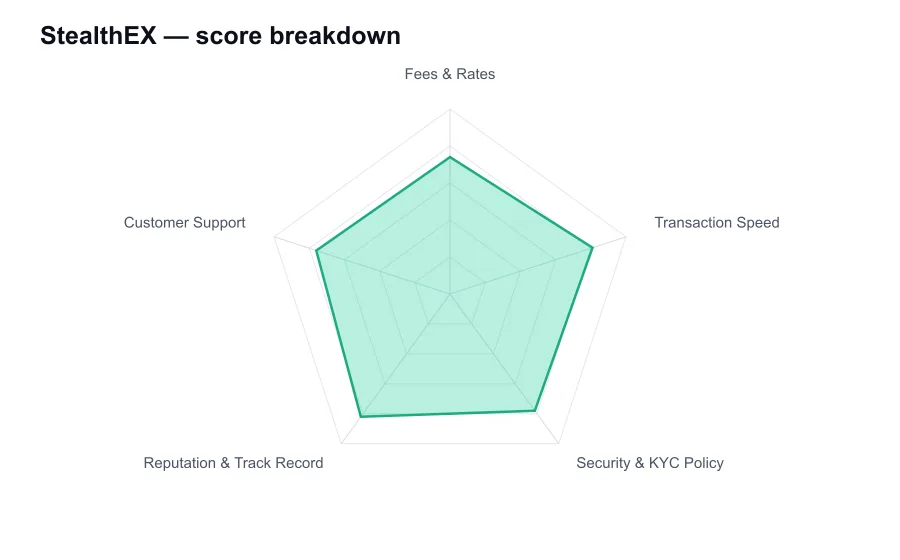
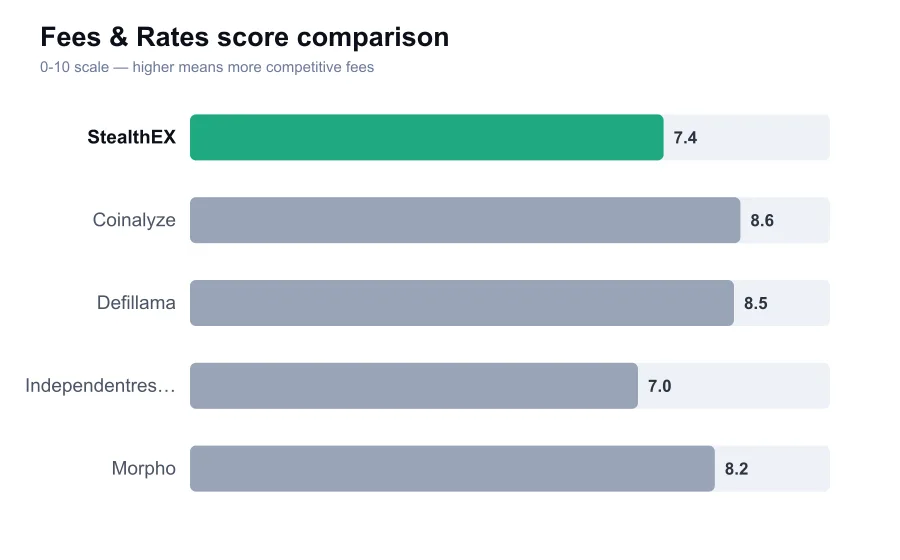
Its fee presentation is reasonable but not perfect. StealthEX states that its service fee is included in the quoted exchange rate, and the platform has generally described a variable fee model that can include a percentage service charge and partner liquidity costs. The exact cost is therefore not best judged by a headline number. The only figure that matters is the amount you will receive, after the provider's margin and network costs. This is standard in the instant-swap market, but users should stop calling it fee-free just because no separate line item appears.
On common pairs, StealthEX is often competitive, though it is not reliably the cheapest quote every time. A centralised exchange can normally beat it if you are willing to deposit, trade on an order book, and withdraw later. For a straightforward wallet-to-wallet exchange, however, the premium can be fair payment for convenience and reduced account exposure. I recommend comparing at least two instant-exchange quotes. The difference can be surprisingly large during volatile periods, particularly where a fixed-rate quote is unavailable or a token's liquidity is fragmented.
The platform offers both floating and fixed-rate transaction options for supported pairs. Floating rate swaps settle at the market rate available during processing, so the final amount can move if prices jump between deposit and execution. Fixed rate swaps aim to lock the output for a limited period, but the deposit must arrive within the stated window and meet the requested amount. Fixed quotes are useful for a payment or a time-sensitive rebalance, but they are not magic. Network fees, late deposits, and major market movement can still complicate an order.
Speed is good by instant-swap standards, although the word instant needs context. A Litecoin or Polygon transaction can move quickly once confirmed. Bitcoin deposits may require more time, especially during congestion, and swaps involving several liquidity hops can take longer again. In ordinary conditions, many common conversions complete within roughly five to thirty minutes after the incoming transfer has the required confirmations. That is convenient, but it will never match an internal trade on a funded centralised exchange.
StealthEX does a better job than many tiny swap sites of providing transaction tracking and visible order information. You should still record the order ID, deposit address, receiving address, and blockchain transaction hash immediately. If an order appears delayed, those details make support much more effective. The provider cannot accelerate a congested blockchain, but it can tell the difference between waiting for confirmations, a liquidity-side delay, a wrong deposit amount, and a transaction that needs review. Clear status information is one of the reasons I rate StealthEX above lesser-known clones.
The non-custodial label needs a little precision. StealthEX does not operate like a custodial exchange account where you park funds, but it necessarily receives the input coins during execution. That means users are trusting the service and its partners for the period of the swap. It is safer than leaving a casual balance on an exchange, yet it is not equivalent to a trustless on-chain atomic swap. The distinction matters most for large amounts, where a user should prefer established venues, split transactions, or use a method with deeper controls.
StealthEX generally allows swaps without routine KYC, which is a major reason users choose it. Its terms also reserve the right to request verification or additional information where risk controls, sanctions screening, or suspicious activity policies require it. That is not unusual and should not be portrayed as a bait-and-switch. The real test is whether a provider has a clear process for a paused transaction and a documented refund path if verification is declined. StealthEX's compliance posture is more credible than an anonymous site pretending regulations do not exist, though it remains less predictable than a fully verified exchange account.
Reputation is one of StealthEX's better areas. It has operated for years, has a recognisable presence in the instant-exchange market, and has built integrations and affiliate visibility across crypto media. That does not make every complaint invalid. Like every swap provider, it has users unhappy about changed floating rates, delayed orders, or compliance holds. But there is a meaningful public history to inspect, which is far more reassuring than a brand with a few months of reviews and no named operational footprint.
Support is available around the clock through live chat and email channels, and the service's team is visibly active enough that delayed-order cases can often be escalated. The quality is best described as solid rather than exceptional. Routine questions and transaction lookups are usually the kind of work chat can handle well. Complex disputes involving an exchange partner, a flagged transfer, or a refund can take time, and users should not expect the concierge treatment of a private banking desk. Still, it is materially better than the silence users encounter at many low-cost swap sites.
There are a few habits that make StealthEX far safer to use. Send a test transaction on a new pair or network. Check whether you chose fixed or floating rate before paying. Never send a token on a chain different from the quoted deposit chain, even if the wallet shows a similar ticker. Finally, make sure the receiving wallet supports the asset and network. A successful swap into an unsupported wallet is still a costly mistake.
StealthEX is best for self-custody users who need a relatively quick conversion and value a broad asset selection more than the absolute lowest trading cost. It is not the platform for active traders, people converting large institutional sums, or anyone who needs advanced limit orders and formal account statements. For those users, a liquid regulated exchange remains the stronger choice. For normal wallet-to-wallet swaps, StealthEX has earned a place on the shortlist.
My take is positive, with the usual instant-exchange caution attached. StealthEX has enough history, functionality, and support visibility to be taken seriously, and its fixed-rate option can be genuinely useful. Its pricing is not transparent in the way an order book is transparent, so comparing quotes remains mandatory. Use it for convenience, not as a place to store money, and keep large transfers within a risk level you can tolerate.