Morpho is not an instant exchange in the usual sense. It is a decentralized finance lending protocol, best known for building more efficient lending markets around established liquidity layers and, more recently, for Morpho Blue's permissionless market architecture. That distinction matters. If you arrive expecting a simple place to swap dollars for Bitcoin, you are in the wrong place. Morpho is for onchain users who understand collateral, borrowing, lending, and smart-contract risk.
Its position in DeFi is unusually interesting because it does not try to replace every existing money market with a closed garden. Earlier Morpho products optimized matching around protocols such as Aave and Compound, while Morpho Blue lets anyone create isolated lending markets defined by a collateral asset, loan asset, oracle, interest-rate model, and loan-to-value parameter. The design is lean, modular, and deliberately closer to financial infrastructure than a consumer exchange.
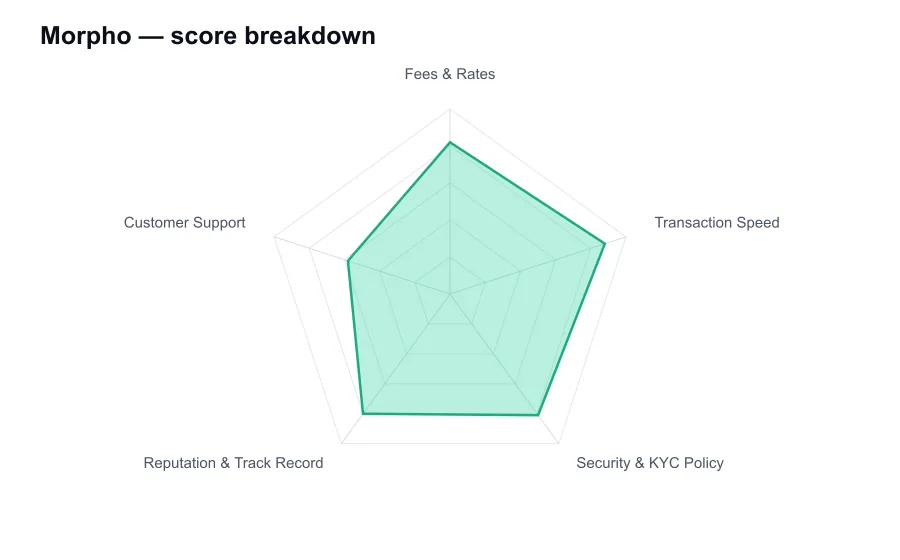
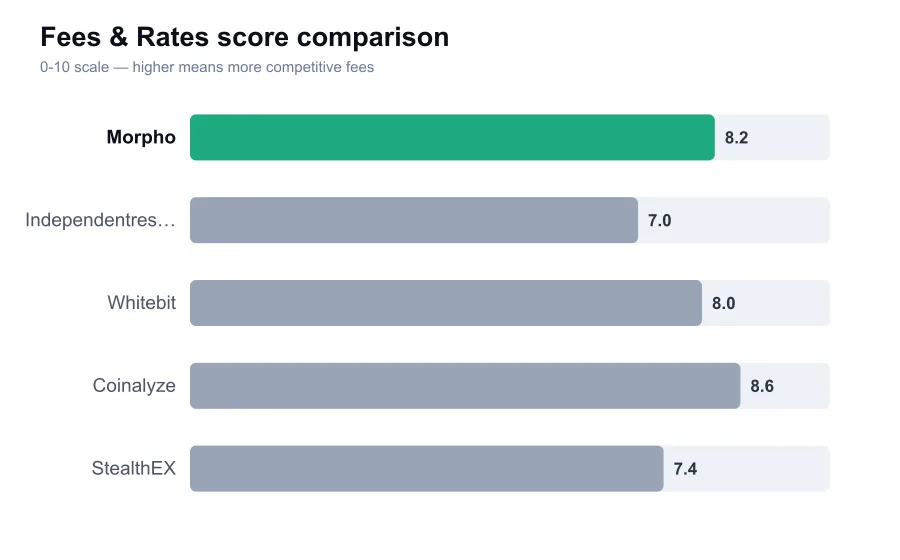
Fees are not a single number at Morpho, and that is one reason careless comparisons are misleading. Borrowing rates are market-specific and change with utilization and the selected interest-rate model. A lender's return is likewise market-specific. Users also pay blockchain gas, which can be minor on lower-cost networks or painfully relevant during congestion. There is no simple platform-wide trading fee to place beside a centralized exchange schedule.
Morpho Blue's core protocol was designed with a minimal structure and does not impose a universal protocol fee in the way some lending protocols do, though interfaces, vault operators, or integrations can introduce their own economics. That can make the protocol capital efficient. It does not make borrowing free. The rate a borrower pays is the central cost, and it can shift rapidly when a market becomes heavily utilized.
For lenders, the attractive headline is often a higher yield than a broad pooled market. Higher yield should never be read as a free upgrade. A specific vault or market can earn more because it accepts a different collateral mix, has less liquidity, takes oracle exposure, or is managed with more aggressive parameters. The right comparison is risk-adjusted yield, not the largest percentage displayed in an interface.
Speed is one of Morpho's strongest characteristics at the transaction level. A borrow, repay, supply, withdrawal, or collateral adjustment settles according to the underlying network's block times. On Ethereum mainnet, confirmation is often measured in seconds to minutes, while supported layer 2 environments can feel much faster and cheaper. There is no support desk waiting to approve an ordinary loan, no banking-day delay, and no conventional withdrawal queue.
But protocol settlement speed is not the same thing as being able to exit at any moment without friction. A lender can only withdraw available liquidity. If much of a market's assets are borrowed, immediate withdrawal capacity may be limited until borrowers repay or liquidity changes. That is standard money-market behavior, but it catches out users who equate a displayed deposit balance with cash sitting idle in an account.
Morpho's security model is technically serious. The protocol code has been subject to audits and has attracted attention from sophisticated DeFi participants, which is more meaningful than a generic security badge. The architecture also favors isolated markets, limiting the direct contagion between unrelated collateral and debt pairs. A problem in one market is not automatically a problem in every market, and that is a real design advantage.
Still, no DeFi protocol deserves the word safe without qualifications. Users face smart-contract risk, oracle risk, collateral volatility, liquidation risk, governance and interface risk, and plain wallet-security risk. Morpho does not hold your private key, which removes the centralized custodian failure mode. It also means nobody can reverse a bad approval, restore a lost seed phrase, or talk you through a liquidation after the fact.
The permissionless nature of Morpho Blue is both its technical achievement and its biggest practical hazard. Anyone can deploy a market with parameters that look plausible to a hurried user. The presence of a market on an interface is not proof that its oracle, interest-rate model, loan-to-value setting, or curator deserves trust. New users should stick to established, well-examined markets and reputable vault curators rather than chasing a newly launched yield figure.
KYC is generally not built into the protocol itself. A self-custody wallet can interact with public smart contracts without creating a conventional account. That is useful for global, composable finance, but it does not exempt users from laws in their jurisdiction. Front ends, wallet providers, fiat ramps, and regulated businesses can apply their own restrictions. It also means the user bears full responsibility for tax records and compliance decisions.
Morpho's reputation is strong within serious DeFi circles. It has drawn meaningful integrations, substantial onchain use, and attention from technically literate lenders and borrowers. That is a better reputation base than a fashionable token launch with little product depth. Yet its record should be judged as DeFi infrastructure, not as a deposit-taking bank. There is no government deposit insurance, no customer service guarantee, and no promise that the value of collateral will remain stable.
Support is decentralized in the literal sense. Documentation, community channels, interface guides, and ecosystem teams can be helpful, but they are not equivalent to calling a broker and demanding a case manager. The official protocol cannot simply freeze a transaction because a user made an error. This lack of hand-holding is a feature for users who value permissionless finance, and a severe weakness for people who need protection from themselves.
Morpho rewards competence. Before borrowing, users should calculate their health factor, understand the liquidation threshold, leave a meaningful buffer below the maximum loan-to-value ratio, and know which oracle prices their position. Before lending, they should investigate the market, the curator if a vault is involved, utilization, and withdrawal liquidity. Clicking the highest APY card is not analysis.
The product also works best for users who already live onchain. If your assets are sitting in a hardware-wallet-controlled Ethereum address and you understand signatures, gas, token approvals, and stablecoin risk, Morpho can be an elegant capital-management tool. If you are converting salary money into crypto for the first time, it is unnecessary complexity. A centralized exchange or regulated brokerage is the better starting point.
My take is that Morpho is one of the more compelling lending designs in DeFi, especially for users who appreciate isolated risk and permissionless market creation. Its speed, composability, and lack of protocol-level bureaucracy are genuine strengths. The same traits demand active risk management. Morpho is not a product to trust passively, it is infrastructure to use deliberately.