Coinalyze is not an exchange in the ordinary sense. It is a crypto market analytics platform that aggregates derivatives and spot-market data into charts, open interest views, funding-rate panels, liquidation information, long-short ratios, and related indicators. That makes it closer to TradingView, Coinglass, Velo Data, or an exchange's analytics page than to Coinbase, Kraken, or Binance. You do not open a Coinalyze account to deposit coins and execute a trade.
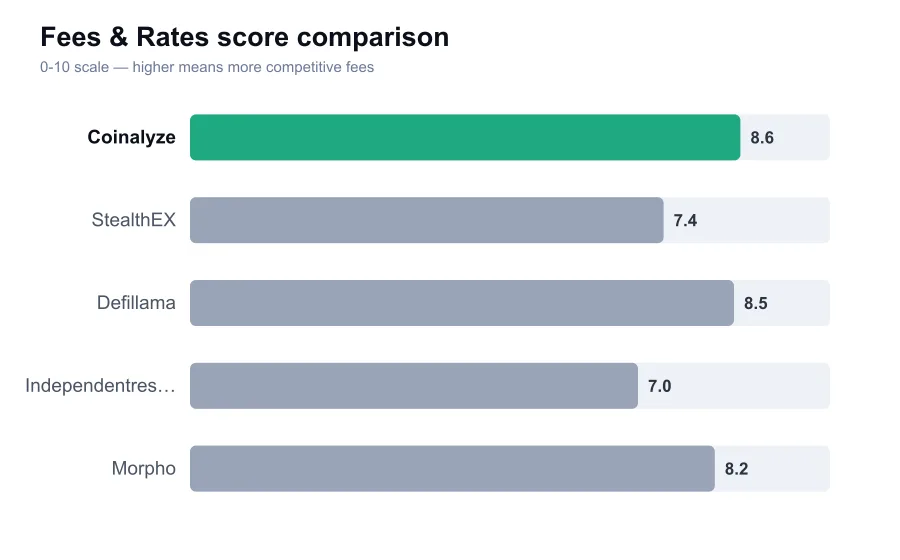
That category distinction should shape the review from the start. There is no conventional trade commission to assess, no maker-taker ladder, and no withdrawal network fee imposed by Coinalyze because the platform is not acting as the trading venue or custodian. A reader searching for the cheapest place to buy bitcoin will get no useful answer here. A trader seeking a compact way to inspect derivatives positioning might get considerable value.
For much of its accessible data and charting, Coinalyze has historically been unusually approachable. The free product is the attraction. Users can inspect aggregated metrics without the subscription barrier attached to many institutional-grade crypto-data products. That is a strong value proposition, especially for independent traders who need context beyond candles but do not need a Bloomberg Terminal substitute.
Free does not mean costless. The price is partly paid in limits, convenience trade-offs, and dependence on third-party data feeds. Advanced users should inspect current plan limits, API access conditions, alert options, historical depth, export availability, and commercial-use rules before designing a strategy around it. Crypto data tools change packaging frequently. A feature that is open today can become restricted, and a free dashboard is not a contractual market-data guarantee.
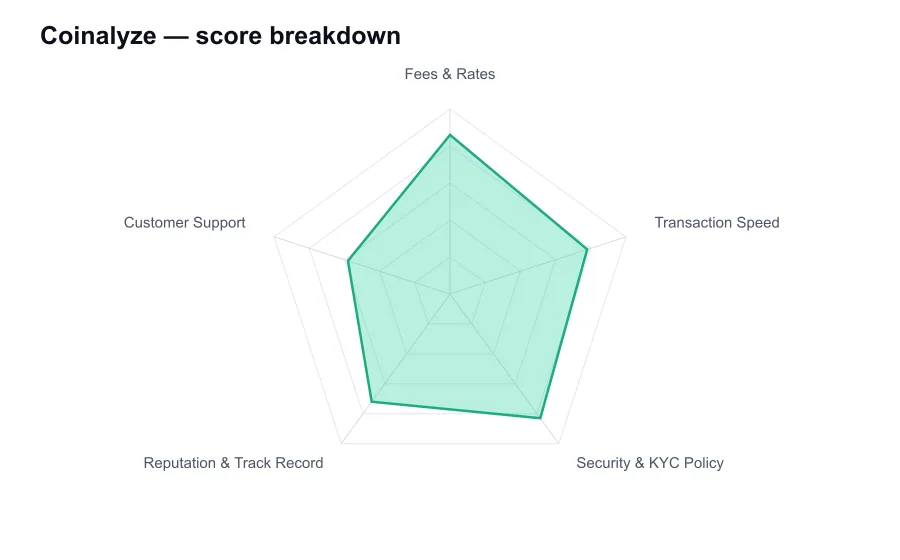
Speed is one of Coinalyze's more important qualities, but users need a realistic definition of it. The platform can display rapidly updating exchange-derived figures and is useful for watching broad changes in open interest, funding, and liquidation activity. It is not a direct exchange matching engine. It cannot make an order fill faster, nor can it remove latency between a signal appearing on a dashboard and an order reaching the exchange where the trader actually executes.
For discretionary traders, the interface is quick enough to be useful during a volatile session. A jump in open interest beside a price breakout, or funding moving to an extreme, can sharpen a trade thesis. It should not be mistaken for a self-contained trigger system. By the time a retail user sees a widely watched liquidation surge and clicks through to an exchange, the easy part of the move may already be over.
Data quality deserves more skepticism than many crypto traders apply. Open interest from separate venues is not perfectly interchangeable. Contract types differ, reporting schedules differ, symbols vary, and exchange-reported statistics are only as reliable as the source exchange. Aggregation is helpful, but aggregation does not magically turn heterogeneous data into ground truth. A serious user cross-checks surprising readings against the relevant exchange and more than one analytics provider.
Coinalyze's security posture is favorable precisely because it generally asks less of users. Browsing charts and market indicators does not require depositing funds or handing over private keys. That sharply lowers the catastrophic risk profile compared with a centralized exchange. There is no exchange wallet balance to freeze, no withdrawal whitelist to compromise, and no custodial insolvency exposure created merely by looking at a chart.
The flip side is that Coinalyze cannot protect the account where you actually trade. If you use its data to place trades on Bybit, Binance, OKX, Coinbase, or another venue, exchange account security remains your responsibility. Use a hardware-backed authenticator, unique credentials, withdrawal controls, anti-phishing codes where available, and a sensible limit on hot-wallet funds. Analytics can improve decisions, but it cannot repair poor exchange security.
KYC is not normally central to a public analytics workflow. That is a genuine advantage for privacy-conscious researchers who simply want to examine markets. It should not be confused with a promise of anonymity in every circumstance. Website logs, cookies, subscriptions, API services, and applicable legal requests all exist in the modern web environment. More importantly, avoiding KYC on a charting site says nothing about the identity requirements of the exchanges linked from it.
Coinalyze has earned a reasonable niche reputation among derivatives-focused crypto traders. It is not the loudest brand in the sector and it does not have the mainstream recognition of TradingView, but it has been around long enough to become familiar to people who follow funding and open-interest data. Its reputation is strongest as a functional specialist tool, not as a research institution producing deeply audited market intelligence.
Its presentation can also tempt users into false confidence. Open interest, liquidations, and long-short ratios are seductive because they look quantitative and precise. They are context, not instructions. High funding does not guarantee a short. Rising open interest does not guarantee continuation. A liquidation chart does not reveal every order waiting in the market. Traders who turn these signals into certainties will find the platform expensive in a way that never appears on its pricing page.
Support is adequate for a lightweight analytics product, but it is not the kind of white-glove service expected from a major broker or paid institutional vendor. Documentation, site feedback channels, and public updates matter more here than a 24-hour trading desk. If a chart feed appears stale, the user may have to diagnose whether the issue is local, platform-wide, or originating at the source exchange. That is tolerable for free research, less tolerable for a professional operation with money at risk.
My opinion is straightforward. Coinalyze is a useful adjunct for a trader who already has sound execution, risk management, and a healthy distrust of single indicators. It offers a lot without requiring custody or account verification. It is not an exchange, not a magic signal service, and not a replacement for primary exchange data. Use it as a fast market-context dashboard, then verify important observations before putting capital behind them.