Sanctum is not a conventional crypto exchange, and judging it as if it were Binance or Coinbase would miss the point. It is a Solana-native liquid staking infrastructure project built around making SOL staking positions more usable. Its central product, Sanctum Infinity, lets users move between supported liquid staking tokens, or LSTs, with far less friction than redeeming and restaking through each issuer separately. For a Solana user who already understands staking, this is useful plumbing. For somebody simply trying to buy Bitcoin with a card, it is the wrong tool entirely.
The pitch is straightforward. Solana has many LSTs, including JitoSOL, mSOL, bSOL, and smaller validator-linked tokens. Historically, each could trade at a different discount or premium, and switching from one to another meant accepting market liquidity, waiting for unstaking, or using a fragmented set of pools. Sanctum aggregates liquidity and creates a route between these assets. It has helped turn liquid staking from a niche DeFi activity into a more interchangeable part of the Solana ecosystem.
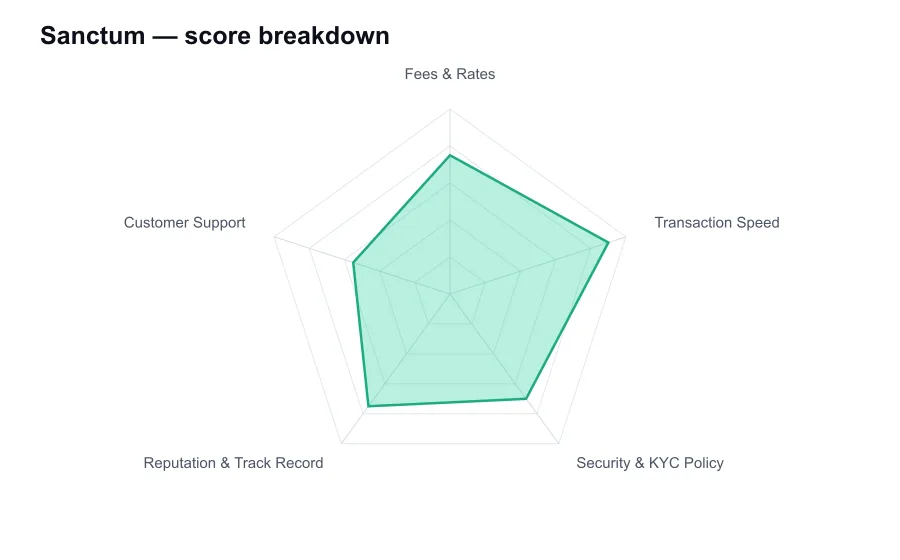
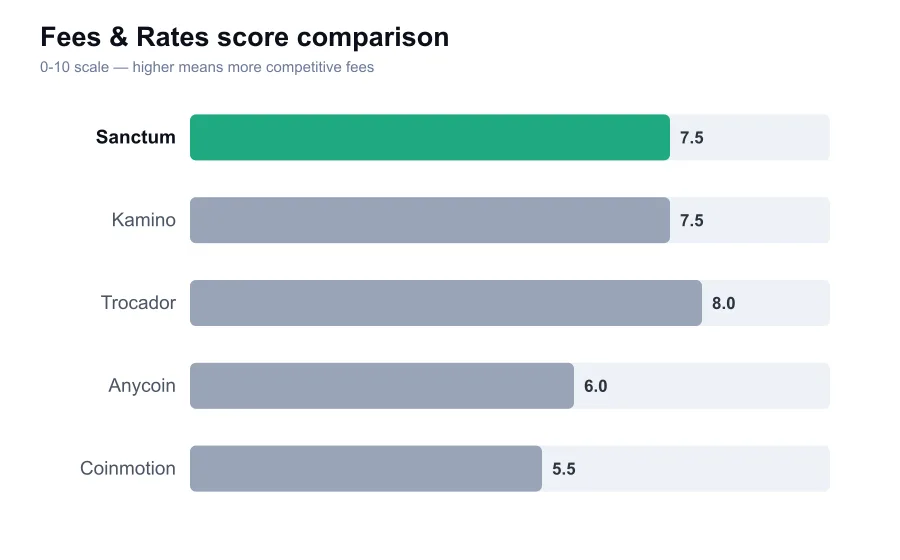
Fees are unusual here because there is no universal Sanctum trading fee that neatly fits in a comparison table. The cost a user sees depends on the action, the LST selected, available pool liquidity, the Solana network fee, and any spread built into the route. Instant unstaking is the area where users should pay closest attention. A redemption may be cheap in calm conditions, but the effective cost can increase as liquidity is used. Anyone claiming it is always free is oversimplifying the product.
That said, Sanctum can be materially cheaper than selling an LST through a thin decentralized exchange pool, particularly for supported assets with weak standalone liquidity. The protocol's design is meant to reduce the penalties involved in moving between staking positions. That is a real advantage for active Solana users. It is not necessarily cheaper than holding one LST for months and doing nothing, because the best fee is still the fee you never trigger.
The user experience is fast by blockchain standards. Solana transactions generally settle in seconds, and a successful swap or deposit through Sanctum feels close to immediate. There is no bank transfer leg, no order matching queue, and no multi-day withdrawal process. However, speed should not be confused with certainty. Wallet approvals, congestion, RPC failures, and a poorly configured wallet can still interrupt a transaction. DeFi remains self-service, even when the front end is polished.
The difference between an instant swap and a standard stake withdrawal matters. Native Solana staking has an activation and deactivation cycle tied to epochs, which can take days. Sanctum's liquidity routes can avoid that waiting period, but they cannot repeal the economics of liquidity. If a user needs SOL at a precise moment, they should inspect the quoted output before approving, rather than assuming an LST is always redeemable one for one.
Sanctum's security model is also very different from a custodial platform's. It does not ask for an email address, passport, or proof of residence for ordinary onchain use. Connect a compatible Solana wallet and interact directly with the protocol. That privacy is attractive, but it moves responsibility onto the user. There is no account recovery desk if a seed phrase is lost, and no support agent can reverse a transaction sent to the wrong address.
The protocol has undergone audits and works with established Solana infrastructure, but audits are not insurance. Smart contract risk, oracle or pricing risk, governance risk, malicious websites, and wallet-drainer scams all remain relevant. The larger the amount, the more I would favor a hardware wallet, a verified URL, and a small test transaction. Users should also understand the underlying LST they choose. Sanctum can improve access and liquidity, but it cannot make a weak validator operator or a risky LST issuer safe.
KYC-free access is one of Sanctum's clearest strengths, provided users understand what that means. It is permissionless DeFi, not an anonymous fiat on-ramp. There are no conventional fiat deposits or cash withdrawals, and local tax obligations do not disappear because a wallet was never verified. Institutions and users needing transaction reports, named account controls, or a regulated custodial relationship will find the model too bare bones.
Reputation is strong within Solana, though it is still a young protocol rather than a veteran financial institution. Sanctum gained prominence during the 2024 Solana liquid staking boom and built recognition around Infinity, its LST ecosystem, and the CLOUD token launch. Its team has been visible in Solana circles and the product has attracted meaningful integrations. That is encouraging, but the project has not yet earned the multi-cycle durability of a long-running venue such as Kraken or Coinbase.
The CLOUD launch also showed the less glamorous side of crypto markets. Incentive programs, points campaigns, airdrop expectations, and token volatility can bring in users who care more about rewards than the product. That can distort liquidity and community sentiment. Sanctum is more convincing as infrastructure for people who genuinely stake SOL than as a place to chase the next campaign.
Support is adequate for a DeFi protocol, not exceptional. Documentation, Discord, social channels, and community guidance are the main routes. Experienced Solana users will probably get what they need, especially for ordinary wallet and transaction questions. Beginners may find the support model frustrating because there is no traditional phone line, no account manager, and no guarantee of personal remediation after a bad transaction.
I like Sanctum for what it actually does. It gives Solana stakers a practical way to use and rotate liquid staking exposure without treating every LST as an isolated asset. The interface is substantially easier than assembling the same process manually through several pools. Still, this is a specialized DeFi product with specialized risks, not a universal exchange and not a savings account.
My view is that Sanctum deserves attention from serious Solana participants, especially those holding or comparing LSTs. Its speed and permissionless access are excellent, while the fee picture requires active checking rather than blind trust. Beginners who do not yet understand staking yield, slashing exposure, wallet security, and liquidity discounts should start simpler. For users who do understand those things, Sanctum is one of the more useful pieces of Solana infrastructure available.