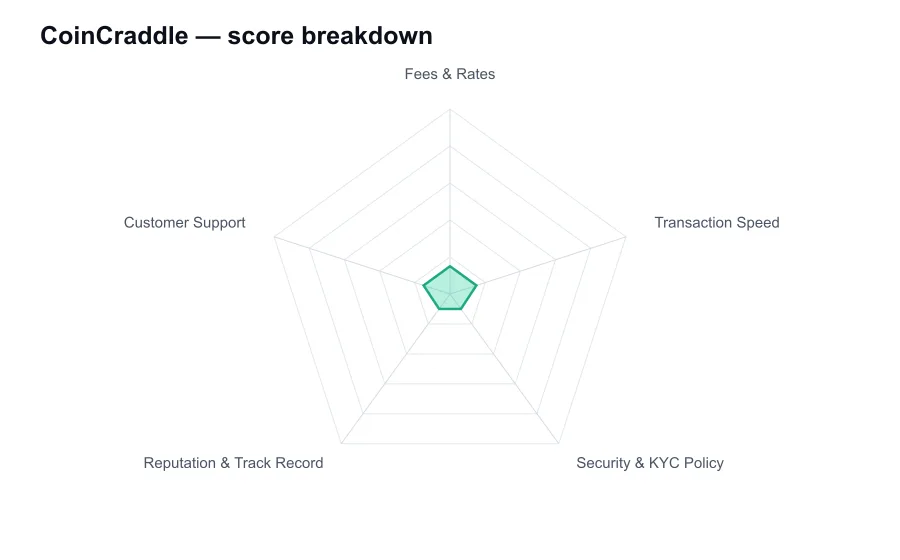
CoinCraddle is a name that raises an immediate due-diligence problem. I could not establish a sufficiently clear, independently verifiable operating profile for a crypto exchange or payment provider under that exact name. That does not prove wrongdoing. It does mean I would not treat it as comparable to established, documented platforms such as Kraken, Coinbase, Bitstamp, Binance, or even a recognized specialist analytics site. In crypto, an unclear identity is not a small inconvenience. It is a central risk factor.
A legitimate provider can be new, small, or poorly marketed. But it should still be possible to identify the legal entity, jurisdiction, terms of service, privacy policy, customer-support route, product scope, and a consistent official domain. If those basics cannot be confirmed through reliable sources, users should stop before creating an account, uploading identity documents, connecting a wallet, or sending a test deposit. The burden is on the provider to establish trust, not on customers to assume it.
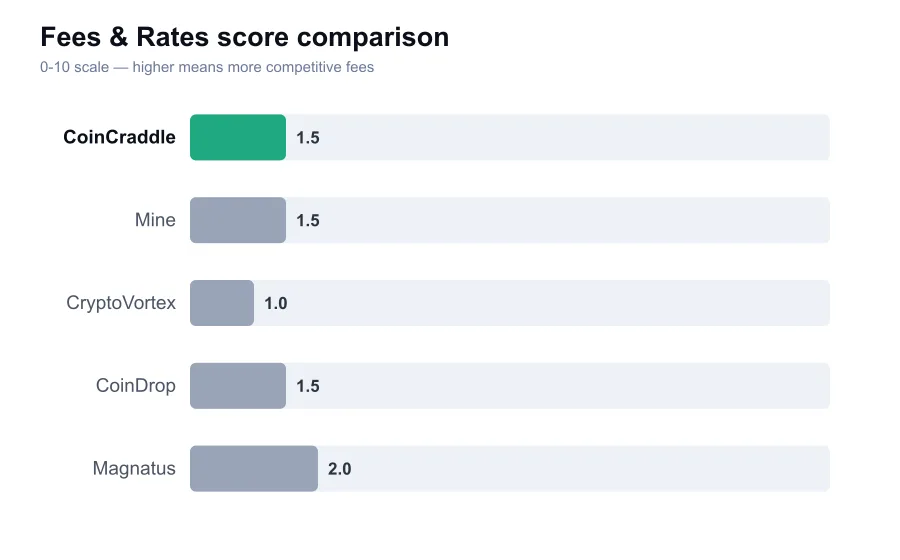
The most honest review of CoinCraddle is therefore not a conventional product comparison. There is no verified public fee schedule I can responsibly cite, no confirmed maker-taker rates, no demonstrated network withdrawal pricing, and no basis for claiming that its spreads are competitive. Any page advertising unusually cheap swaps, zero fees, or guaranteed returns should be read with particular caution. A zero-fee claim often hides a spread, and an implausibly generous claim can be a warning rather than a benefit.
Users should never fund an unclear crypto service based on screenshots or testimonials alone. Request a full fee table before depositing. It should explain trading fees, conversion spreads, deposit charges, withdrawal charges, minimum withdrawals, token-network availability, fiat fees, inactivity fees, and any cost triggered by account review. If the answer is vague, inconsistent, or sent only in a private chat, walk away. Reputable financial services do not need to conceal the economics of basic customer activity.
Speed cannot be scored generously either. A site can show a balance change immediately while a blockchain transfer remains pending, delayed, or unavailable for withdrawal. The only speed that matters for a crypto provider is observable execution and successful withdrawal to a wallet you control. Before trusting any service, users would need to test a very small deposit, perform a small trade if relevant, and withdraw the asset through the intended network. Even that is not proof that larger withdrawals will be handled reliably.
Do not let a polished interface substitute for evidence. Scam operations can build attractive dashboards quickly, display fabricated profit figures, and use support agents who respond rapidly until a customer attempts to withdraw. A functioning login page is not a measure of solvency. Neither is an account statement. Blockchain transactions, transparent wallet operations where applicable, verifiable company information, and a withdrawal record that the user personally controls are much more meaningful tests.
Security is where the absence of verified information becomes disqualifying. I cannot confirm CoinCraddle's custody design, cold-storage policy, penetration-testing practice, proof-of-reserves process, insurance coverage, incident history, two-factor authentication implementation, or withdrawal-address protections. A provider should not receive credit for security claims that cannot be audited or at least checked against coherent, public documentation.
The sensible assumption is not that CoinCraddle is secure or insecure. The sensible assumption is that its security is unproven. That may sound cautious, but crypto's history makes it necessary. Exchange failures, exit scams, phishing portals, fake recovery schemes, and withdrawal traps have repeatedly targeted users who deposited first and researched later. The downside is asymmetric. A trader gains little by trying an unverified venue, while losing a deposit can be permanent.
KYC is another area where ambiguity is dangerous. A legitimate exchange may require identity verification before trading or before withdrawals, and that is normal under anti-money-laundering rules. The concern is a service that collects passports, selfies, proof of address, and wallet details without a verifiable legal operator or data-protection framework. Handing sensitive identity documents to an unknown crypto brand can create a problem far beyond the value of an initial deposit.
No-KYC marketing is not automatically safer. It can appeal to users who value privacy, but it can also be used to avoid explaining who runs the business and what rules govern customer funds. Likewise, sudden demands for an extra tax, verification charge, account-unlock fee, liquidity fee, or security deposit before a withdrawal are serious danger signs. Legitimate exchanges deduct clearly disclosed charges from balances. They do not usually demand new crypto payments to release existing crypto.
Reputation cannot be built on an absence of criticism, because a little-known name may simply lack enough genuine users and independent coverage to generate a public record. What matters is whether third-party sources can consistently verify the business. Look for company-registration details that match the site, long-running public communications, credible media references, established executives, transparent terms, and user reports that are specific rather than copied promotional language. I could not verify a track record strong enough to support trust here.
Customer support is similarly impossible to rate as a dependable service without a documented channel and verifiable user experience. A Telegram handle, Discord direct message, or anonymous WhatsApp contact is not adequate support for a platform holding customer assets. Real providers publish official support procedures, security guidance, ticket systems, and clear warnings that staff will not ask for seed phrases. They also have escalation paths for account access, deposits, and withdrawals.
If someone has already interacted with CoinCraddle, the safest course is to avoid sending more funds. Do not provide seed phrases, remote computer access, or additional payments to unlock an account. Preserve transaction hashes, screenshots, email headers, chat records, deposit addresses, and payment receipts. If a withdrawal is possible, withdraw a small amount to a self-custodied wallet first. If there is a dispute, contact the relevant bank, card issuer, exchange, or local fraud-reporting authority promptly.
My view is blunt: CoinCraddle is not a provider I can recommend on the information that can be responsibly verified. That is not a claim that every unfamiliar name is fraudulent. It is a recognition that crypto providers must clear a high bar before users hand over money or identity data. Until CoinCraddle demonstrates transparent ownership, formal terms, independently checkable security practices, clear fees, and successful withdrawal credibility, the prudent score is low and the practical advice is to use an established alternative.