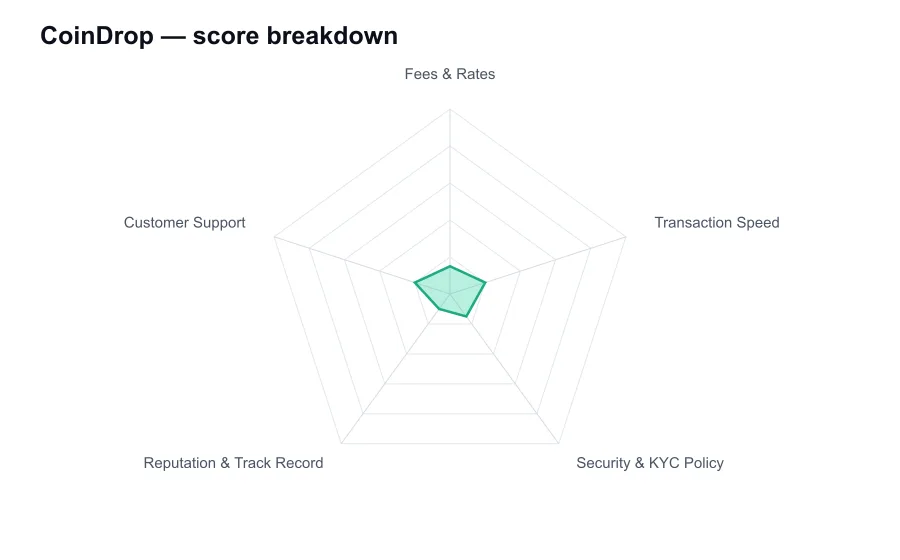
CoinDrop is a name that surfaces in crypto searches, social posts, and promotional listings, but it does not have the public footprint expected of a mature exchange or a clearly accountable brokerage. That matters more than a slick landing page or a promise of quick swaps. A financial service asking people to send irreversible assets needs a verifiable company, clear legal terms, operating history, and a support trail that can be checked independently. CoinDrop does not presently meet that standard of transparency.
The first practical problem is identity. I could not establish a consistently documented corporate entity, regulated operating company, or authoritative public record tying the CoinDrop name to a particular exchange business. Crypto has plenty of similarly named projects, apps, token giveaways, and abandoned domains. That makes it dangerously easy for a user to land on an unofficial site and assume it is the same service mentioned elsewhere. A provider cannot earn trust merely because its name sounds plausible.
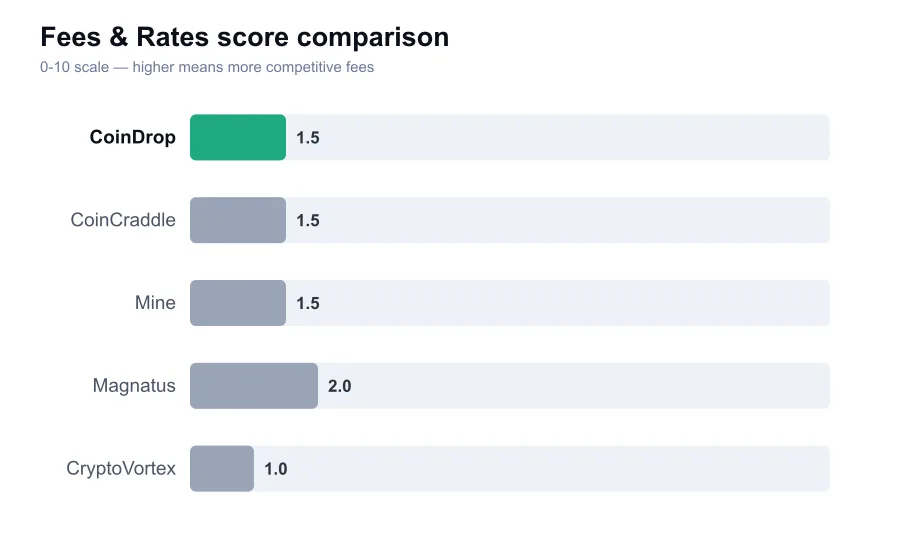
That uncertainty makes fee analysis difficult, and it should. Reliable exchanges publish a trading schedule, withdrawal charges, spread methodology, and conditions for card or bank payments. With CoinDrop, there is no dependable public fee schedule I would treat as authoritative. If a service displays a quote but does not spell out its spread, network fee treatment, and withdrawal terms before deposit, the effective cost can be far higher than the headline suggests. That is a poor starting point for any crypto purchase.
The most expensive fees in crypto are often not labeled fees. They show up as a weak exchange rate, a withdrawal that never clears, an unexplained account restriction, or a request for another payment to unlock funds. Established competitors such as Kraken, Coinbase, Bitstamp, and Coinmotion give users enough documentation to calculate at least the basic cost of a trade. CoinDrop's public information is not sufficiently stable or detailed to support the same calculation.
Speed claims should also be treated with skepticism. Blockchain transfers can settle quickly after a provider actually sends them, but the provider controls the crucial first step. A Bitcoin withdrawal might take an hour or several hours depending on mempool conditions and confirmation rules. An Ethereum transfer can be fast but expensive during congestion. None of that explains a platform holding a withdrawal in review for days without a clear case number, documented compliance reason, or an accessible escalation route.
A legitimate exchange can occasionally delay a transfer. Banks, sanctions screening, fraud controls, and wallet maintenance are real operational constraints. The difference is whether the company explains what happened, provides a realistic timeframe, and has a traceable support channel. CoinDrop does not provide enough independently verifiable evidence of those processes for me to credit it with a strong speed score. Fast deposits are not proof of fast withdrawals, and users should never confuse the two.
Security is where the lack of disclosure becomes most serious. I could not verify a published custody model, a named security team, third party penetration testing, proof of reserves, bug bounty coverage, or meaningful incident reporting. Not every good company publishes every defensive detail, but a serious custodian usually discloses basics such as two factor authentication, withdrawal confirmation controls, cold storage practices, and how customer assets are segregated. Silence leaves customers guessing.
KYC policy is similarly unclear. Some users see a vague promise of no verification as a benefit, but it can be a warning sign if the company also takes fiat deposits or holds customer balances. Regulated businesses must follow anti money laundering rules, and legitimate noncustodial services explain exactly what data they collect and when verification may be required. A provider that markets anonymity yet can freeze funds at will puts users in the worst possible position.
There is a recurring pattern worth recognizing. Questionable crypto operations often make the registration and deposit process feel simple, then introduce verification requests, tax charges, liquidity fees, or recovery payments after a user tries to withdraw. I am not asserting that every site using the CoinDrop name follows that pattern. I am saying the absence of independently verifiable governance makes it impossible to rule out, which is enough reason not to deposit meaningful money.
Reputation cannot be built from anonymous testimonials, affiliate pages, or promotional Telegram channels. The records I would want to see include a long running company presence, named executives, substantive independent reviews, app store history tied to the same operator, public responses to complaints, and ideally a regulatory registration where appropriate. CoinDrop does not offer a persuasive body of evidence on those points. It has no track record comparable with a recognizable exchange.
Customer support is another area where unknown providers can become costly. Before using any platform, try its support route with a specific question about withdrawal limits and expected processing times. A proper answer identifies the support channel, explains the policy, and does not steer the conversation to a private messaging account. If the only route is a chat widget, a personal Telegram contact, or an email address without a published company address behind it, walk away.
I would not use CoinDrop for trading, savings, card purchases, or a first crypto transaction. The risk is not just market volatility. It is the basic counterparty risk of sending funds to an operator whose ownership, terms, fees, and security controls cannot be adequately verified. A small test transfer does not solve that problem either, because fraudulent services often permit early small withdrawals to encourage larger deposits.
People seeking a simple purchase route have better options. In Europe, Coinmotion has a named Finnish operator and transparent onboarding. Kraken and Coinbase are imperfect but extensively documented. For users who only need to hold crypto, a reputable self custody wallet paired with a well known exchange is a safer structure than giving assets to an opaque service. Convenience is never worth losing the ability to identify who has your money.
My view is blunt. CoinDrop has not supplied the public evidence necessary to be treated as a credible exchange provider. Until there is a clearly verifiable official operator, full legal documentation, transparent pricing, established support history, and independently checkable security information, it belongs in the avoid category. Crypto users have enough unavoidable risks already. There is no sensible reason to add an unverified intermediary to the list.