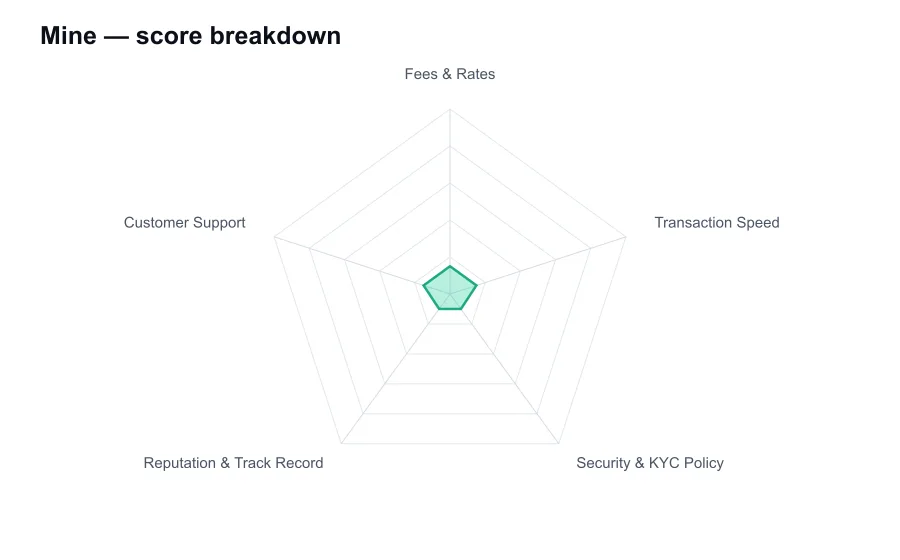
Mine is an unusually hard provider to assess because the name is so generic and the public crypto market has used it for multiple unrelated products, tokens, mining services, and applications. A responsible review cannot pretend that a search result identifies one clear exchange operator. I could not confidently link the name alone to a current, widely established trading venue with a verified legal entity, transparent ownership, and a durable public operating history. That ambiguity is itself a serious warning sign.
Users should be very careful not to confuse a project called Mine with MinePlex, a mining company, a token named MINE, or an unrelated mobile application. Impersonation thrives on generic names. Fraudulent sites often borrow familiar words, use search advertising, and mimic the visual language of legitimate exchanges. Before entering an email address, connecting a wallet, or sending a deposit, a user needs an independently confirmed official domain and evidence that the service is the one they intended to use.
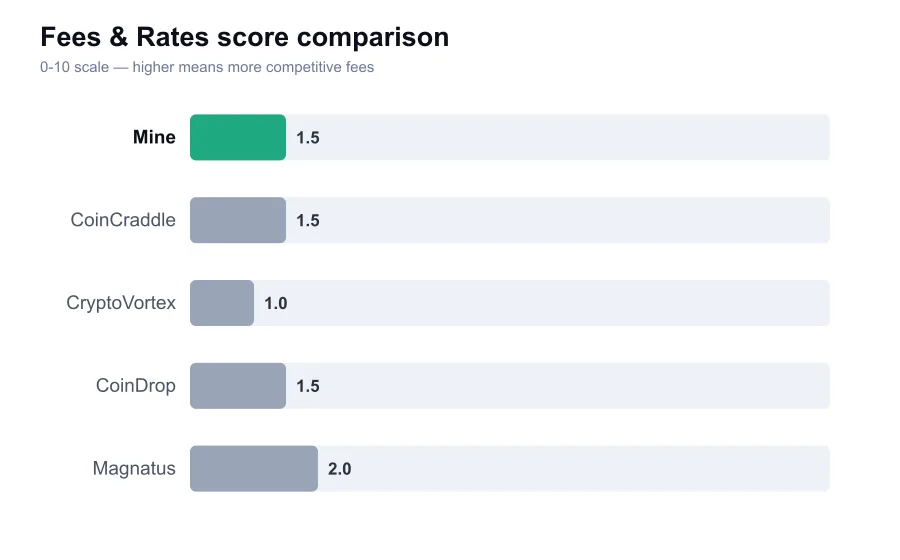
Because I cannot verify a definitive active exchange identity for Mine, I cannot responsibly assign it a positive fee rating. A claim of zero commission is not enough. Exchanges can recover revenue through wide buy and sell spreads, punitive withdrawals, unfavorable conversions, or restrictions that only surface at the point of cashing out. If a platform does not show a public trading fee table, a withdrawal-fee page, and clear spread disclosure, the advertised cost is not meaningful.
This is especially important for services that market simple crypto purchases. A new user might see a convenient card widget and assume the quoted price reflects the market. It often does not. Compare the final amount of bitcoin, ether, or stablecoins received against a quote from Kraken, Coinbase Advanced, or Binance where available. Include card charges and network withdrawal fees. A platform that cannot be compared clearly should not receive the benefit of the doubt.
Transaction speed is impossible to separate from reliability. Any website can display an immediate balance after a purchase request, but the customer needs to know when assets can actually leave the platform. A genuine exchange publishes deposit confirmations, maintenance notices, supported networks, minimums, and withdrawal status information. Mine does not have enough verifiable public operational evidence for me to say that a user can reliably deposit, trade, and withdraw on a predictable timetable.
The phrase instant withdrawal deserves particular skepticism. Blockchain confirmation times depend on the chain, but exchange processing is a separate decision. A platform can hold a withdrawal for fraud review, liquidity reasons, or simply because its wallet is unavailable. For a barely documented provider, a small test is the only sensible way to check execution, and even that test does not establish how the platform behaves under a large withdrawal or during market volatility.
Security disclosure is the weakest part of Mine's profile. I could not verify standard safeguards such as proof-of-reserves reporting, third-party audit information, published custody partners, named security leadership, a bug bounty, or detailed account protection features. Two-factor authentication is useful but insufficient on its own. What matters is whether customer funds are segregated, how keys are controlled, whether withdrawals have safeguards, and what happens if the operating company becomes insolvent.
A lack of public information also makes KYC policy hard to interpret. Some poorly documented crypto sites advertise no verification to attract users, then request identity documents when a withdrawal is attempted. Others collect personal data without explaining where it is stored or which company controls it. Neither approach is acceptable. A credible financial service should state its verification thresholds, prohibited jurisdictions, privacy policy, and account-review process before it accepts money.
Mine has no visible reputation comparable to long-running exchanges or even to recognizable niche DEXs. That does not prove misconduct, and a small startup should not be condemned merely for being small. It does mean the platform has not earned the trust premium that comes from years of successful withdrawals, public incident handling, regulatory visibility, and a large body of credible user feedback. Money should not be used to fill that evidence gap.
There is a tendency in crypto to treat a low-profile platform as an early discovery. Sometimes that instinct works with a new protocol that has open-source code, known builders, public audits, and active technical discussion. Mine does not present enough readily checkable material to fit that profile. A service handling deposits must meet a far higher standard than a speculative token website. It needs operational accountability, not just a polished landing page.
Support is likely to be the first painful issue if a user proceeds without due diligence. An exchange support system should offer a ticket trail, stated response expectations, secure document submission, and official announcements that cannot be easily spoofed. Social-media direct messages are not support. Telegram administrators who request seed phrases are scammers, without exception. Any provider that relies solely on informal channels creates unacceptable risk for users with frozen or missing funds.
There is no practical reason for a novice to choose Mine over a better documented alternative. Major exchanges have their own problems, including KYC friction and occasional support delays, but they offer identifiable operators, published pricing, clearer jurisdictional terms, and a much larger record to inspect. Self-custody users also have established DEX options with visible contracts and deep liquidity. Mine's information gap offers no compensating advantage.
If someone believes they have found a legitimate active Mine service, they should pause and verify every part of the claim. Check the domain against the company's official filings and verified social accounts, search for current withdrawal reports rather than old promotional reviews, inspect terms for the legal entity, and ask support a specific question before depositing. Do not install unverified software, share a seed phrase, or send a large amount to unlock a supposed account tier.
My assessment is severe because the cost of being wrong is high. Mine may refer to a legitimate service in a particular context, but the provider name by itself does not supply enough verifiable evidence to recommend a crypto exchange. The appropriate score reflects opacity, not a proven allegation of fraud. Until a clearly identified Mine operator establishes transparent fees, credible security practices, dependable support, and a public track record, users should avoid treating it as a place to hold or trade assets.