EasyBit is a non-custodial instant crypto exchange aimed at people who want to convert one coin into another without opening a trading account. It sits in the same broad market as ChangeNOW, SimpleSwap, Godex and LetsExchange. The proposition is straightforward, choose a pair, send the source asset, and receive the destination asset to your own wallet. That convenience is real, but it should not be confused with the precision and transparency of a full order-book exchange.
The service supports a broad list of cryptocurrencies and presents both floating-rate and fixed-rate exchange options for many pairs. Floating rate means the final amount can change with the market while the deposit is being confirmed and processed. Fixed rate is intended to lock a quoted output for a limited window, usually at a higher effective cost. For users who care about certainty during volatile conditions, the distinction matters more than the page's simple design suggests.
EasyBit's main advantage is avoiding account friction. A user does not normally need to create a username, submit a passport or leave a balance sitting on the platform. You supply a receiving address, send the coins and the exchange delivers the result after the swap is completed. That is attractive for people who value privacy or just dislike creating another custodial account. It also means there is no password reset route if you enter a bad receiving address.
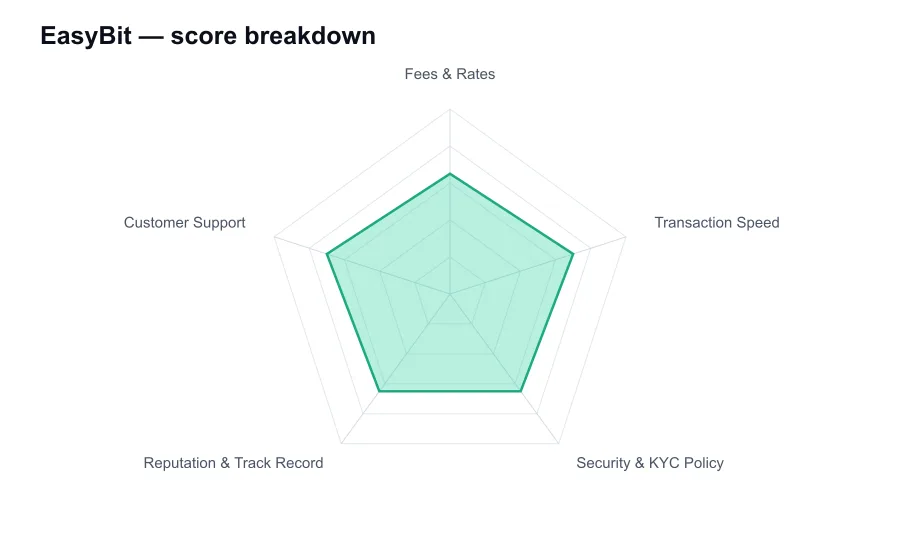
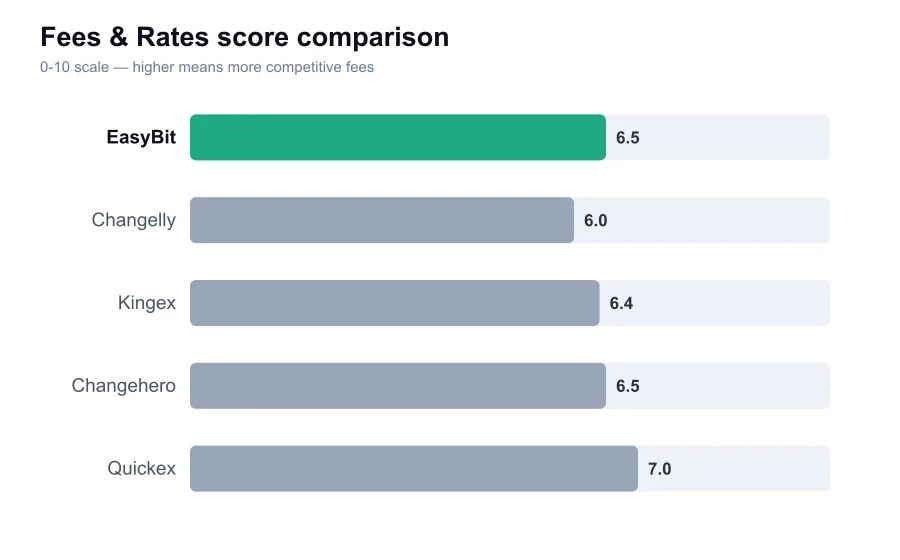
Fees are the weak point in this entire instant-exchange category, and EasyBit is no exception. The service may not present a clean, universal commission such as 0.1% on every trade. Its revenue is reflected in the exchange rate, along with liquidity-provider charges and network fees. That makes the effective cost pair-specific and sometimes hard to compare at a glance. The only number that matters is how much destination crypto reaches your wallet against the amount you send.
For small, urgent conversions, that spread can be an acceptable price for simplicity. For larger trades, it can be noticeably more expensive than using a liquid centralized exchange or a DEX aggregator. I would always obtain a quote from at least one competitor before sending anything substantial. EasyBit can be competitive on some routes, but there is no reason to assume it will win every time. A polished instant-exchange screen does not guarantee best execution.
Fixed-rate orders deserve extra attention. They can shield the customer from a sudden market move between the quote and execution, but fixed quotes usually build in a wider margin. They also come with deposit instructions and time limits. If the exact amount arrives late, arrives short after a sender-side fee, or is sent on the wrong network, the order may need manual handling. Read the deposit page rather than treating it like a normal wallet transfer.
Speed is generally good for a service of this type, though no honest reviewer can promise a fixed number of minutes. It depends on the inbound asset's confirmations, liquidity availability, blockchain congestion and the destination network. Common pairs can often complete after the deposit reaches the required confirmations. Bitcoin and other slower chains naturally take longer than a quick transfer on a low-fee network. During volatility, additional processing checks can also slow the experience.
EasyBit is non-custodial in the limited but important sense that it is not designed to hold a standing customer balance. During an exchange, however, it temporarily receives the source funds and relies on liquidity partners or its own execution processes to pay out the destination asset. That is different from directly swapping through an audited DEX contract from your wallet. You are trusting an operator to complete a conversion after you send funds, so counterparty risk does not disappear.
The platform advertises a no-registration and no-mandatory-KYC experience for ordinary swaps, but users should read that alongside its anti-money-laundering policy. Like most instant exchanges, EasyBit can request verification or source-of-funds information if automated monitoring flags a transaction. This is not necessarily improper, but it undermines the simplistic claim that every exchange is permanently anonymous. If a transaction is flagged, funds can be delayed while a review happens.
That policy creates a practical dilemma for privacy-focused users. It is better than submitting identity documents before every small conversion, but it is not equivalent to an unstoppable on-chain swap. Anyone moving coins from high-risk sources, using unusually large amounts, or expecting zero compliance screening should not assume the service will process the transaction without questions. The safest course is to use legitimately sourced funds and avoid sending an amount that would be financially painful to have delayed.
EasyBit has been around long enough to be more credible than a brand-new anonymous exchange page, and it has built a visible footprint in the instant-swap market. Still, its reputation is not on the level of a long-established regulated exchange, nor does it have the on-chain transparency of Curve. Public feedback for this type of provider is inherently mixed because users usually remember a smooth swap as routine but post urgently when a transaction needs support.
Customer support is one of the areas where EasyBit tries to compete. The site offers live chat and email-style assistance, and support can be genuinely useful for locating a transaction or clarifying a memo, tag or confirmation issue. The important limitation is that support cannot reverse a blockchain payment or recover coins sent to an incompatible address. Response quality also matters most in compliance reviews, which are exactly the cases where users tend to report the most frustration.
The interface is approachable, but newcomers must still understand networks. Sending USDT on Tron when the order expects USDT on Ethereum is not a minor typo. Some assets need destination tags or memos, and some wallet providers deduct fees that can make an exact deposit arrive short. Start with a modest test transfer for a new pair or a new receiving wallet. That habit is cheaper than learning through a five-figure mistake.
I would use EasyBit for occasional conversions between assets when I already hold crypto in self-custody and want a simple route without a permanent account. I would not use it as my default venue for active trading, price-sensitive large orders or fiat purchases. A deep exchange with limit orders is better for those jobs, even if it asks more of the user during onboarding.
EasyBit is competent within its niche, but its niche should be kept in perspective. It sells convenience, not necessarily the lowest possible spread or the strongest possible customer protections. The no-account flow, broad asset support and fixed-rate option are appealing. The opaque effective pricing and possibility of AML review are the cost of using an intermediary instant exchange. Compare quotes, send carefully and keep expectations realistic.