Swapuz is an instant cryptocurrency exchange service that targets the same user as StealthEX, ChangeNOW, SimpleSwap, and other no-account conversion platforms. It is not trying to replace a professional exchange terminal. Its job is narrower: let a user send one crypto asset and receive another in a personal wallet with as little sign-up friction as possible. That makes it attractive for occasional self-custody users, but it also means the customer has to evaluate the quote, the route, and the operator more carefully than they would on a visible order book.
The core workflow is refreshingly simple. Pick the asset you are sending, select what you want to receive, enter the destination address, and transfer the deposit to the address provided. Swapuz then executes the trade through its own liquidity arrangements and sends the output onward. There is usually no conventional balance to maintain and no need to trust the platform with funds after the trade is complete. For users who dislike leaving assets on centralised exchanges, that is a meaningful advantage.
Swapuz has built much of its appeal around broad asset coverage and an interface that does not intimidate newcomers. A large list of supported coins can be useful for moving between chains or dealing with assets that major exchanges do not list. Yet users should be selective. The best experience will normally be on liquid pairs such as BTC, ETH, USDT, USDC, SOL, LTC, and other widely traded assets. Exotic tokens can carry hidden costs through thin liquidity, wider spreads, or a route that relies on several conversions behind the scenes.
The provider offers floating-rate and, on supported routes, fixed-rate exchange choices. That distinction deserves more attention than most users give it. A floating rate can be the cheaper option in a calm market, but the received amount is determined during execution rather than frozen at the first screen. A fixed rate seeks to protect the quoted amount for a specified payment window. If you are sending a payment, rebalancing into a known target amount, or operating during sharp market movement, fixed-rate execution is usually the more sensible choice.
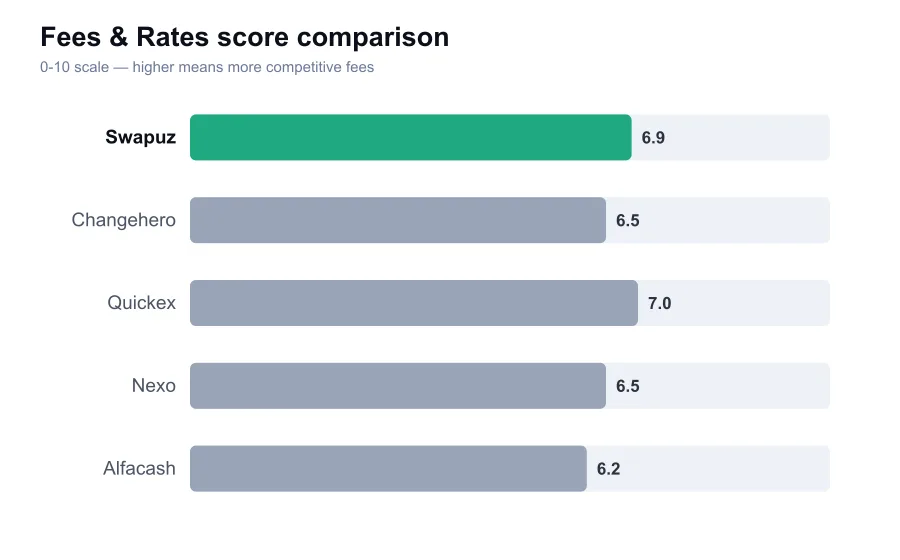
Fees at Swapuz are included in the exchange quote rather than handled like a transparent maker or taker schedule. That is normal for instant-exchange providers, but it creates a comparison problem. A platform can advertise a low service fee while offering a weaker effective rate, or it can produce a good final quote despite a visible charge. The only serious way to assess cost is to compare the estimated received amount for the same pair, amount, and rate type across several services at the same time. Do not compare a floating quote on one site with a fixed quote on another and assume the cheaper-looking number is equivalent.
Swapuz can be competitively priced on some routes, especially where its liquidity sources line up well with the asset pair. It is not consistently the lowest-cost option, and users should not expect it to beat a liquid spot exchange after all costs if they are willing to manage deposits and withdrawals. The premium is for speed of workflow and the absence of account management. For a $100 or $300 wallet conversion, that trade-off can be perfectly rational. For a five-figure trade, every fraction of a percent becomes meaningful and deeper venues generally deserve consideration.
Speed is usually adequate for the service type. Once the input transaction reaches the required confirmations, a liquid conversion may be processed and paid out in minutes. The total wait can be longer on Bitcoin, Ethereum during fee spikes, or token routes with multiple dependencies. Swapuz cannot eliminate blockchain confirmation time, and no legitimate service can promise otherwise. What it can do is communicate the stage of the order clearly. Its transaction pages and order information are useful, though I would still save every detail yourself before closing the browser.
There is an important difference between fast and predictable. A floating-rate swap may complete quickly but still deliver less than the opening estimate if the market turns. A fixed-rate transaction can provide more certainty but may fail to preserve that rate if the deposit arrives late or does not match the instructed amount. Users who are new to instant exchanges often blame the provider for conditions they accepted on the quote screen. Read the rate type, payment deadline, minimum, and maximum before sending. Those few seconds can save a frustrating support conversation.
Swapuz presents itself as a non-custodial service, and that is broadly accurate in the sense that it does not ask users to maintain a trading account or store a standing balance. Still, it is not a decentralised exchange in the strict sense. Your deposit enters a service-controlled execution process, often involving external liquidity providers, before the output arrives. That leaves counterparty risk for the duration of the swap. The model is safer than casually parking funds on a small exchange, but it is not the same as retaining cryptographic control at every stage.
KYC is generally not part of the ordinary onboarding flow, which will appeal to privacy-conscious users. As with reputable competitors, Swapuz retains the ability to apply risk and compliance checks where a transfer triggers monitoring controls. That is the realistic middle ground in this market. Anyone claiming that no transaction can ever be reviewed is not being candid. The more useful question is whether the provider states what may happen, responds promptly, and offers a workable return procedure if it cannot complete a transaction. Swapuz's published approach is acceptable, though it does not yet inspire the same confidence as the longest-running names.
Its reputation is respectable for a smaller instant-swap operator, but it remains a step below the most established services. Swapuz has developed a visible presence and a meaningful number of public user references, which is better than a newly launched anonymous exchange clone. It also has the inevitable mix of feedback common to this sector: praise for easy transactions, complaints about delayed orders, and disputes involving rates or reviews. I would not dismiss negative reports automatically, but neither would I judge an instant exchanger on a handful of angry posts without knowing the transaction details.
Customer support is available through the channels users expect, including site chat and email. For routine order questions, that is usually enough. The test comes when the matter involves a missing memo, a token deposited on the wrong network, a flagged source transaction, or a payout delayed by an external partner. Those cases can take longer than customers like, partly because no front-line agent can reverse a blockchain or force a liquidity provider to settle faster. Swapuz's support appears more accessible than the smallest competitors, but it has not earned a reputation for flawless resolution.
I would use Swapuz with the same disciplined process I apply to every instant exchanger. Start with a small test on any unfamiliar network. Verify that the output wallet accepts the precise asset and chain. Use a fixed rate if the received amount matters more than chasing a slightly better floating quote. Keep the deposit transaction hash, order number, screenshots of the quote, and the destination address. Those records are vital if you need help, and they also make it easier to spot an error before it becomes permanent.
Swapuz is a decent fit for a user who wants a straightforward wallet-to-wallet conversion, values a broad choice of assets, and is comfortable comparing real-time quotes. It is not the best choice for day traders, institutions, users who need audited account records, or anyone transferring an amount that would create real hardship if held up. A centralised exchange with a deep book is better for price discovery and repeated trading. A hardware-wallet user making an occasional conversion is much closer to Swapuz's intended audience.
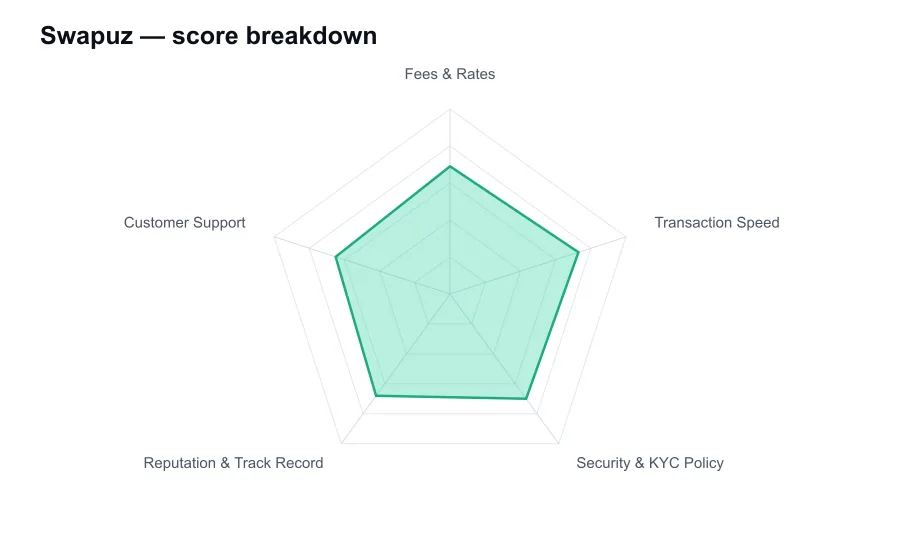
I rate Swapuz as a capable middle-tier instant exchange. It has more substance than a brand-new swap page, and its fixed-rate functionality makes it more useful than services offering only floating estimates. Still, the spread-based pricing and less extensive track record mean it should not be treated as the automatic default. Compare the output, choose the rate mode deliberately, and keep high-value transfers with providers that have deeper liquidity and stronger accountability.