ClickPay is a payment gateway rather than a conventional crypto exchange. Its core market is merchant payments, particularly businesses selling online across the Middle East and North Africa. That distinction matters. Anyone arriving expecting a Binance-style trading venue, order books, token custody, or a broad retail crypto menu will be in the wrong place. ClickPay is built for checkout pages, payment links, invoicing, recurring billing, and getting paid through local and international payment methods.
The company sits in a competitive field populated by regional processors, banks, Stripe, Checkout.com, PayTabs, Telr, and several country-specific gateway providers. Its pitch is practical rather than glamorous: help merchants accept cards and alternative payment options while dealing with the regional complexity that larger global providers don't always handle elegantly. That can be genuinely valuable for a retailer in Saudi Arabia, the UAE, Jordan, Egypt, or neighboring markets.
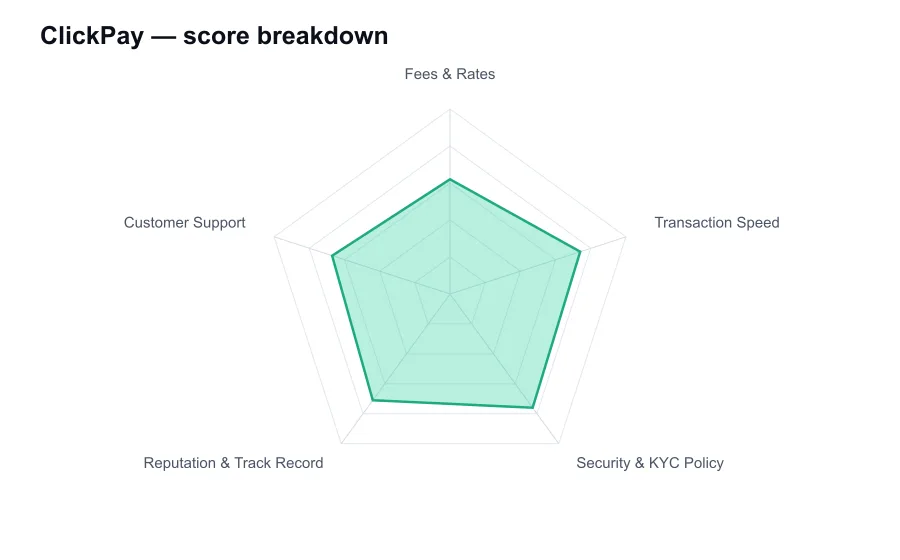
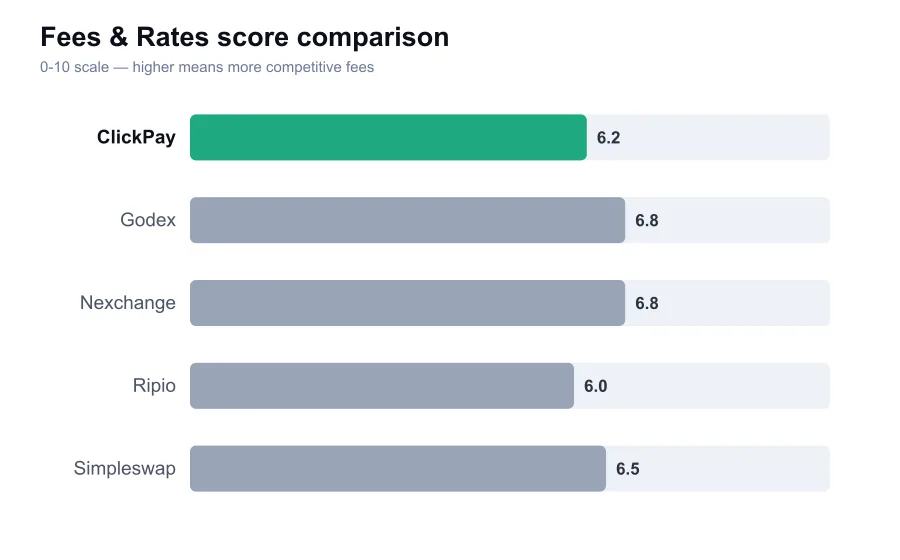
Fees are the first area where prospective customers need to slow down. ClickPay does not present a universal public rate card that lets every merchant calculate exact costs before speaking with sales. Pricing can vary with country, payment method, sector, transaction volume, settlement currency, and risk profile. That's standard in payment acquiring, but it is less transparent than a self-service crypto platform publishing a flat maker and taker schedule.
A serious merchant should request an itemized quote and ask direct questions. Ask for domestic versus international card rates, fixed per-transaction charges, refund costs, chargeback fees, minimum monthly commitments, currency-conversion spreads, payout fees, and costs for payment links or recurring billing. The headline percentage is only part of the bill. A gateway that appears cheaper can become more expensive if foreign cards, disputes, or multi-currency settlements are central to your business.
ClickPay's pricing model makes more sense for an established business with enough volume to negotiate than for a hobby seller processing a few payments each month. Very small merchants often prefer simple, published pricing, even if the rate is slightly higher. The time spent decoding a custom payment proposal has a cost too. ClickPay can be competitively priced, but there is not enough public detail to call it a low-fee option without seeing an actual merchant quote.
Speed is more encouraging on the customer-facing side. A well-integrated gateway should authorize a card payment in seconds, and ClickPay offers the sort of APIs, hosted payment pages, plugins, and payment-link workflow merchants expect. For a buyer, that is the speed that matters most. A checkout that is clumsy, redirects strangely, or makes customers re-enter data loses sales. ClickPay's product is designed to reduce that friction.
Merchant settlement is a different question. Approval at checkout does not mean cleared money is immediately available in the merchant's bank account. Settlement timing depends on country, acquiring arrangement, cut-off times, card scheme, weekends, holidays, reserve requirements, and merchant risk. New businesses and higher-risk categories should expect more scrutiny and should not build cash flow plans around instant access to card proceeds. Payment processing has never worked that way, despite how some gateway marketing can sound.
On security, ClickPay's role as a regulated payments business is more relevant than crypto buzzwords. Card data handling, tokenization, fraud controls, secure checkout, and PCI-focused payment practices are what count here. Merchants should still confirm exactly which party is the acquiring bank, what compliance scope applies to their account, where data is processed, and how liability is allocated after fraud or a disputed transaction. A payment gateway can secure its systems well without eliminating card-not-present risk for the merchant.
KYC and business verification are not optional in this line of work. Expect ClickPay to request company formation documents, ownership information, identification for beneficial owners, bank details, business model explanations, and sometimes evidence of inventory, delivery practices, or refund policies. Some users complain about this process because they confuse a payment gateway with an anonymous wallet. That criticism misses the point. Robust onboarding is inconvenient, but weak checks would be a bigger warning sign for a merchant processor.
The real security weakness is not necessarily technical. It is operational dependence. If an account is flagged, held for review, or affected by a spike in chargebacks, a merchant can face delayed payouts while the gateway investigates. That happens across the industry, including at larger processors. Businesses selling digital goods, tickets, supplements, high-value goods, or cross-border services should ask about reserves and account-review procedures before routing all revenue through one processor.
ClickPay has a more credible operating profile than an anonymous payment page or a little-known crypto swap site. It has an identifiable commercial purpose, merchant-facing integrations, and a regional presence built around payments rather than speculative token promotion. Still, it does not have the global public track record, documentation depth, or developer ecosystem of Stripe or Adyen. That is not a fatal flaw. It simply defines the comparison set.
Support appears most useful during setup, where integration help and local market knowledge can matter more than a glossy dashboard. The frustrating part is common to almost every processor: support quality often feels excellent during onboarding and less predictable once a complex settlement, compliance, or dispute issue appears. Before signing, businesses should test response times with specific pre-sales questions and make sure they know whether help is available by phone, ticket, account manager, or only email.
I would not choose ClickPay solely because a salesperson promises broad regional coverage. Coverage means little without written confirmation that the business category, destination markets, currencies, and settlement bank are supported. A merchant should also run a limited launch, process real orders, issue a test refund, inspect reconciliation reports, and see how fast funds actually settle. That small pilot tells you more than a feature list.
For merchants focused on MENA payment acceptance, ClickPay can be a sensible, professional gateway candidate. It is not a crypto exchange, and treating it like one creates the wrong expectations around fees, custody, and speed. Its strengths are regional payments infrastructure and practical merchant tools. Its weaknesses are limited public pricing clarity and the unavoidable compliance and settlement constraints of card processing. My view is favorable but conditional: get a complete written commercial offer, test the workflow, and keep a backup payment route.