Godex is a long-running instant cryptocurrency exchange built around a simple promise: exchange coins without registration, without stated upper limits and with a fixed rate shown before you send. It has been operating since the mid-2010s and sits among the older names in the no-account swap market. The product is deliberately narrow. You do not get a conventional trading account, fiat deposits, advanced order types or a custody wallet. You get a conversion route from one crypto asset to another.
That focus has made Godex useful for a certain kind of user. If you already hold crypto in a personal wallet and need to turn one asset into another without joining a centralized exchange, the workflow is easy to understand. Choose the pair, enter the receiving address, send the deposit and follow the order page. There is a practical appeal to avoiding another login, another password and another database holding your identity documents. It is one of the reasons instant exchangers remain popular despite higher implicit costs.
Godex is particularly associated with fixed-rate exchanges. In a volatile market, a fixed output amount can be more valuable than chasing a slightly better floating quote. A customer moving Bitcoin into a stablecoin before a payment deadline may prefer certainty to the possibility of market upside. The fixed quote is also easier to audit at the time of purchase. You know the promised payout before transmitting the deposit, subject to the service's stated terms about the amount sent and the timing of confirmations.
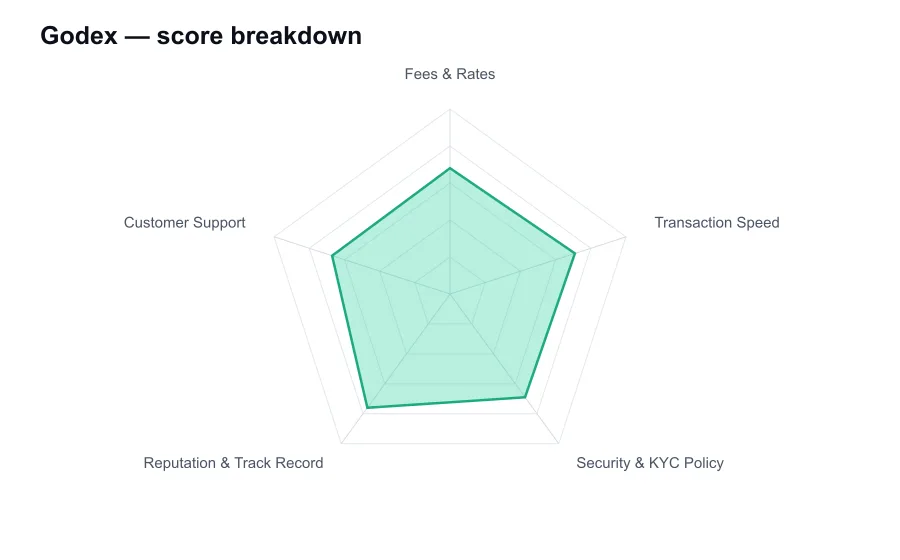
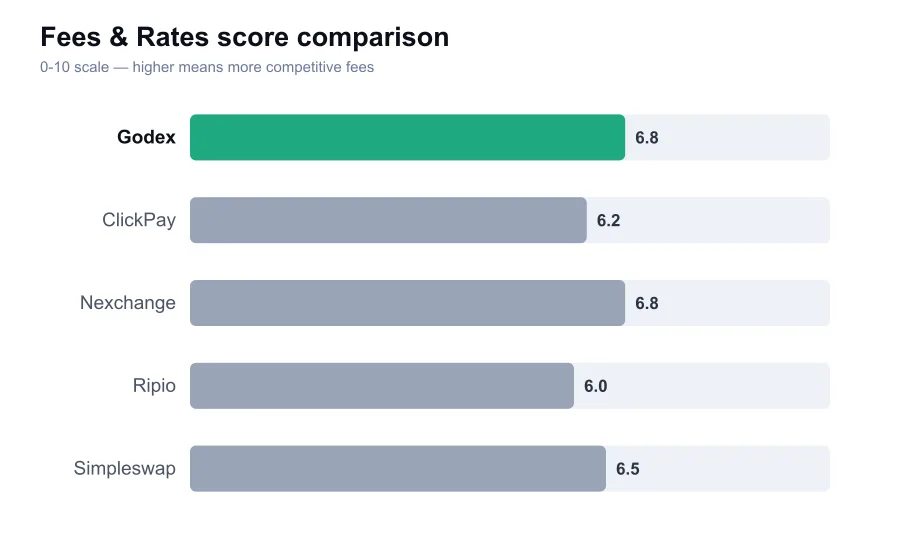
There is a price for that certainty. Godex does not publish a simple, universally applicable percentage service fee in the way FixedFloat historically has. Its revenue is effectively reflected in the offered rate and in the liquidity it can source for a given route. That means the platform can be competitive on one pair and noticeably expensive on another. The honest way to assess Godex is not to ask whether it has “low fees” in the abstract. Enter the exact pair and amount, then compare the final output with Exolix, ChangeNOW, SimpleSwap and a liquid centralized exchange.
The platform's rate is often acceptable for convenience-driven transactions, particularly when a fixed quote has value. It is rarely the obvious choice for a high-frequency trader or someone moving a large balance where every basis point matters. A trader with access to a deep order book can generally obtain tighter pricing by selling one asset and buying another directly. Godex is selling simplicity and reduced account friction, not professional execution. Users who understand that trade-off are less likely to be disappointed.
Godex advertises no registration and no maximum exchange limit. The first point is broadly accurate for normal use. You can initiate an exchange without opening a traditional customer account. The second should not be read as a guarantee that every large transfer will pass without questions. Like other exchange providers, Godex maintains AML procedures and may freeze or seek information on transactions flagged by its risk systems. No-KYC marketing and AML enforcement can coexist, and prospective customers should plan for that reality.
This is one of the category's persistent tensions. A user may choose Godex partly to avoid handing documents to a large centralized exchange, then feel misled if a transaction triggers review. From the service's perspective, screening is a legal and operational necessity. From the user's perspective, a frozen swap can be alarming, especially if support is vague. The safest lesson is to avoid using any instant exchange for funds whose delay would create a crisis. Privacy is not the same thing as immunity from compliance controls.
Godex's security model is better understood as limited custody rather than no risk. The service does not encourage users to leave an ongoing balance on the platform, which reduces the exposure that comes with a traditional hosted account. During an active conversion, it still receives your deposit and must send the output correctly. You are relying on its operational wallet security, liquidity providers, transaction monitoring and recovery processes. The company provides basic service-level assurances, but it does not offer the kind of granular public audit information that would allow outsiders to assess those systems in depth.
The practical protections are therefore in the user's hands. Use a self-custody wallet for the payout. Verify every address character, tag and network. Never send coins from a chain that is not explicitly selected in the order. Avoid browser ads and phishing links by typing or bookmarking the official domain. Save the order ID and transaction hash before closing the page. These habits may sound mundane, but most painful instant-exchange incidents begin with a wrong network, wrong address or fake site rather than an exotic technical failure.
Godex's longevity is a point in its favor. A service that has remained visible for years, retained integrations and handled a large number of ordinary retail swaps deserves more credit than a recently launched anonymous site. It has a recognizable reputation in the instant-exchange market and a substantial pool of public commentary. The feedback is mixed in the familiar way: many routine exchanges complete quietly, while negative reports tend to focus on delayed payouts, rate disputes or compliance holds. That pattern does not make Godex unique, but it should temper any claim that the process is frictionless.
Speed is usually adequate rather than class-leading. The service can process a straightforward transaction promptly after the deposit receives required confirmations and liquidity is available. On fast networks, that may feel quick. Bitcoin and congested Ethereum transactions are governed by their chains first, not by Godex's marketing. Because Godex emphasizes fixed-rate settlement, it can be a better fit for users who care more about a known output than shaving a few minutes off execution. It is not the specialist Lightning-oriented option that FixedFloat has been.
Customer support is available through its website contact methods and is presented as around-the-clock assistance. For basic order-status questions, the order ID gives agents a useful starting point. The real test is the difficult case, a missing tag, a delayed source transaction, a wallet under maintenance or an AML review. Godex does not have the public service infrastructure of a regulated major exchange, so expectations should be realistic. Clear documentation, a precise ticket and patience tend to get better results than repeated short messages through multiple channels.
I would choose Godex for an occasional fixed-rate conversion where I value a no-account workflow and have checked that its quote is competitive. I would not choose it automatically just because it says there are no limits. Large transfers deserve more preparation, more comparison and, often, a platform with a named legal entity, stronger disclosures and a dedicated account manager. The convenience premium is easier to justify for a modest personal swap than for a treasury movement.
Godex has survived because its basic service remains useful. It is not glamorous, and it is not the cheapest route in every market, but it delivers a familiar fixed-rate instant-exchange experience with a longer record than many newer contenders. Use it with clear eyes. Compare the final quote, respect the possibility of AML review, and keep the transaction size sensible. For the right wallet user, that is enough. For everyone seeking tight spreads, fiat rails or institutional assurance, it is simply the wrong tool.