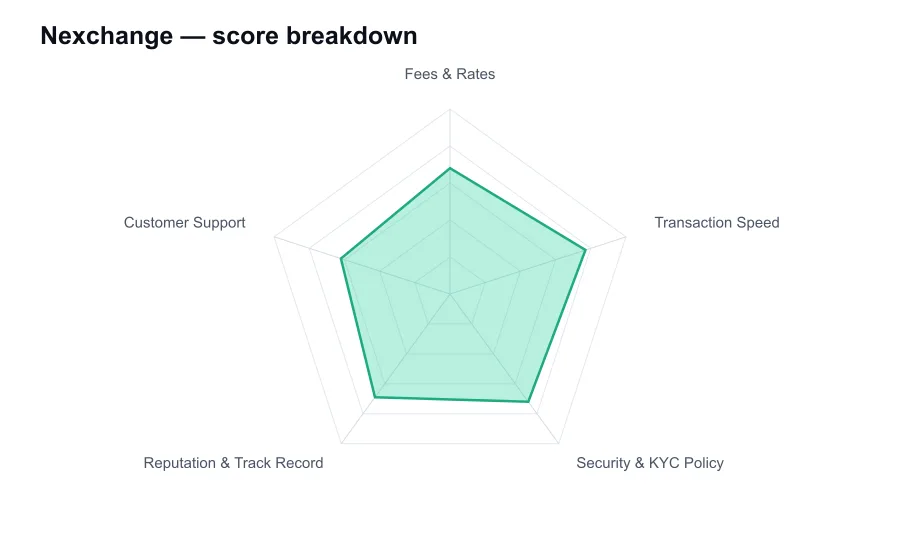
Nexchange is an instant cryptocurrency exchange service with a practical, infrastructure-minded identity. It is aimed at people who want to convert one coin into another without spending the day on a trading terminal, and it has also positioned itself as a provider of exchange functionality for partners through API-style integrations. That makes it more utilitarian than flashy. The question is not whether it has every feature, but whether its quote, execution, and support justify using it instead of a larger venue.
The service sits in the broad category occupied by providers such as ChangeNOW, SimpleSwap, Changelly, and Swapzone-listed partners. A user selects a pair, enters a destination address, receives a deposit address and quote, then waits for settlement. There is no need to maintain a long-term account balance in the normal flow. That is appealing to self-custody users who do not want another centralized login holding their assets.
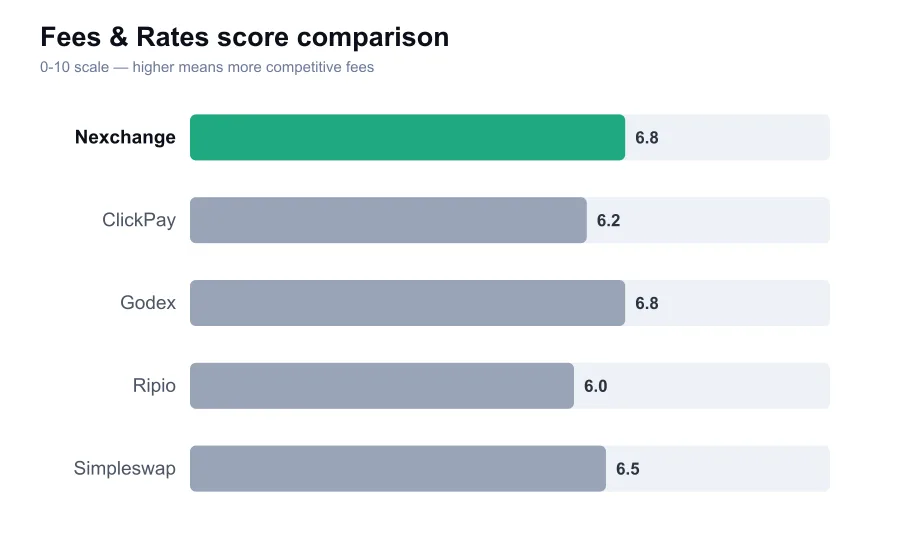
Nexchange's pricing should be judged from the final receive amount. Instant exchanges commonly combine a service margin with liquidity-provider pricing and network costs. Even where a quoted rate appears competitive, the effective spread can widen for thinly traded assets, volatile periods, or larger orders. This is not necessarily deceptive, but it is fundamentally different from paying a visible maker or taker fee on a liquid order book.
For common, liquid routes such as BTC, ETH, USDT, or major stablecoin conversions, compare the Nexchange quote against at least one alternative before committing. The comparison takes seconds and can save more than obsessing over a stated fee percentage. For unusual pairs, Nexchange may be convenient because it handles routing that would otherwise require several manual trades. Convenience has value, but users should know exactly what they are paying for it.
Rate choice matters. A floating-rate transaction may offer a better starting quote, but the amount received can change as the deposit travels through confirmations and the provider executes the trade. A fixed-rate option, where available, reduces that uncertainty but often embeds extra protection in the quote. Neither is universally superior. Floating rates suit users who can tolerate normal market movement, while fixed rates make more sense for a precise payment or an asset with sharp short-term volatility.
Execution speed is respectable for an instant exchanger, provided the customer sends the correct asset on the correct network. The process usually begins only after a deposit reaches the required confirmation threshold. Once that happens, the provider has to source the destination asset and broadcast the payout. A routine trade on fast networks can feel quick. Bitcoin, congested Ethereum transactions, and less liquid coins can turn the same process into an hour or several hours.
Nexchange should not be used for an emergency payment with no margin for delay. There are too many moving parts: the sender's wallet fee, blockchain confirmations, liquidity availability, destination-chain conditions, and occasional transaction reviews. That limitation applies to most services in this category. A normal order can be smooth, but a quoted conversion is not the same thing as a guaranteed wire transfer or an exchange order already resting in a deep market.
The noncustodial aspect is a meaningful security benefit, with one important qualification. Nexchange does not ask users to leave a permanent portfolio on the platform as a conventional exchange does. After settlement, assets land in the wallet address chosen by the customer. This reduces exposure to a long-term exchange insolvency or account takeover. During the swap itself, however, the service is still a counterparty handling the conversion path.
KYC is generally not the default starting point for ordinary crypto-to-crypto orders at instant exchanges of this type, and Nexchange has historically supported a low-friction flow. That should not be confused with a guarantee of anonymity in every case. Anti-money-laundering systems, sanctions screening, suspicious transaction patterns, and compliance obligations can result in a request for information or a hold. A service that says no registration is not promising that every transaction is beyond review.
This point is particularly important for users moving funds from gambling sites, mixers, sanctioned services, stolen-wallet clusters, or other high-risk sources. Do not send a transaction you would be unable to explain if asked. The most common complaint in this segment is not that an order took 20 minutes, but that a transaction became subject to a review the user did not anticipate. Clearer pre-trade risk disclosures would improve the entire instant-exchange industry.
Nexchange has a more substantial operating identity than an anonymous one-page swap widget, particularly because of its business-facing infrastructure angle. Still, it does not have the scale, regulatory profile, audited public financial reporting, or mainstream consumer brand recognition of Coinbase, Kraken, or Bitstamp. That is normal for an instant exchange, but it sets the appropriate ceiling on trust. Use it as a transaction tool, not as a vault.
Reputation in this area is also vulnerable to factors outside the provider's control. A customer may blame Nexchange for a slow Bitcoin confirmation, an incorrect tag, or a destination wallet that rejects a transfer. Conversely, a smooth small order does not prove that every large order will be frictionless. The sensible reading of its record is that it is an established niche operator, not a risk-free replacement for a top-tier exchange.
Support appears structured around online contact channels and transaction tracking rather than branch offices or telephone escalation. That is enough for a user who knows what an order ID, transaction hash, and wallet address are. It is less comforting when a complex case involves a missing memo, a token sent on the wrong network, or a compliance hold. The quality of support is most visible during exceptions, and users should keep every transaction detail available.
Before sending, double-check the selected network, minimum amount, expected address format, and whether the receiving asset requires a memo or tag. This sounds basic, but it is where instant exchange losses often begin. Nexchange can execute a correctly formed request efficiently. It cannot reliably rescue every deposit sent on an unsupported chain or every transfer directed to an exchange deposit address without the needed identifier.
For modest self-custody conversions, Nexchange has a sensible proposition. It removes the overhead of opening a trading account, moving funds into it, placing a trade, and withdrawing. That can be worth a slightly weaker rate for a user who values speed of workflow. For a large conversion, the arithmetic changes. Deep order books, transparent fees, and more formal support at major exchanges are usually worth the extra effort.
My judgment is positive but conditional. Nexchange is a credible convenience service for users who understand wallets and compare quotes. It is not the cheapest universal route, and it is not a place to park money or execute a large trade blindly. Keep orders proportionate, select the correct rate type, and regard no-KYC convenience as a lower-friction process rather than an immunity from compliance checks.