Quickex is an instant cryptocurrency exchange service built for direct wallet-to-wallet conversions. It does not try to be a full brokerage with charting tools, recurring buys, fiat balances or a social trading layer. You select the assets, enter a receiving address, send coins and wait for delivery. For users who already understand wallets and simply need to move between assets, that can be refreshingly direct. For everyone else, the absence of a traditional account environment can feel less forgiving.
The service's appeal is speed and a relatively low-friction flow. There is usually no need to create a conventional custodial trading account for an ordinary exchange, and that removes some onboarding friction. Quickex still operates in a compliance-conscious industry, though. The fact that a swap can begin without routine KYC does not mean every transaction is immune from screening. Customers should understand that distinction before treating it as a privacy guarantee.
Quickex supports a broad selection of coins and tokens, including many assets that are awkward to trade directly on large regulated exchanges. That breadth is useful if you are converting an altcoin from a personal wallet or moving value between chains. It also creates the normal risks of long asset lists: liquidity varies dramatically, wallet maintenance can interrupt individual routes and ticker symbols can be confused. Check the exact chain and token contract, not just the asset name displayed on a page.
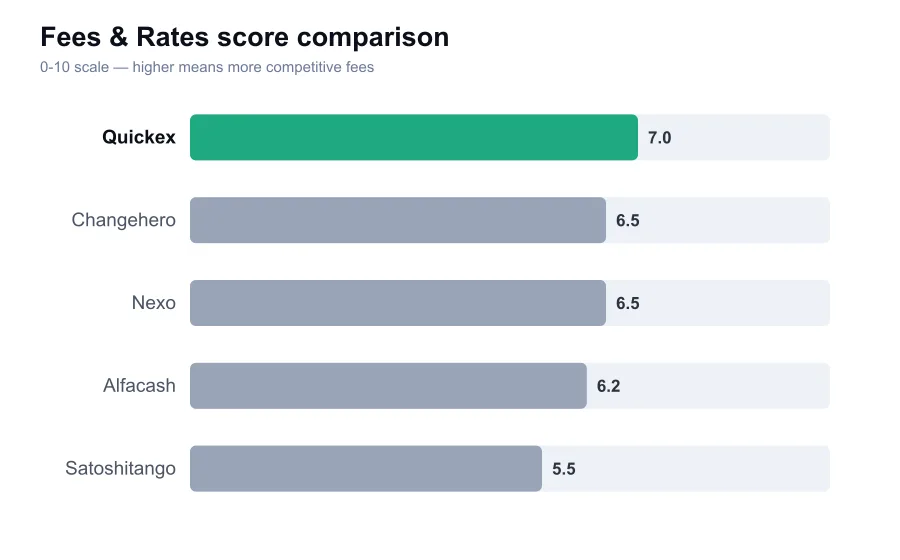
Pricing is based on the exchange rate shown for the selected route. Quickex has historically promoted a fee around 0.25 percent for exchanges, but a headline percentage should not be read as the entire cost of every transaction. The actual result can include a liquidity spread and network costs, particularly for floating-rate swaps. The final amount displayed before sending is the number that matters. Compare that output with ChangeNOW, SimpleSwap and a liquid spot exchange if the amount is large enough to justify the extra minute.
Fixed-rate and floating-rate choices are important here. A fixed-rate route can protect a customer from a sharp market move while the deposit is confirming, but it may carry a worse quote or strict timing requirements. A floating rate may produce a better initial estimate, yet the delivery amount can change before execution. Neither is inherently superior. For a volatile asset or a large amount, I prefer a clearly explained fixed quote. For a small routine conversion, floating execution is often acceptable.
Quickex can be fast once the incoming transaction has enough confirmations. The company has advertised average processing around a few minutes for suitable routes, and many liquid exchanges do complete quickly. But users should not confuse that estimate with a promise. Bitcoin deposits require confirmations, Ethereum gas conditions vary and a cross-chain route can involve more than one liquidity step. If a conversion is needed at an exact time, an on-chain instant exchanger is the wrong tool regardless of the provider's marketing.
The platform's status page and transaction-tracking flow matter more than they might seem. A good instant exchange should tell the customer whether it is waiting for a deposit, confirming it, exchanging funds or broadcasting the payout. Quickex generally provides an order page for that purpose. Save the exchange ID, the deposit transaction hash and the payout transaction hash. Those records are essential if you need support, and they are useful for tax records as well.
Security is reasonable for the service type, but users need to define the threat model correctly. Quickex is preferable to leaving assets on a lightly used exchange account because the intended flow is temporary rather than long-term custody. Yet during the swap, funds are controlled by the service and its liquidity partners. There is no magic noncustodial shield once you send the deposit. Use a self-custody wallet before and after the conversion, and don't assume a wallet-to-wallet interface removes counterparty risk.
Quickex's no-registration approach will appeal to privacy-minded users, but compliance policies still apply. A transaction can be flagged and the provider may ask for identity documents or supporting information. That possibility is not unique to Quickex, but its handling is especially important because a customer may only discover it after funds have been sent. Read the AML and refund terms before use. If a source-of-funds request would be impossible for you to satisfy, do not route money through any instant exchanger.
Reputation is middling but materially stronger than an obscure new swap site. Quickex has operated for several years, maintains public-facing support and has accumulated third-party reviews. It is not in the same trust tier as Kraken, Coinbase or Bitstamp, which have deeper regulatory histories and much larger public footprints. Nor is it as anonymous as the countless short-lived exchange widgets that appear during bull markets. That makes it viable for modest use, not automatically suitable for substantial holdings.
Public reviews of instant swap services need to be read with context. Happy users often report only that a transaction arrived. Negative reports may involve a bad address, a network mismatch, a KYC flag or a genuine execution delay. The useful question is whether the company responds with transaction-specific details and resolves cases. Quickex has a visible support presence, but users should still expect a slower, more document-heavy process if automated compliance systems intervene.
Support is available through its website and email channels, and the company presents round-the-clock assistance. For basic questions and ordinary delayed orders, that is generally the level of support an instant exchanger needs. It is not the concierge service a bank customer might expect. The practical advice is simple: never send a transaction without retaining every detail. A vague message saying that coins are missing will not help an agent locate an order nearly as quickly as an exchange ID and transaction hash.
Quickex works best as a utility, not a home for a portfolio. Use it to turn one asset into another, then take the received assets to your own wallet. Don't use it as a replacement for a fiat on-ramp, a professional trading venue or an audited custodian. It is particularly handy for users who hold coins in self-custody and do not want to deposit them into a centralized exchange merely to make a single conversion.
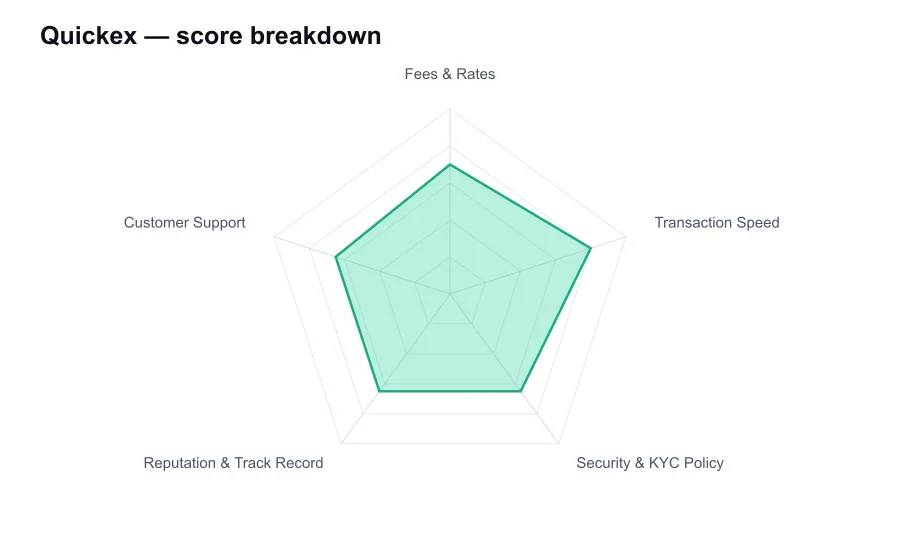
My view is that Quickex is a respectable mid-tier instant exchanger with an appropriately limited role. Its rate quotes can be competitive, its workflow is straightforward and it has enough history to be more credible than a newly launched swap brand. It loses points for the inherent opacity of instant-exchange execution, possible compliance holds and the fact that quoted prices can be less competitive than direct exchange trading. Keep transaction sizes sensible, verify every network detail and it can be a useful tool.