SimpleSwap is a recognizable instant crypto exchange service built for people who want to convert one asset into another without operating a conventional exchange account. It sits between a decentralized swap interface and a full custodial trading venue. You send crypto in, SimpleSwap arranges the conversion through its liquidity partners, and the output goes to the wallet address you supplied. The idea is practical, especially for a user who wants a quick exchange without leaving funds on a platform after the transaction.
The service has been operating since 2018 and has built wider name recognition than many smaller instant exchange brands. It supports a large list of coins and tokens, which is useful for obscure conversions that a mainstream exchange may not offer directly. Breadth is not the same thing as liquidity, though. A supported asset can still produce a poor quote, a longer completion time, or a minimum amount that makes a small exchange uneconomical.
SimpleSwap is easiest to understand as a broker-like routing service, not a traditional market. There is no public order book where a user can see bids and offers. The platform presents a quote based on its available liquidity sources. That makes the process approachable, but it also means users have less visibility into how their price is formed. For convenience buyers, that may be acceptable. For price-sensitive traders, it is a major limitation.
The platform offers both floating-rate and fixed-rate exchange options for supported pairs. Floating rate is the default choice for many users and can produce a competitive result if markets remain stable while the deposit confirms. Fixed rate gives more certainty about the expected output, though it can carry a less favorable quote because SimpleSwap is taking on the volatility risk. Neither setting is automatically better. The choice depends on the asset, network speed, and how much price movement a user can tolerate.
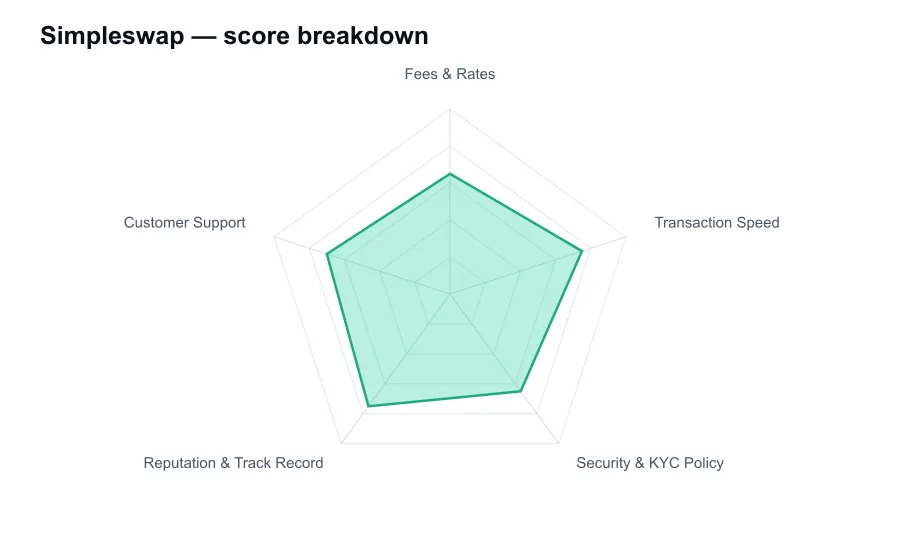
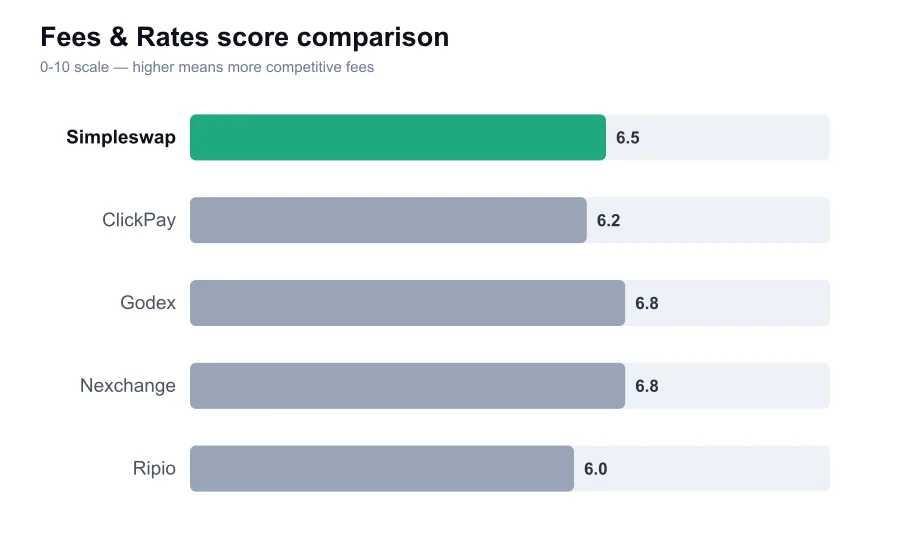
Fees are not usually presented as one clean percentage. The service's compensation is generally reflected in the quoted exchange rate, alongside network costs and liquidity-provider pricing. That is common in this segment, but it is also why SimpleSwap can look cheaper or more expensive than a competitor depending on the specific pair and moment. I strongly recommend comparing final output amounts, not marketing claims about low fees.
For major pairs such as BTC to ETH, ETH to USDT, or USDT to SOL, SimpleSwap can be convenient but is rarely the lowest-cost route for someone who already has accounts at large exchanges. A liquid centralized spot market often offers tighter execution, even after withdrawal fees. SimpleSwap becomes more compelling when account friction, regional access, or token availability matters more than shaving every basis point off a trade.
Transaction speed is usually good for standard assets once the incoming transfer receives the required confirmations. Many exchanges finish within several minutes, though Bitcoin transactions and congested Ethereum transfers can take longer. The service cannot control block confirmation times, and users should be skeptical of any claim that every swap is instant. It is fast relative to opening a new account and passing KYC, not necessarily instant in the literal sense.
Users need to be precise with networks. Sending USDT on the wrong chain, entering an incompatible destination address, or selecting an unsupported token version can turn a convenient swap into a support case. SimpleSwap provides transaction tracking, which is useful, but tracking a mistake is not the same as fixing it. Test amounts are especially wise when using newer networks, wrapped assets, or large sums.
SimpleSwap does not normally require users to create an account for a standard exchange, which is one of its better features. A wallet address and transaction details are enough for the basic flow. Still, it is not accurate to describe this as guaranteed no-KYC service. Like other centralized instant exchangers, it can request verification or additional information if its risk systems flag a transaction. That possibility should be considered before sending funds, particularly for large or unusual transfers.
The platform is not non-custodial in the strict smart-contract sense. It may not hold a customer balance like a conventional exchange, but it takes control of funds during the swap process. That is a temporary counterparty exposure. For a normal completed exchange, the distinction may feel academic. During a delay, a compliance check, or a dispute, it becomes very real.
On reputation, SimpleSwap is one of the more established names in its category. It has been around through multiple market cycles, has a visible web presence, and has accumulated a substantial volume of public feedback across review platforms. That does not make every review equally persuasive, and instant exchange review scores should never replace independent judgment. Still, it gives SimpleSwap a stronger starting point than a newly launched anonymous swap site.
Security is decent for the model, provided users do their part. The main dangers are phishing, sending assets on the wrong network, and assuming a temporary exchange flow carries no custodial risk. Use the official domain, avoid links from unsolicited messages, verify every wallet address, and do not leave a browser wallet loaded with more assets than necessary. SimpleSwap cannot recover a seed phrase, and nobody legitimate should ask for one.
Customer support is one of the reasons SimpleSwap remains competitive. It offers online support and transaction-specific assistance, and the order ID gives users a concrete reference when something goes wrong. Response times can vary, especially in a busy market, and complex compliance cases are never pleasant. Still, the platform is more approachable than an anonymous DEX contract when a transaction is stuck or a network issue needs explaining.
I would use SimpleSwap for modest conversions where speed, token availability, and avoiding account setup matter more than absolute best price. I would not use it as a primary trading venue, a bank-like custody provider, or a way to avoid all compliance obligations. Its large asset list is handy, but users should avoid treating every listed token as equally liquid or equally safe.
SimpleSwap has earned a better reputation than most instant exchange competitors because it has lasted, remained usable, and built a recognizable support operation. Its weakness is structural rather than scandalous: opaque all-in pricing and temporary custody are built into the instant-swap model. If you understand those trade-offs, it is a practical service. If you need transparent execution and the lowest possible cost, a major exchange or onchain venue is usually the better answer.