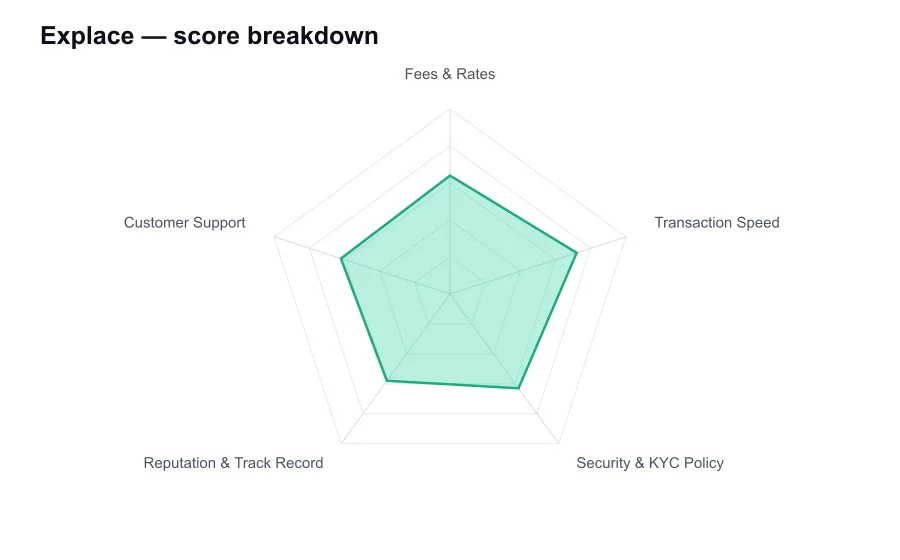
Explace is a smaller instant cryptocurrency exchange service rather than a full-scale trading platform. Its appeal is straightforward: select a pair, provide a destination address, send the deposit and receive the converted asset without maintaining a custodial account. That puts it in the same consumer category as Exolix, Godex and ChangeNOW. It is built for convenience and privacy-minded swapping, not for charting, margin positions, fiat banking or professional execution.
The first thing a prospective customer should understand is the difference between a simple interface and a simple transaction. Explace reduces the visible steps, but the actual trade still depends on blockchain confirmations, liquidity providers, wallet availability and risk checks. The service is an intermediary in the execution chain. You are not trading directly against a transparent public order book, and the headline market price shown on a price app is not necessarily the price that will determine your payout.
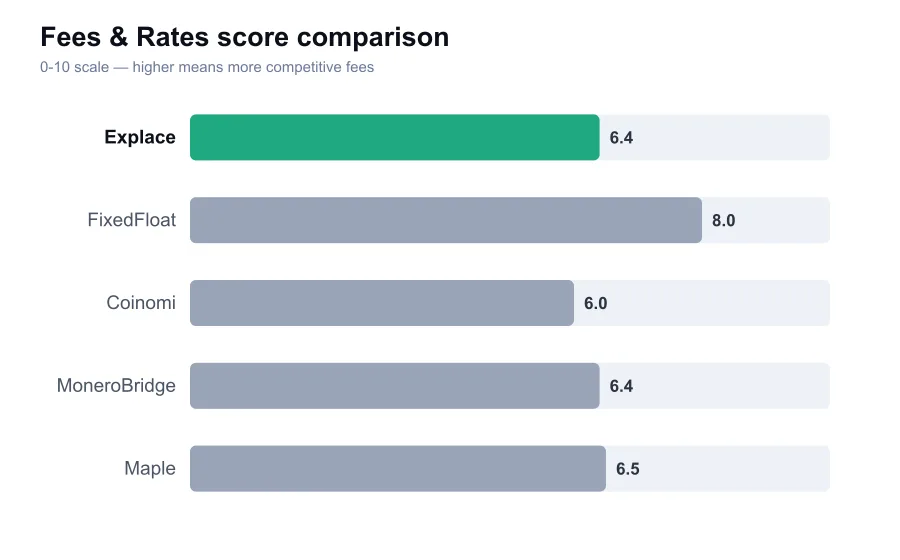
Explace's pricing is quote-based. Like many instant exchangers, it presents the amount expected at the end of the transaction instead of publishing a conventional maker and taker fee table. That can be convenient, because the customer has one number to judge, but it makes fee analysis harder. The service's compensation, liquidity-provider costs and market spread can all be reflected in the rate. A good quote is a good quote, regardless of its label, but users should compare the final output with at least one rival before committing.
On major pairs, that comparison may reveal only a modest difference. On smaller assets and cross-chain stablecoin routes, the variation can be much larger than newcomers expect. A service that appears cheaper based on a displayed exchange fee may still pay less after spread and network costs. Explace does not have the same degree of independently documented price history as larger competitors, so I would be especially disciplined here. Open a few tabs, enter the same amount and compare the amount delivered, not just the advertised rate.
The platform's lack of a permanent user account can be a real advantage. There is less personal data to hand over, no password to forget and no stored trading balance waiting for an account takeover. It is also a limitation. Without an account dashboard carrying a detailed history, users must preserve their order ID, deposit hash, destination address and correspondence. Take a screenshot before you send. That small habit can save a painful support conversation if the transaction needs investigation.
Explace promotes an account-free experience, but it should not be described as a guaranteed no-KYC service in every circumstance. A responsible exchange provider has AML obligations and risk controls, and Explace's policies allow it to request information or pause a transaction in suspicious or high-risk situations. This is the industry norm, even among platforms that advertise privacy. If your primary concern is avoiding any possible verification, you are choosing a risk that Explace cannot honestly remove.
Security is therefore mixed in the way it often is for smaller instant services. The non-custodial flow reduces the danger of leaving a long-term balance on the site. You control the destination wallet and only transfer the asset being exchanged. Yet a swap still requires trust during the settlement window. Explace does not offer the public proof-of-reserves reporting, detailed security architecture or regulatory disclosures that would let an outsider inspect its operations deeply. That makes careful transaction sizing essential.
I would not send a first-time five-figure transfer through Explace simply because the landing page looks clean. Start with a small order on the exact pair and network you plan to use. Check whether the destination amount arrives, whether the tracking page updates clearly and how quickly support responds. This is sensible on every instant exchanger, but it matters more with a lesser-known brand. Trust should be earned through a completed test, not through a polished claim about fast exchanges.
Speed can be very good when all parts of the route are healthy. A swap involving Litecoin, Tron or another quick network may settle shortly after the incoming deposit receives the required confirmations. Bitcoin and Ethereum are different stories. A busy mempool, an underpriced sender fee or a temporarily unavailable partner wallet can turn a quick exchange into a wait. Explace cannot bypass those realities. Its role is to process efficiently after it has enough confidence that the incoming payment is final.
The platform is best viewed as a practical conversion tool, not a timed settlement guarantee. If you need funds at an exact minute to meet a payment obligation, use an exchange where you already hold both assets or build a generous timing buffer. Instant exchange branding encourages the wrong expectation. In normal conditions the service can be fast, but no provider can promise that every chain, token and liquidity source will remain available at every hour of every day.
Explace has a much thinner public track record than older names such as Godex or Exolix. That does not automatically make it unreliable, but it does lower the confidence that comes from years of visible operations, extensive integrations and a large body of independently discussed customer experiences. A young service has fewer opportunities to prove how it handles market shocks, wallet incidents, disputed deposits and compliance escalations. I score it accordingly rather than pretending a short record equals a long one.
Support is one area where smaller services can either win loyalty or lose it quickly. Explace provides direct contact channels and transaction tracking, but its public support reputation is not as established as that of the better-known operators. For basic questions, a quick chat or email reply may be enough. For a delayed order, users should send a concise ticket containing the order ID, transaction hash, asset, network and screenshots. Vague messages such as “my money is gone” make a technical investigation slower.
There is a particular class of user for whom Explace makes sense. It suits someone with an existing self-custody wallet who wants an uncomplicated conversion and is prepared to verify the quote and network independently. It can also suit occasional users who do not want to register at a large centralized exchange for one trade. It is a poor fit for frequent traders, users needing bank transfers, and anyone whose risk policy requires audited custody arrangements or a regulated counterparty.
My final take is measured rather than enthusiastic. Explace appears to offer the familiar instant-exchange proposition competently, but it has not earned the same depth of trust as the category's older, more visible names. Its convenience is real, and account-free swaps have a place. Keep transactions modest until you have tested it, compare the net quote carefully, and retain every transaction record. Those precautions turn a potentially useful tool into a much less risky one.