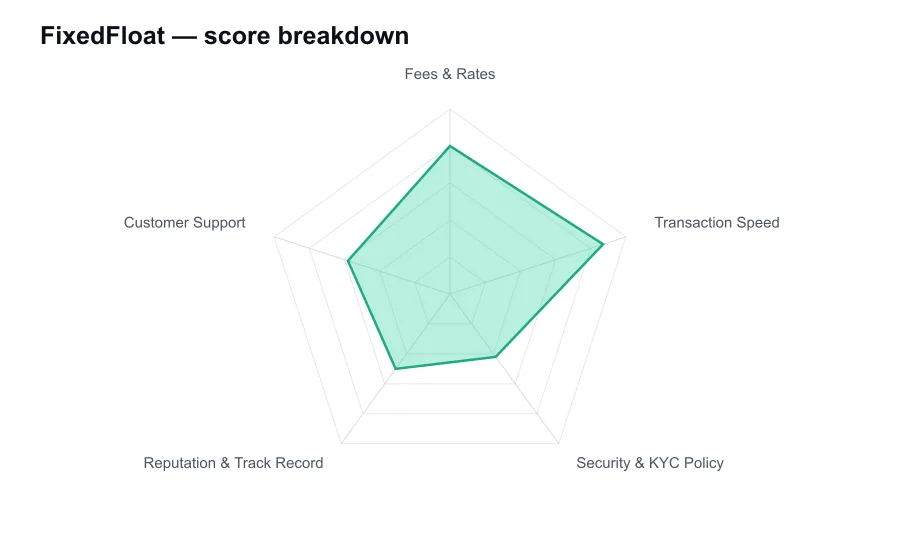
FixedFloat is one of the more distinctive instant exchanges because it was built with automation and Bitcoin's Lightning Network firmly in mind. Rather than trying to resemble a polished retail brokerage, it has traditionally appealed to technically comfortable users who want rapid crypto-to-crypto conversions, API-style efficiency and minimal account friction. At its best, the service can feel exceptionally fast. At its worst, its security history makes it impossible to treat it as a carefree default choice.
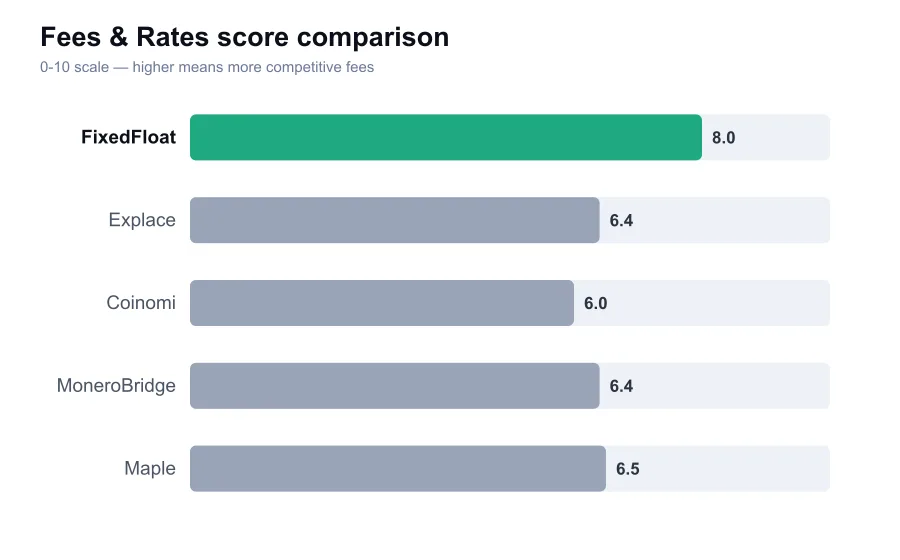
The platform offers two pricing modes that are unusually clear for this sector. The floating-rate mode has historically charged a 0.5 percent service fee, while the fixed-rate mode has historically charged 1 percent, with network fees added as applicable. Those published percentages are more transparent than the embedded-margin model used by many instant exchangers. They also explain the trade-off neatly. Floating pricing is cheaper but exposes the customer to market movement. Fixed pricing costs more because the service takes the volatility risk during the deposit and settlement process.
That clarity should not be overstated. A stated 0.5 percent fee is not the full economic cost of every swap. Network fees, liquidity spreads and the price movement during a floating exchange can still affect the final amount. Yet FixedFloat deserves credit for making its own cut more visible than competitors that only show an all-in quote. For frequent small swaps, especially on fast and cheap networks, that can be meaningful. For a large conversion, compare the net output with a major exchange and at least one aggregator.
Lightning is the feature that made FixedFloat stand out. Lightning payments can settle in seconds and avoid the slower confirmation cycle of an on-chain Bitcoin transaction. For a user converting BTC to another asset, or returning funds to a Lightning wallet, that can be dramatically more convenient than waiting for blocks. The practical limitation is that both the sender and recipient route need sufficient liquidity, and Lightning invoices have their own expiry and amount rules. It is fast technology, not magic.
On-chain speed is less exceptional. FixedFloat can automate an order quickly after the required confirmations arrive, but it cannot alter Bitcoin block times, Ethereum congestion or a token network's maintenance status. Its best reputation for speed came from simple, liquid routes with adequately priced incoming transactions. Users who choose a low blockchain fee to save a few dollars may lose far more in delay or a changing floating rate. The deposit is the starting gun, not the moment your swap is guaranteed to be finished.
The no-registration model remains attractive. FixedFloat has generally allowed users to exchange without creating an account, and that reduces personal-data collection as well as account takeover risk. It is not a blanket guarantee that verification will never occur. Its AML policy allows the service to investigate suspicious activity and request information in selected cases. Anyone using a privacy-oriented exchange should understand this before sending funds. The practical question is not whether a service advertises no KYC, but what happens if its screening system disagrees with your transaction.
Security is where this review cannot be casual. In February 2024, blockchain investigators reported that FixedFloat wallets suffered a major exploit, with estimates around $26 million in Bitcoin and Ether taken. The service acknowledged an attack and said it had addressed a vulnerability. A theft of that scale is a serious event for any exchange provider. Even if the platform resumed operations and the specific flaw was fixed, outside users have limited ability to inspect the remediation, audit its wallet architecture or verify the present security posture.
That incident does not mean every FixedFloat swap is unsafe or that the team acted maliciously. It does mean that the service's risk profile changed. Security is not just a question of whether an exchange asks for a password. It includes hot-wallet controls, monitoring, key management, incident response, reserve practices and the ability to protect customer flows under pressure. FixedFloat's public disclosure around those deeper controls is limited. After a material breach, limited transparency deserves a meaningful score penalty.
The right way to use FixedFloat, if you choose to use it, is transactional. Send the amount for a specific exchange and direct the payout immediately to a wallet you control. Do not regard it as a place to leave funds, do not make your first transaction enormous and do not rely on it for an inflexible deadline. The non-custodial marketing is helpful because there is no conventional deposit account, but the service still takes possession of the coins during execution. That interval is where counterparty risk lives.
The company's reputation has two competing elements. It had become well known among Lightning users and gained real goodwill for speed, simple pricing and automatic processing. It is also permanently associated with a substantial hack, plus the interruptions and uncertainty that followed. A provider can recover from a breach, but the burden of proof rises afterward. FixedFloat may still be useful for a narrow technical use case, yet it should not receive the automatic trust granted to an exchange with a long, unbroken security record.
Support has traditionally relied on online channels such as email, website contact tools and community-facing communication rather than phone-based customer service. That is normal for a lean automated exchanger, but it can feel inadequate during a delayed transaction or security incident. The quality of support is less important when everything is automatic. It becomes crucial the moment an order is stuck, a Lightning invoice expires or a compliance question is raised. In those moments, customers need specific status information rather than a generic reassurance.
FixedFloat is not for beginners who need hand-holding. The interface assumes that you understand confirmations, wallet addresses, network selection, floating rates and the difference between a regular Bitcoin address and a Lightning invoice. That technical focus is a strength for experienced users. It cuts away the clutter. But it also means there is little margin for error. A user who is still learning how to move coins safely will be better served by a larger platform with clearer education and more robust escalation paths.
Its pricing structure still compares well against many instant services, and its Lightning capability remains genuinely useful. Those strengths are why I would not write it off completely. But fees and speed are not enough to carry a service after a high-profile security breach. The risk-adjusted answer is to treat FixedFloat as a specialist tool for limited, carefully monitored swaps rather than a general-purpose exchange provider for every situation.
My final judgment is blunt. FixedFloat deserves recognition for clear published fee modes, automation and strong Lightning utility, but its breach history weighs heavily against it. Technical users who understand the risks may find it efficient for small, time-sensitive conversions. Everyone else has safer ways to obtain a similar swap, even if they are slightly slower or less elegant. Convenience is valuable, but it should not outrank confidence in the platform holding your funds mid-transaction.