WxMoney is a small online exchange service aimed at people who want to swap cryptocurrency, electronic money, and selected fiat payment methods without opening an account at a conventional exchange. It sits in the familiar exchanger market rather than the trading-platform market. You visit, choose a direction, enter receiving details, pay, and wait for settlement. That simplicity is its appeal, but it also means buyers have to judge the service with less public information than they would get from a large regulated exchange.
The first thing I noticed is that WxMoney feels built for direct conversions, not for price discovery. There are no charting tools, order books, staking products, or advanced controls to distract from the basic task. For someone cashing out a modest crypto balance or moving between payment systems, that can be refreshing. For an active trader, it is plainly the wrong product. The interface is best approached as a payment form, not an investment account.
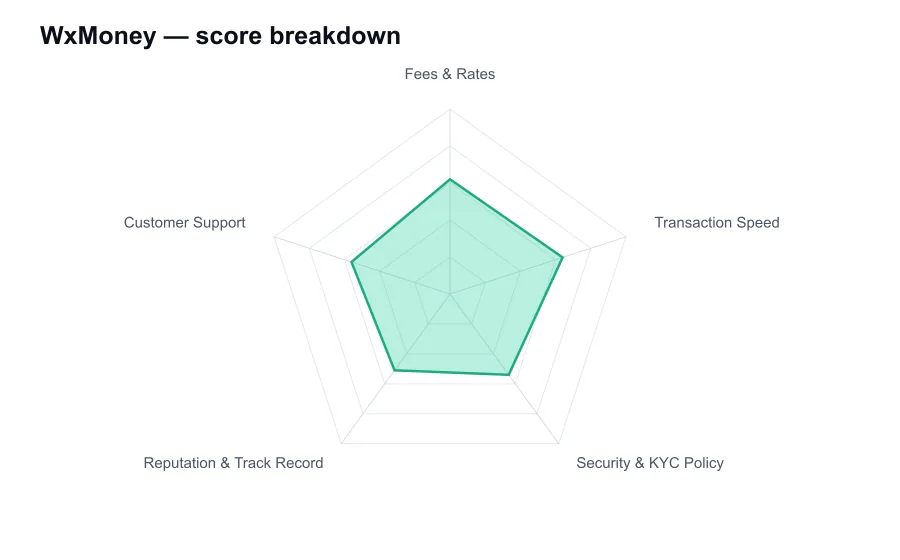
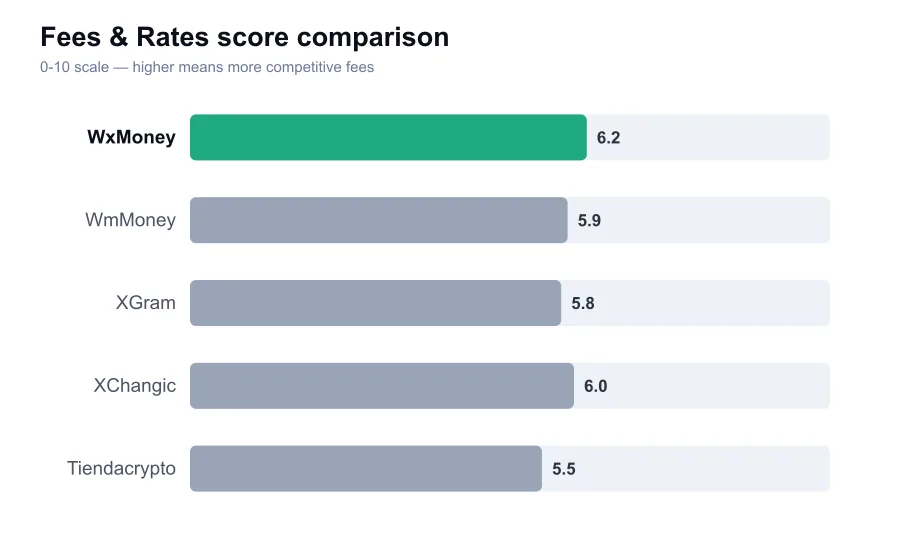
Rates are the key issue with services in this category, and WxMoney should be compared by the final amount shown, not by a headline claim about low commissions. The service generally builds its compensation into the offered rate. That is standard practice among instant exchangers, but it makes apples-to-apples comparisons harder. A quote can look clean while still containing a meaningful spread against the market price, especially on thinly traded assets or less common payout methods.
For popular pairs such as BTC, ETH, USDT, and mainstream fiat rails, the practical cost can be acceptable if the quoted amount is close to competing exchanger listings at that moment. I would still open at least two other quotes before committing. The gap is often not a fixed percentage. It changes with liquidity, network conditions, payment method risk, and the size of the order. Anyone expecting exchange-level maker fees in the tenths of a percent will be disappointed.
Small transactions deserve particular care. Network fees and the spread can consume a surprisingly large part of a low-value swap, even where the displayed rate looks reasonable. Read the minimum and maximum limits before sending money. If the order is close to a stated minimum, there is little room for a blockchain fee change or a payment shortfall. Sending an amount that does not match the order can turn a quick conversion into a support case.
Speed is usually decent on straightforward crypto-to-crypto directions. Once an incoming transaction receives the required confirmations, settlement may be relatively quick if the receiving reserve is available. That is not the same thing as instant. Bitcoin, Ethereum, and congested token networks can introduce delays outside the exchanger's control. A fixed quote also normally has a payment window, so users should not create an order and then wait an hour before sending funds.
Fiat and e-money directions are less predictable. Bank transfers, card-related payment methods, and manual checks can add hours or longer, depending on the route and the day. WxMoney should not be used for a deadline-sensitive payment unless support has confirmed that the specific direction is currently processing normally. The service model works best for transfers where a modest delay is inconvenient, not financially damaging.
Its privacy posture is another area where users need to be realistic. A no-account flow does not mean an unconditional no-KYC guarantee. Exchangers can request verification where an order triggers anti-fraud rules, a payment provider flags activity, or compliance checks require more information. That is common across the sector. Anyone using WxMoney should assume that a transaction can be paused for review and should not send funds they cannot afford to have temporarily tied up.
There is also a difference between transaction privacy and platform security. Not requiring a permanent user profile reduces the amount of data held in a customer dashboard, but it gives the customer fewer account-security controls too. You are relying on the correctness of the order details, the security of your email or messenger contact, and the provider's operational process. Check every wallet address carefully. Crypto transfers do not have a chargeback button.
WxMoney does not have the public footprint of the established global exchanges or the long institutional history that inspires immediate confidence. That does not automatically make it unsafe, but it changes the standard of care I would apply. A smaller exchanger can perform perfectly well for routine orders and still be a poor place to send a life-changing amount. Public reputation signals, independent monitoring listings, and recent user reports matter more here than marketing language on a homepage.
I would avoid treating a handful of positive reviews as proof that every transaction will go smoothly. Exchange reviews often cluster around completed small orders, while complaints arise when an order is delayed, a rate changes, or identity documents are requested. Read how the provider responds to those difficult cases. A service's character is clearer in a disputed transaction than in a five-star comment saying a USDT swap arrived quickly.
Support is likely to be the deciding factor if something goes wrong. A direct exchanger needs reachable operators because users cannot simply cancel a blockchain payment after sending it. Before placing a substantial order, check whether the site shows current contact channels, operating hours, and an order reference process. Keep screenshots of the quote, payment receipt, transaction hash, and correspondence. That is sensible discipline with any exchange service, but it is essential with a smaller one.
The best way to use WxMoney is cautiously and deliberately. Start with a test transaction, confirm the destination address, and see whether the actual result matches the displayed quote and expected timing. If the first order is handled cleanly, that tells you more than a polished landing page ever will. It also lets you learn whether the service's support team communicates in a useful way if a minor question comes up.
My view is that WxMoney can suit users who value a straightforward conversion flow and are willing to shop quotes manually. It is not a service I would recommend for storing assets, high-frequency trading, or large first-time transfers. The rates may be competitive in individual directions, but the lack of a broad public track record means the risk premium remains real. Use it as a transaction tool, not as a financial home.