YaObmen is a classic online exchanger serving users who want to convert cryptocurrency, electronic money, and payment-method balances through a direct order rather than a full exchange account. The name and style place it firmly in the Russian-language exchanger tradition, where the service is expected to be quick, practical, and quote-driven. That can be exactly what a customer needs for a specific transfer. It also means the customer has to do more due diligence than they would with a household-name financial institution.
The service's strongest use case is a defined exchange direction. You know what you are sending, you know what you need to receive, and you do not need a trading screen to get there. YaObmen can remove several unnecessary steps from that process. It is not a venue for building a portfolio, researching tokens, or managing a long-term balance. Think of it as a conversion counter on the internet, where the live rate and the reliability of settlement are the whole proposition.
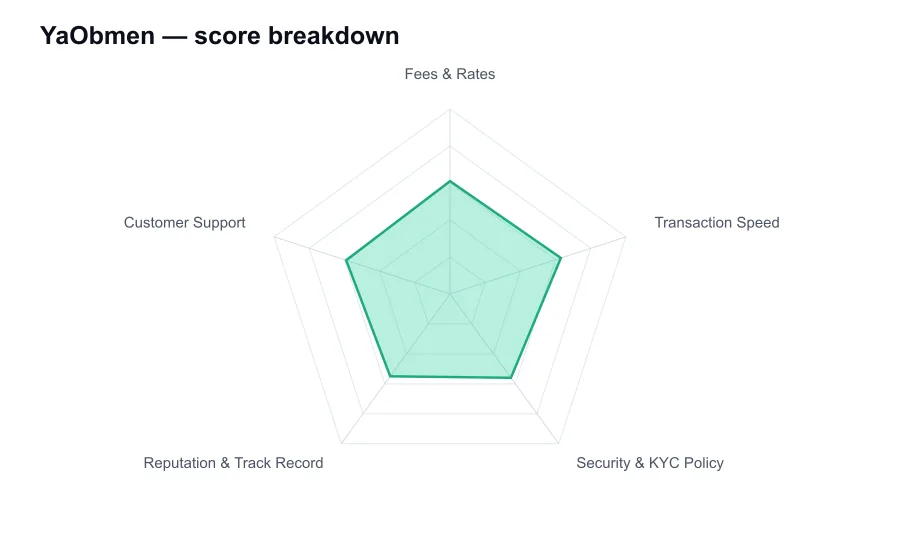
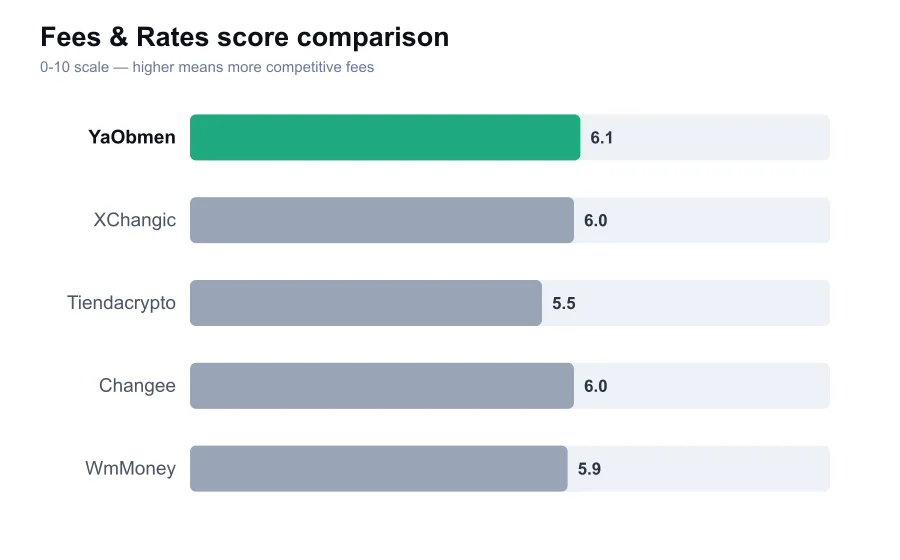
Fees are rarely presented in the neat maker-and-taker language used by large crypto exchanges. The real charge is largely in the rate offered for the selected direction, sometimes alongside network or payment-system charges. This is not unusual, but it puts the burden on the buyer. Do not judge a quote by whether the site says commission is low. Judge it by the exact number of rubles, dollars, stablecoins, or other assets that will arrive after every deduction.
YaObmen can be competitive on routes where it has available reserve and a favorable payment relationship. It can also be noticeably less attractive when the route is unusual, demand is high, or the outgoing asset is costly to send. Rates change with market conditions. A quote that looks favorable in the morning is not a promise for the afternoon. For anything more than a casual amount, compare the same input on multiple services immediately before creating an order.
The minimum order deserves attention because direct exchangers often set thresholds based on operational and network costs. Users trying to move a very small amount can find that the effective percentage cost is poor even if the displayed rate is acceptable. There is also little tolerance for underpayment. If you create an order for one amount and send another, processing may stop while support reconciles it. That is an avoidable problem, so copy the requested amount and address precisely.
Speed depends heavily on the direction. A routine stablecoin exchange on a functioning network can be completed far faster than an old-fashioned bank transfer. Bitcoin transactions can take longer, particularly when fees are low or the mempool is busy. Fiat, card, and e-wallet directions may involve manual confirmation or third-party processing. Anyone promising same-minute completion for every combination is selling fantasy. The relevant question is whether YaObmen clearly explains status once the payment has been made.
I would not use the service for a payment that must arrive at a particular minute. A conversion may be delayed by chain confirmations, wallet maintenance, banking hours, reserve replenishment, or a compliance review. Most of those events are not evidence of misconduct. They are normal operational realities. But they are still your problem if you have a deadline. Build in time, especially on weekends and holidays, and avoid sending funds before you have checked that the chosen direction is available.
Security on an exchanger like YaObmen is as much about process as it is about code. A short transaction path means the provider may not retain your assets for long, which is positive. Yet you still have to trust it after you send the deposit. Check the browser domain carefully, use a clean device, and verify the receiving wallet address character by character. Do not rely on a search-ad link or a forwarded message. Phishing copies of exchanger sites are a persistent risk.
Customers should also be clear-eyed about KYC. A provider can offer an order flow without a full customer account and still request documents in selected cases. This can be triggered by fraud controls, the origin of funds, transaction patterns, or requirements of payment partners. A user seeking guaranteed anonymity should not assume it exists simply because the initial form asks for limited information. Read the policy and be prepared for the possibility that a flagged order may not be automatic.
YaObmen's reputation needs to be viewed in proportion to its place in the market. It is not a globally dominant exchange with extensive regulatory reporting, public financial statements, and a huge support organization. That makes independent reputation sources more important. Look for recent feedback from customers using the same direction you intend to use, and distinguish between a normal confirmation delay and a pattern of unresolved complaints. Time matters too. Recent evidence is more useful than praise from years ago.
I am especially cautious about overly broad claims that any exchanger is universally safe. Reliability can vary by reserve, by payment route, and by the current workload of the operator. A service may be perfectly capable of handling a standard USDT transaction while struggling with a more niche payout method. Start with the exact route you actually need. A small test tells you whether the instructions are clear, the quoted amount is honored, and the support channel can answer a question with substance.
Support has to carry more weight here than at a self-service exchange. If a bank payment is pending or an address was entered incorrectly, there is no automatic order book to solve the issue. YaObmen should be judged on whether it provides a traceable order number, current status, and actionable communication. Before transferring a substantial amount, verify the listed support hours and response channel. Keep screenshots, transfer receipts, and transaction IDs. Being organized makes resolution dramatically easier.
For experienced users, the service can be a practical part of a wider toolkit. It is useful to have a direct exchanger available when a particular payout route is inconvenient at a major exchange. But that is different from making YaObmen your primary crypto provider. Long-term holdings belong in self-custody or with a carefully chosen regulated custodian. Frequent trading belongs on a platform with transparent liquidity and lower marginal costs. YaObmen is a bridge, not a bank.
My final take is measured but skeptical in the healthy sense. YaObmen can do a straightforward job well if the live quote is strong and the order is simple. Its limitations are the familiar ones of the smaller exchanger model: embedded spreads, variable processing by route, possible verification, and less public accountability than major platforms. I would consider it for a small or medium transaction after comparison shopping. I would not make a large first transfer or use it where timing and regulatory certainty are non-negotiable.