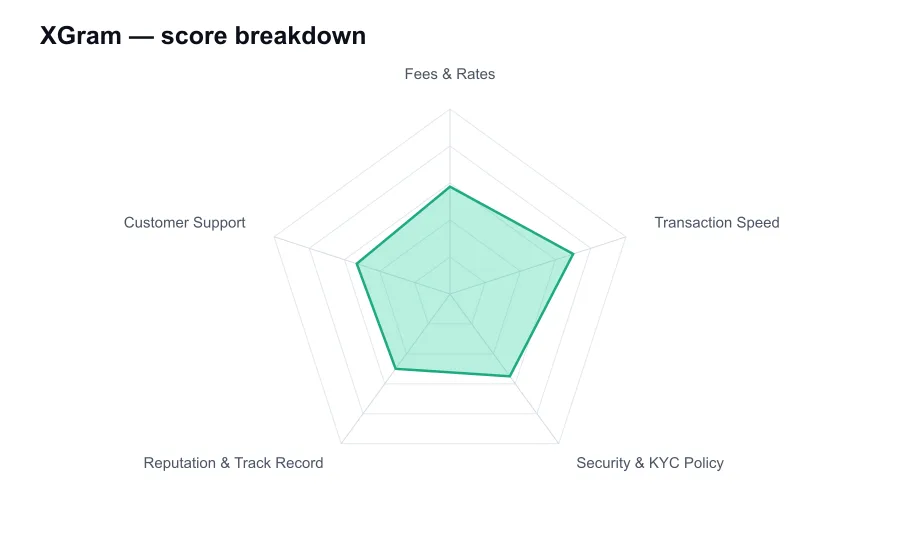
XGram belongs to the quick-exchange end of the crypto market, where the promise is a simple swap without the ceremony of a full trading account. That market is crowded, and the serious question is never whether a site can display a conversion form. Most can. The important questions are whether its quote is fair, how reliably it executes during volatility, how it handles compliance checks, and whether someone useful answers when an order does not proceed normally.
For a user moving from one coin to another, XGram's appeal is obvious. It avoids order books, complicated account settings, and the need to leave funds sitting on a centralized exchange. You provide a destination wallet, send the input asset, and receive the output asset if the order completes. This is a good model for occasional swaps. It is a poor replacement for an exchange where you need limit orders, portfolio records, tax exports, or dependable fiat banking access.
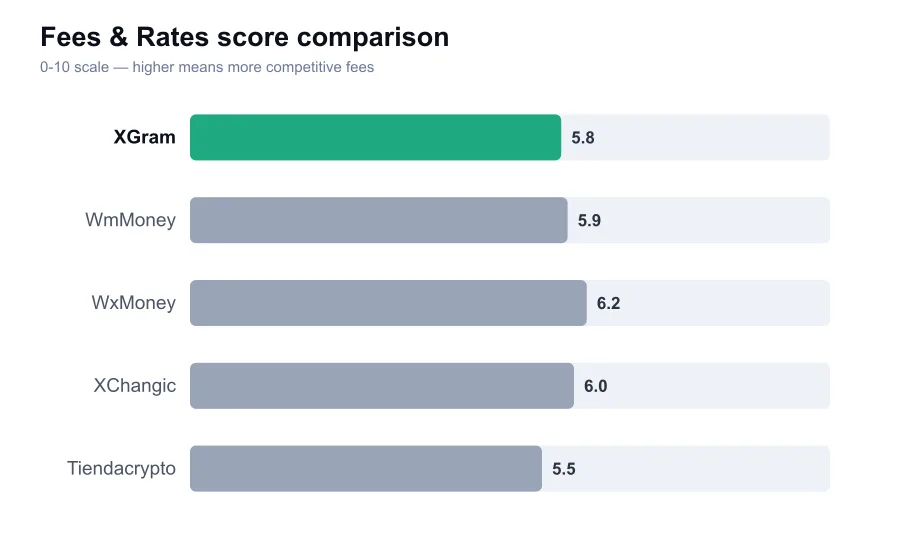
The pricing model deserves blunt treatment. Instant exchangers rarely win a fee comparison against the lowest-cost spot exchanges on liquid pairs. Their price includes convenience, operational costs, liquidity sourcing, and a spread. XGram should be evaluated by the amount that lands in your wallet after all deductions. A low-looking service fee is irrelevant if the rate is materially worse than the live market or if a network charge is added later in the order flow.
That does not mean every XGram quote will be expensive. On certain pairs, particularly where a full exchange would require multiple trades and withdrawals, the total cost can be competitive. The only responsible method is to calculate it. Take the input amount, compare the promised output against two or three alternatives, and check the destination network. A cheap token swap can become costly if you select an expensive chain for the final transfer.
Users should also distinguish a quoted estimate from a fixed commitment. Crypto prices can move quickly between order creation, payment broadcast, and confirmation. A floating-rate swap may settle at a different result even when everything works correctly. A fixed-rate order offers more certainty but can have stricter timing and amount requirements. Neither model is automatically better. The wrong choice is assuming that both work the same way and learning otherwise after the funds have left your wallet.
Speed is where XGram has a chance to justify its convenience premium. If the incoming asset is on a responsive network and the provider has liquidity available, a routine swap can be faster than funding an exchange, waiting for a deposit, trading, and withdrawing. Yet the word instant is easily abused in crypto. An order cannot be truly immediate if the source blockchain has not confirmed payment. Ethereum gas conditions, Bitcoin mempool pressure, and token-network outages still control part of the clock.
The practical question is whether the provider updates status clearly while that wait is happening. A good order page tells the customer that the deposit has been detected, how many confirmations are needed, whether the outgoing payment has been sent, and the resulting transaction hash. That trail matters. Without it, a customer is left guessing whether a delay belongs to the chain, the exchanger, or an incorrect payment. Keep the order ID and monitor both wallet addresses independently.
Security requires more than a claim that the service does not hold funds for long. Short custody reduces some exposure, but customers still take counterparty risk from the moment they send the input transaction. They must trust the provider to deliver the output, protect the destination details, and handle exceptions fairly. Never reuse an address copied from an old browser tab without checking it. Clipboard malware remains a more common threat than many users appreciate.
KYC is similarly more nuanced than promotional language suggests. Some exchange flows may begin without registration, while particular orders can trigger identity or source-of-funds questions. That possibility is common in the sector because liquidity partners and payment controls impose their own rules. A privacy-conscious user should read the policy before paying, not after a transaction has been placed on hold. A user who cannot provide documents should not gamble on an assumption of anonymity.
XGram does not carry the public weight of the largest regulated brands, and that should affect how much money you entrust to it. Reputation is not simply a score on an aggregator. Look for a sustained pattern of reports across time, especially during periods of high market activity. One can learn more from the handling of a delayed order than from a page of generic praise. Publicly visible, specific responses to problems are a positive sign. Silence is not.
The service is more defensible for a single wallet-to-wallet exchange than for repeated buying and selling. Each transaction is its own operational event, subject to a live quote, network state, and available liquidity. That is fine if you are moving assets occasionally. It is inefficient if you are dollar-cost averaging, managing a trading strategy, or converting six figures. Those users need the lower spreads, controls, and audit trail of a conventional exchange.
Customer support should be judged by its ability to resolve details. Can it identify an order by number? Can it distinguish an unconfirmed deposit from an outgoing transaction? Can it say which exact document is required if a check occurs? These are basic questions, but a vague response is a warning sign. Contact options that exist only on paper are not enough. Test them with a minor query if you plan to rely on the service.
I would also advise users to treat the stated minimum as a real technical limit rather than a suggestion. Sending less than ordered, sending the wrong network, or using a token contract that the service does not support can create a recovery problem. Recovery may be impossible or may incur a fee. That is why XGram's simple front end should not be mistaken for a beginner-proof product. The transaction is simple only when the user gets every detail right.
My assessment is that XGram can be useful as a fast, occasional swap tool for people already comfortable with self-custody. It offers convenience, and convenience has genuine value, especially for a clean crypto-to-crypto conversion. But it does not earn the same confidence as an established exchange with mature public disclosures and comprehensive account protections. Compare the payout, send a test amount, and keep larger balances in your own wallet or at a provider built for custody.