LetsExchange is one of the larger instant swap aggregators, not a traditional exchange with an order book where customers trade against each other. Its pitch is breadth. The service connects users to liquidity partners and presents a conversion route for thousands of assets across many networks. That makes it handy for awkward long tail swaps that would otherwise require several accounts and bridges. It also means the quality of an individual trade depends heavily on the route selected behind the screen.
The first impression is polished and practical. A user can select a pair, see a projected output, choose a fixed or market rate where available, and send funds from a personal wallet. There is no need to deposit into a standing trading balance or learn a professional terminal. LetsExchange is clearly designed for people who already understand wallets and networks but do not want the friction of centralized exchange onboarding for every conversion.
Its asset catalogue is a genuine advantage. LetsExchange has advertised support for thousands of cryptocurrencies and numerous blockchain networks, a scale that few single venues can match. That does not make every market equally deep. Major pairs such as BTC to USDT or ETH to USDC are one thing. An obscure token on a newer chain is another. Before swapping a thin asset, check the minimum amount, destination network, and expected output with more skepticism than the attractive interface encourages.
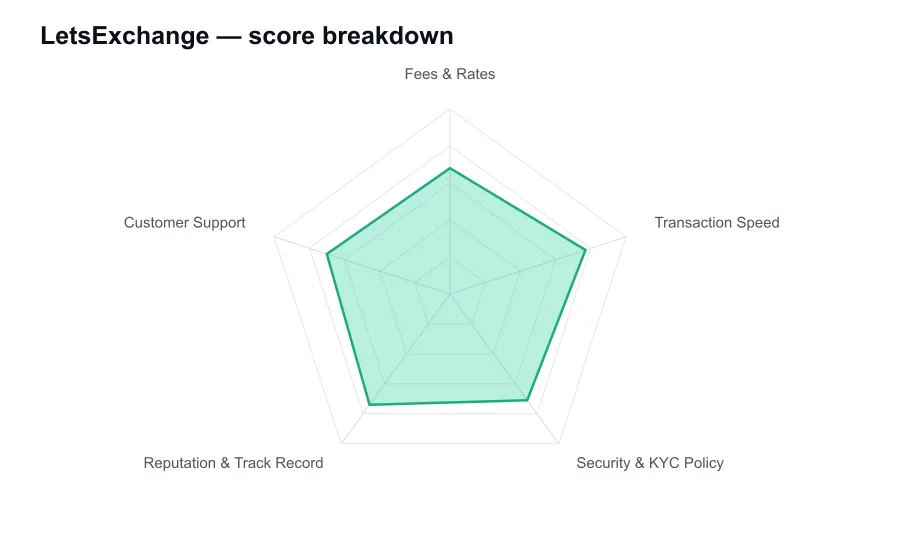
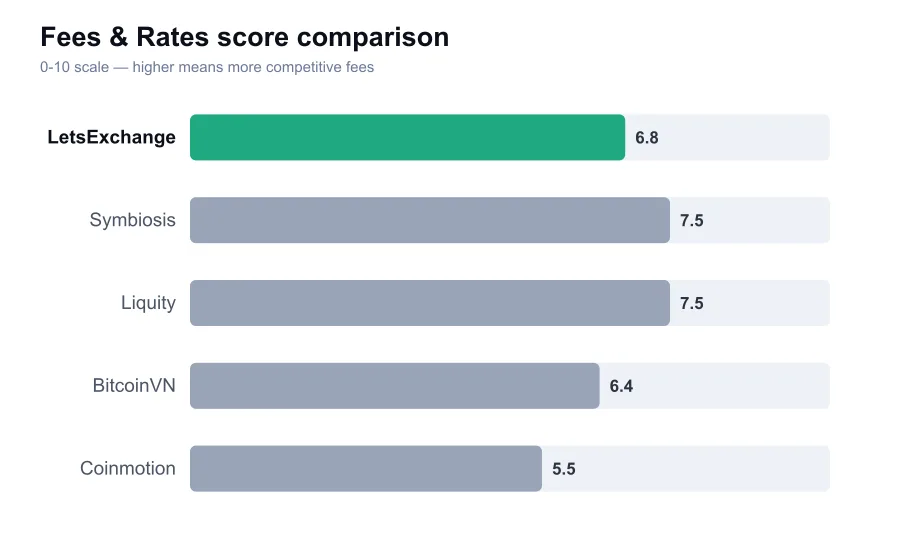
Fees are the least transparent part of the proposition. LetsExchange says it seeks competitive rates through partner liquidity, but it does not publish a simple flat percentage that tells you what every swap costs. The final quote can include provider spread, the chosen rate mode, and network fees. This is normal for an aggregator, yet it prevents easy comparison with Kraken's explicit trading fees or a decentralized exchange's visible pool fee. The receive amount is the only honest number to compare.
A fixed rate can be valuable when markets are jumpy. LetsExchange locks the displayed output for a set period, subject to its stated conditions and receiving the exact deposit amount in time. A market rate follows price movement and may deliver more or less than the estimate. I prefer fixed quotes for a meaningful conversion into a stablecoin or for paying a known amount. For small, liquid swaps, market rate can be cheaper, but users must accept that the number can move while confirmations arrive.
Network charges remain separate from the service's own economics. Ethereum gas, Bitcoin miner fees, and withdrawals on certain networks can materially affect a transaction. This is especially painful on small orders. LetsExchange shows relevant transaction details before completion, but a user still needs to read them. Do not judge a route by a token price alone. A $25 swap that carries several dollars of chain cost is often poor value even if the exchange rate itself is competitive.
Speed is usually one of LetsExchange's better traits. The site can route straightforward swaps quickly once the incoming payment is detected and confirmed. Fast chains and high liquidity help. Bitcoin deposits, Ethereum congestion, partner availability, and extra checks do not. The company cannot honestly guarantee a universal completion time because it does not control every blockchain or liquidity provider. Its status page and transaction tracking are useful, but they do not turn a delayed onchain transfer into an instant one.
The operational detail that catches users out is exactness. Send the wrong asset, use an unsupported token contract, underpay a fixed order, or choose the wrong chain, and a simple swap becomes a recovery request. LetsExchange has a support process for such cases, but recovery is not always possible and can involve delays or network costs. This is not a flaw unique to the company. It is the price of self directed crypto transfers, and the platform should be used with the same care as a bank wire.
LetsExchange is noncustodial in the practical sense that it does not ask customers to maintain an account balance. Coins pass through the transaction flow and are then delivered to a wallet address supplied by the user. That is preferable to storing funds indefinitely on an exchange. It is not the same as an atomic swap or a fully trustless decentralized trade. For the period between sending and receiving, you are relying on LetsExchange and whichever liquidity partner fulfills the route.
No routine account registration or KYC is normally required to request a swap. That privacy friendly design is one reason the service has grown. But the terms and compliance policy allow it to stop or investigate activity connected with AML risk. A transaction can be reviewed, and users may be asked for identification or evidence of funds. Anyone advertising such services as permanently anonymous is overselling them. If that possibility is unacceptable, do not send the coins in the first place.
LetsExchange has a more substantial public footprint than many anonymous instant exchanger clones. It has operated for years, maintains integrations and affiliate relationships, and is regularly compared with established competitors such as ChangeNOW, SimpleSwap, and ChangeHero. That history gives it credibility. It still lacks the regulatory reporting, proof of reserves framework, and deep corporate disclosure that a major centralized exchange can offer. For private retail swaps, that gap may be acceptable. For serious capital, it should matter.
The reputation picture is mixed in the familiar way for this sector. Many customers praise the broad selection and successful fast exchanges. Negative reports tend to center on a swap held for review, a lower floating rate after volatility, or a support case that felt too slow. Those experiences are frustrating but not surprising given the model. The sensible response is risk control: begin with a test transaction, retain the transaction hash, and avoid sending a life changing amount through any aggregator.
Support is advertised around the clock through live chat and email, with transaction identifiers serving as the starting point for an investigation. The knowledge base is decent for basic operational questions. Human support matters most when a deposit is missing or a route stalls, and that is where responses can feel less immediate than the marketing suggests. I would expect competent assistance, but I would not assume the white glove escalation available to a large institutional exchange client.
LetsExchange is one of the better tools in its category because its asset coverage is real and its workflow is clean. It works best as a routing service you use deliberately, not as a blind default. Check the output against at least one rival, confirm every network twice, and choose fixed rate if certainty is more important than a marginally better quote. It is excellent for flexible retail swaps. It is a poor substitute for a transparent order book, regulated custody, or a platform built for high frequency trading.