Swapter is a compact instant crypto exchange service aimed at users who want to move between assets without signing up for a conventional trading platform. Its pitch is familiar: select a pair, enter a receiving wallet, send crypto, and let the service arrange the conversion. It belongs to the crowded non-custodial swap sector, where the core interface is easy to build but the hard parts are liquidity quality, honest execution, compliance handling, and customer support after the deposit has left the user's wallet.
That crowded market is important because Swapter is not operating with the reputation advantage of a Kraken, Coinbase, or even the better-known instant-exchange brands. A small provider can still offer a useful product, especially if it accesses decent liquidity and avoids custody. But users should not treat a clean website as evidence of operational maturity. In this category, the most consequential test is what happens to a difficult transaction, not how quickly the quote screen loads.
Swapter's wallet-to-wallet model is convenient for users who do not want another password, another identity-verification process, or another hosted balance. You normally provide the destination address before depositing the source currency. That design keeps the user in control of their receiving wallet and removes the temptation to leave funds on the platform. It also makes accuracy essential. There is no account recovery process for an address typed incorrectly, and there is rarely a practical way to reverse a completed blockchain payment.
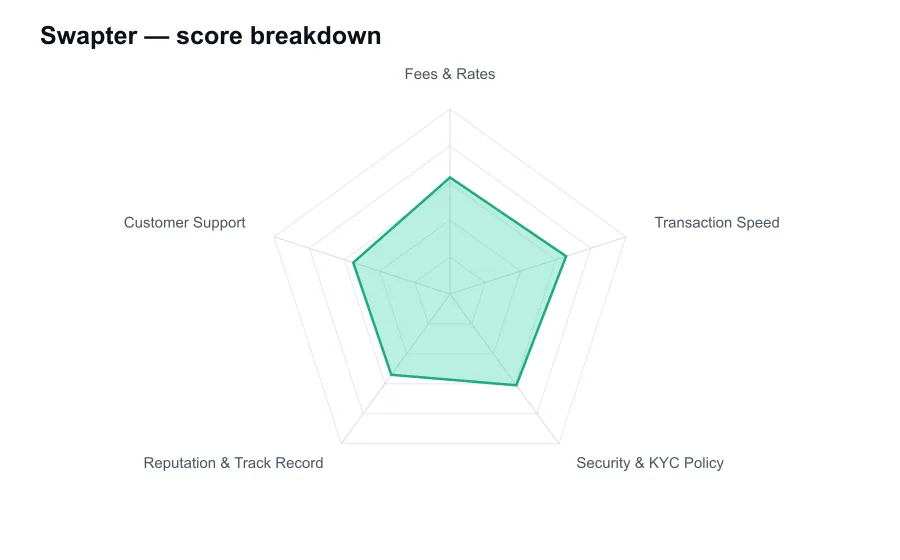
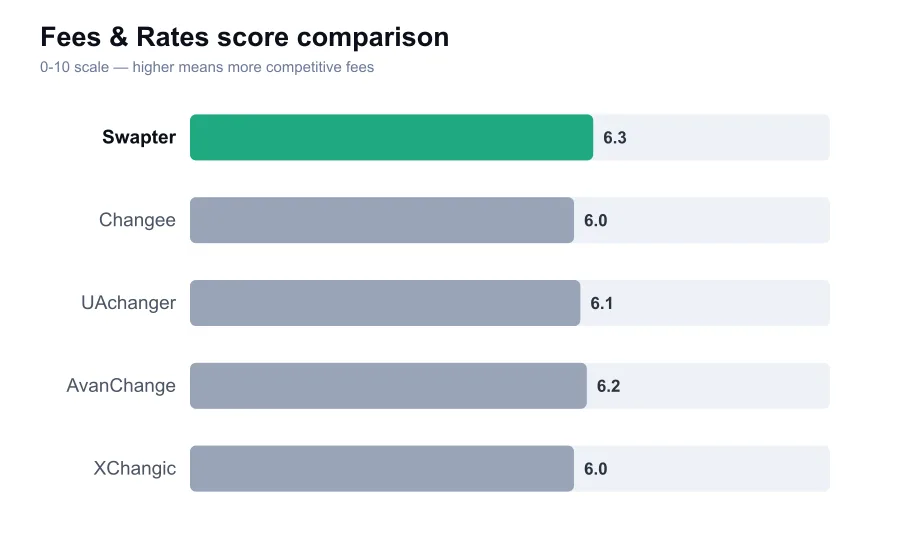
The platform's pricing is quote-driven. Like many instant exchangers, it may show little or no separately labelled service fee while incorporating its revenue and liquidity costs into the exchange rate. That is not automatically deceptive, but it means the published fee claim is far less useful than the estimated output. A customer swapping 1 ETH should compare the exact amount of BTC, USDC, or other destination asset received, not just look for a percentage fee badge. Network fees can also change quickly, especially on Ethereum and Bitcoin.
Swapter can be attractive if its quote happens to beat more familiar services on a specific route. That is possible because instant-exchange providers use different partners and pricing logic. It is not a reason to assume it will always be cheap. Smaller services sometimes appear competitive on the headline quote but become less attractive after a floating-rate movement or an additional network cost. Test the same pair and amount on at least two competitors. If Swapter is only marginally better, the stronger reputation of the alternative may be worth more than a few dollars.
Transaction speed has the same caveat. The exchange itself can process an order quickly once it has received the required confirmations and secured liquidity, but the blockchain remains the clock. Faster networks may settle in minutes. Bitcoin, Ethereum during heavy activity, and cross-chain routes involving several steps can take much longer. Swapter should be judged on whether it reports those stages clearly, rather than on an unrealistic promise that every swap is instant. A proper tracker needs to distinguish deposit detection, confirmations, exchange processing, and payout broadcast.
My concern is that Swapter has a lighter independent public footprint than the category leaders. There is less long-running user discussion, fewer detailed third-party assessments, and less evidence of how the company handles major disruptions. This does not mean every transaction will go badly. It does mean there is less external evidence to rely on if a transaction stalls. Reputation is earned through years of visible execution, not by listing hundreds of coins or displaying a security icon in the footer.
The security model has positive elements. Avoiding a persistent custodial account reduces the attack surface associated with centralised exchange logins and hot-wallet balances. The service can also be easier to use privately than a fully regulated platform, since routine swaps may not require a full onboarding process. Yet the customer still sends funds into a provider-controlled process. The risk shifts from account custody to counterparty execution, liquidity partners, address validation, and the quality of the firm's internal controls.
KYC is another area where users need to read rather than assume. A no-registration service may still apply anti-money-laundering screening and may pause an order if a transaction triggers risk controls. That can be reasonable, but the customer needs a plain answer on what documents can be requested, how long review can take, and how a refund is handled. Swapter's policy information is not as reassuringly detailed or as widely tested in public as that of more established alternatives. Do not use an amount you cannot leave inaccessible for a while.
Support is likely adequate for basic questions, but this is not where I would place much faith without a small test first. Crypto support needs to be technical. A useful agent should understand transaction hashes, confirmations, memo tags, contract addresses, token networks, and return procedures. The decisive question is whether support can obtain an answer from the liquidity side of the operation when an order is abnormal. A chat bubble is easy to add. A competent resolution team is much harder to prove.
Swapter also faces the standard smart-user problem of token and chain confusion. USDT is not one uniform asset in practical use. It can be sent on Ethereum, Tron, Solana, BNB Chain, Polygon, and other networks. A quote for one chain is not permission to deposit on another. Before sending, verify the exact network, the deposit minimum, any destination tag or memo requirement, and whether your receiving wallet supports the output asset. Those checks prevent more losses than any marketing promise about security.
For a small conversion of a liquid asset, Swapter can be a reasonable option if it has the best final quote and the transaction status page provides clear details. I would start with a test amount, particularly before trying a new chain or an asset with thin liquidity. That advice is not paranoia. It is the rational way to use a service with less public history than its better-known competitors. Successful small transactions give you more useful evidence than an affiliate review ever will.
It is a poorer fit for someone cashing out a large portfolio, converting funds for a property purchase, moving treasury assets, or swapping under a tight deadline. Those users need formal records, more predictable execution, and an accountable support structure. A large regulated exchange, a specialist OTC desk, or an established self-custody route is more suitable. Swapter is convenience infrastructure, not financial infrastructure on which I would build a major decision.
There is nothing fundamentally wrong with Swapter's product category. The site offers a familiar and potentially useful path between crypto assets, and no-account swaps fill a real need. But the provider has not accumulated enough public credibility to earn blind trust. Competitive pricing and simple execution can make it worth trying, but the service should be approached with the caution normally reserved for a newer counterparty.
My final assessment is guarded. Swapter may work well for modest, non-urgent swaps, particularly if its all-in output is clearly superior at the moment you check. Its weak point is not the basic swap flow, it is the limited evidence around long-term reputation and difficult-case support. Keep transactions small until the service has proved itself to you, and choose a more established platform whenever the cost of a delay would be serious.