AvanChange is a long-running instant exchange service aimed at people who want to swap crypto, electronic money, and selected fiat payment methods without opening a full trading account. It occupies the old-school exchanger niche rather than competing directly with Binance, Kraken, or a self-custody swap protocol. The appeal is simple: choose a direction, see a quote, send funds, and receive the payout. That simplicity is real, but so are the compromises that come with using a relatively opaque broker-style exchanger.
The site has been visible in exchanger-monitoring circles for years, particularly among users moving between Bitcoin, stablecoins, Perfect Money-style payment systems, bank cards, and regional transfer methods. That history counts for something. AvanChange is not a newly launched domain with a glossy landing page and no transaction record. Still, longevity is not the same thing as institutional strength. This is a service where a buyer should assess each order carefully, rather than assuming the brand carries the safeguards of a regulated exchange.
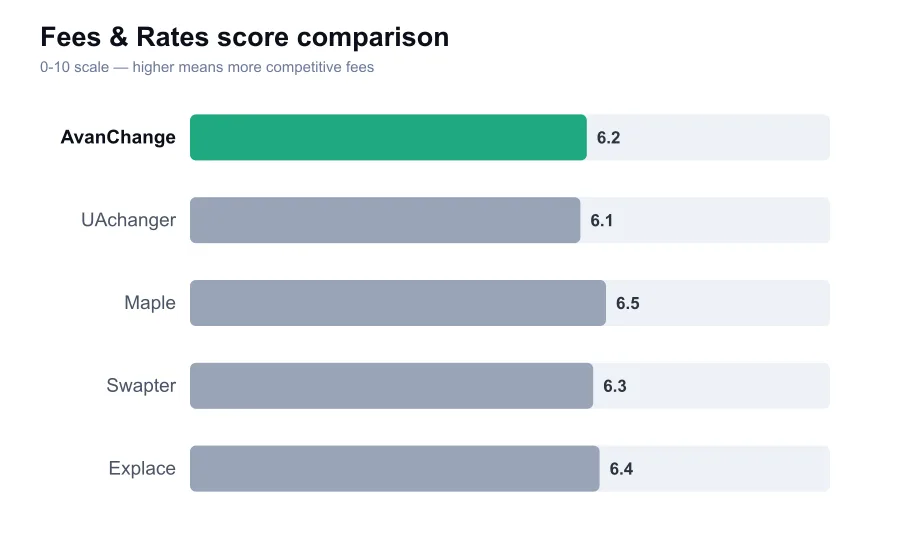
Its rate display is the first thing to scrutinize. AvanChange generally builds its compensation into the conversion rate instead of presenting a clean trading commission like 0.1 percent or 0.25 percent. That is common for instant exchangers, but it makes comparisons harder. A quoted transaction can look fee-free while carrying a meaningful spread against the market price. For a small, urgent exchange that may be acceptable. For a larger conversion, it can become expensive very quickly.
The right way to judge the price is not to ask whether the page says "no fee." Compare the final amount with at least two alternatives at the same moment. Check a major exchange's spot price, then compare the cash-out amount at a known exchanger listed on a monitoring service. AvanChange can be competitive on some less common payment directions, especially where liquidity is fragmented. On heavily traded pairs such as BTC to USDT or USDT to card, it often has little reason to beat deep order-book venues.
Minimums and reserve levels matter more here than at a centralized exchange. An exchanger can advertise a route, then show that the available reserve is smaller than the amount a customer wants to receive. That can force a split order, a manual discussion with support, or a different payout method. Before sending anything, I would check the stated reserve, minimum, maximum, and whether the quote is fixed or recalculated after confirmation. Those details decide whether an apparently convenient swap stays convenient.
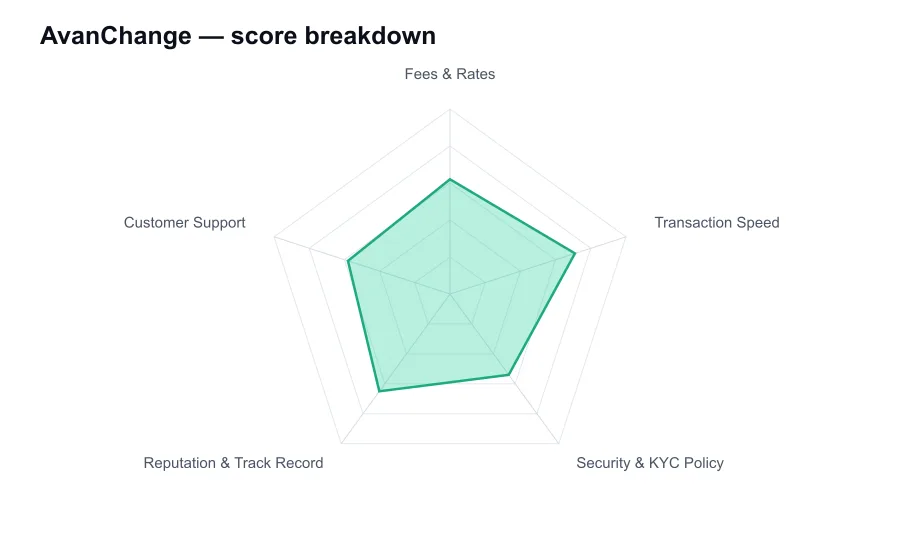
Speed is one of AvanChange's stronger points, provided both sides of the order are automated and the incoming crypto payment has enough confirmations. Many straightforward stablecoin and electronic-currency exchanges can be completed in minutes after the deposit is recognized. Bitcoin transactions naturally depend on network conditions and the confirmation rule shown in the order. Card, bank, and manual payment directions can take longer, sometimes substantially longer, because a human review or payment-provider processing step enters the picture.
The service should not be treated as a guaranteed instant settlement rail. The word instant is frequently used across this market, but any order can pause if the amount differs from the invoice, the sender uses a flagged address, the payment arrives late, or the receiving bank payment requires additional checks. A sensible user saves the order number, takes a screenshot of the quoted result, and sends the exact amount requested. Small avoidable mismatches are a common cause of delays at exchangers.
AvanChange's security model is more limited than the model offered by a proper account-based exchange. The upside is that a visitor can often place an ordinary exchange without maintaining a permanent custodial balance or handing over a large amount of personal information at registration. The downside is that users have fewer account-level controls, fewer visible audit signals, and less transparency about custody arrangements. You are trusting the operator to settle a one-off bilateral transaction correctly.
No-KYC should never be interpreted as no compliance checks. Services in this category commonly reserve the right to request identification, source-of-funds information, or wallet-related explanations when an order triggers risk controls. AvanChange's public terms and order flow should be read before funds are sent, especially for a sizable transfer. If a user cannot tolerate a compliance review or temporary hold, the answer is not to gamble on an exchanger. Use a venue whose verification requirements are clear before depositing.
I would also avoid sending funds from or to questionable third-party wallets. A customer who is paid from an unfamiliar source, or who uses an address connected to risky activity, can create trouble for themselves even if the exchange itself completes. For receiving crypto, use a wallet you control. For bank payouts, use an account in your own name where possible. These are basic precautions, but they matter more with a brokered conversion than with a transparent on-exchange withdrawal.
Reputation is mixed in the way many established exchangers' reputations are mixed. AvanChange has enough operating history and enough presence on comparison and monitoring sites to be taken more seriously than an unknown storefront. It also has the familiar complaints found across the category: users unhappy with a changing rate, a delayed order, a reserve issue, or a request for clarification. None of those complaints automatically prove misconduct. They do show why a first transaction should be small.
The support experience is likely to feel efficient for routine orders and less satisfying when an exception occurs. A chat or ticket response can solve a simple payment-reference issue quickly. A disputed rate, compliance flag, or bank-side delay is a different matter, because support cannot always give the customer the immediate answer they want. I prefer services that publish a clear escalation process and precise terms for refunding failed orders. AvanChange gives less operational visibility than I would like.
For a user who knows the mechanics of exchangers, AvanChange can be a useful tool rather than a primary crypto home. It is particularly suited to a targeted conversion where a mainstream exchange does not support the payment method, the amount is modest, and the quote has been checked elsewhere. It is not the place I would leave money, route a salary, or use for repeated high-value treasury transfers. Convenience is its product, not deep infrastructure.
My view is practical rather than dismissive. AvanChange has the signs of an established exchanger and can settle ordinary orders without drama, but it asks for more trust than its public transparency earns. Check the rate against competitors, read the order conditions, and test with a small amount before relying on it. If the quote is materially better for your specific route, it can make sense. If it is not, a larger regulated exchange or a better-documented specialist is usually the safer choice.